
CUETMOCK
  • Pricing
  • Mentors
Log inStart freeStart free mocks→

First test, then trust

Try a free CUET mock test.

Join 5,00,000+ students who rehearsed exam day on the exact NTA screen before sitting CUET. On the web and on Android.

Start free mocks →Get the Android app
CUETMOCK

India's #1 CUET Mock Test Platform. Original NCERT-based questions on the exact NTA exam screen — trusted by 5,00,000+ students since CUET 2022.

Get it onGoogle PlayScan to download the CUETMOCK app

Mock tests

  • CUET mock test series
  • Commerce mocks
  • Humanities (Arts) mocks
  • Science mocks
  • Languages & GAT mocks
  • Free practice questions
  • Pricing

Resources

  • CUET exam guide
  • CUET syllabus
  • Universities accepting CUET
  • Expert blogs
  • News & notifications
  • Webinars & counselling
  • CUET score calculator
  • How we estimate your rank
  • FAQs

Company

  • About us
  • Our leadership & team
  • Our toppers
  • Mentors
  • For schools
  • Contact us
  • Terms
  • Privacy
  • Refund policy

Talk to us

+91 7696 6630 56info@cuetmock.comWhatsApp us

Our other platforms

  • JEE Mock — For IIT-JEE aspirants
  • NEET Mock — For NEET aspirants

Newsletter

Exam updates, study material and offers — no spam.

© 2026 NYC Ventures Pvt. Ltd.

701-702, Royal Business Park, Zirakpur, Punjab - 140603

  • Terms of use
  • Privacy policy
  • Refund policy
  • Contact us

iCUETMOCK is an independent preparation platform, not affiliated with the National Testing Agency (NTA). Always check exam details on the official NTA website.

  • Home
  • Mock tests
  • CUET guide
  • Pricing
  • Log in
Home/Practice questions/Chemistry
ChemistryOrganic: Biomolecules

Glucose on prolonged heating with HI forms

Please read the passage carefully for the following questions

Carbohydrates are primarily produced by plants and form a very large group of naturally occurring organic compounds. Some common examples of carbohydrates are cane sugar, glucose, starch, etc. Most of them have a general formula, Cx(H2O)y, and were considered hydrates of carbon from where the name carbohydrate was derived. For example, molecular formula of glucose (C6H12O6) fits into this general formula, C6(H2O)6. But all compounds which fit into this formula may not be classified as carbohydrates. For example, acetic acid (CH3COOH) fits into this general formula, C2(H2O)2 but is not a carbohydrate. Some of carbohydrates, which are sweet in taste, are also called sugars. Carbohydrates are classified on the basis of their behavior on hydrolysis. They have been broadly divided into following three groups: (i) Monosaccharides, (ii) Oligosaccharides, and (iii) Polysaccharides. The carbohydrates may also be classified as either reducing or non-reducing sugars. All those carbohydrates which reduce Fehling’s solution and Tollens’ reagent are referred to as reducing sugars. All monosaccharides, whether aldose or ketose, are reducing sugars. Glucose is an aldohexose and is also known as dextrose. It is the monomer of many of the larger carbohydrates, namely starch and cellulose. Glucose is found to exist in two different crystalline forms which are named α-D-Glucose and β-D-Glucose. The two monosaccharides are joined together by an oxide linkage formed by loss of a water molecule. Such a linkage between two monosaccharide units through oxygen atom is called glycosidic linkage. Polysaccharides contain a large number of monosaccharide units joined together by glycosidic linkages. Vitamins are classified into two groups depending upon their solubility in water or fat: (i) Fat-soluble vitamins, and (ii) Water-soluble vitamins.

Glucose on prolonged heating with HI forms

Answer & explanation+

Correct answer: option 3

The correct answer is Option (3) → n-Hexane

The open chain structure of glucose was worked out from a set of reactions, each of which reveals one feature of the molecule:

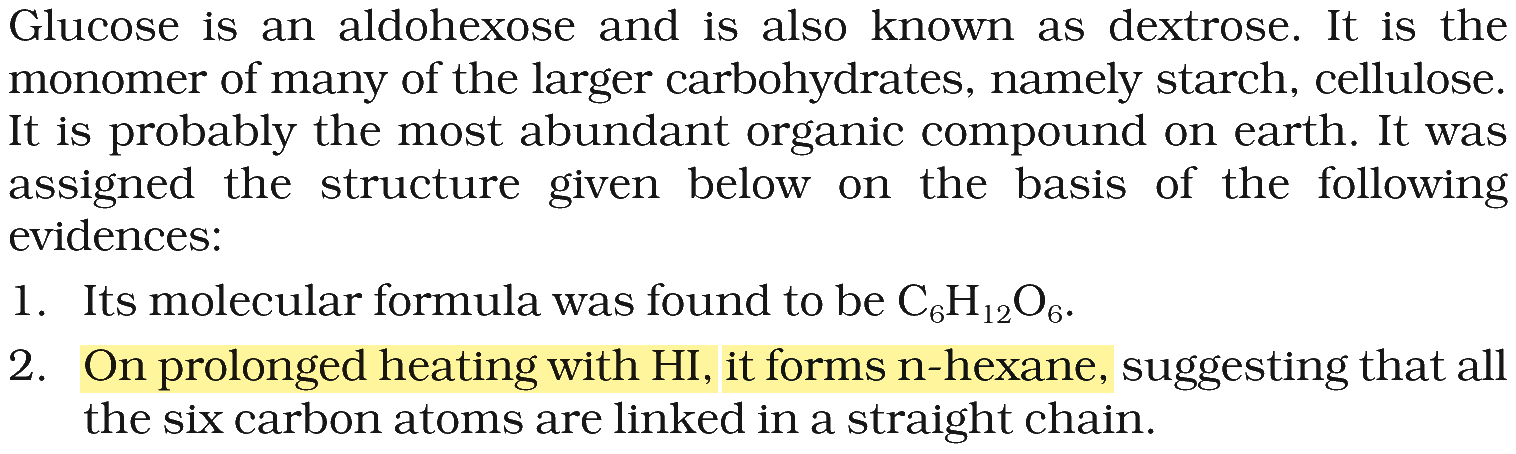
  • Prolonged heating with HI gives n-hexane: the six carbon atoms are in a straight chain.

  • Reaction with hydroxylamine (oxime) and HCN (cyanohydrin): a carbonyl group is present.

  • Oxidation by bromine water gives gluconic acid: the carbonyl group is an aldehyde group.

  • Acetylation with acetic anhydride gives a pentaacetate: five –OH groups are present.

  • Oxidation by nitric acid gives saccharic acid: one of the –OH groups is a primary alcohol group.

    \( \displaystyle \ce{C6H12O6} \xrightarrow[\Delta]{\ce{HI}} \ce{CH3-CH2-CH2-CH2-CH2-CH3} \)

HI removes all the oxygen atoms and reduces the chain completely. So glucose on prolonged heating with HI forms n-hexane.

Why the other options are incorrect

  • Option (1) Saccharic acid — Incorrect. It is formed by oxidation of glucose with nitric acid.

  • Option (2) Gluconic acid — Incorrect. It is formed by oxidation of glucose with bromine water.

  • Option (4) 3-Iodohexane — Incorrect. The final product of prolonged heating contains no iodine; HI reduces glucose all the way to the hydrocarbon.

NCERT (2026-27 edition):
Glucose – …
Textbook extract

Note: The same/similar question has been asked in different years by NTA as per the details given below:

20262025202420232022
18-05 S1––24-05 S3–

Advertisement

Practise more on Organic: Biomolecules

Chapter-wise mocks on the real NTA exam screen, with solutions and your rank. Your first mocks are free.

Start free mocks →

Advertisement

Next questions

  1. A wire element of length 5 mm is placed along the x-axis at the origin and it carries a current of 5.0 A. The magnetic field at a point on…Physics · Moving Charges and Magnetism
  2. Identify the correct statements among the following:(A) Champaran movement began in 1917.(B) Civil Disobedience Movement began at Noakhali…History · Modern India: Mahatma Gandhi and the Nationalist movement
  3. Which of the following religious groups is distributed mainly along the Western coast around Goa, Kerala and also in the hill states of Meg…Geography · India-People and Economy: Population-Distribution,Density, Growth and Composition
  4. Write the major product A in the following chemical reaction.Chemistry · Organic: Haloalkanes and Haloarenes
  5. The complementary strand of DNA of the following sequence isATCCGTTCGChemistry · Organic: Biomolecules
  6. Choose the correct word which can substitute the following words .An apartment building in which each apartment is owned separately by the…English · One Word
  7. Every accounting software ensures data security, safety and confidentiality. Therefore, every software provides the following:Accountancy Part C · Overview of Computerised Accounting System
  8. Arrange the following compounds in increasing order of their pKa values.(A) m-Nitrophenol(B) o-Nitrophenol(C) Ethanol(D) o-CresolChoose the…Chemistry · Organic: Alcohols, Phenols and Ethers
  9. If E and F are two events such that P(E) = 0.8, P(F) = 0.7 and P(E ∩ F) = 0.6 then P( overlineE / overlineF ) is:Applied Maths. Section A · Probability (Section A)
  10. How many triangles are there in the following figure?General Aptitude Test · Non-Verbal Reasoning