Arrange following alcohols in increasing order of ease of dehydration:
(A) (CH3)3C-OH
(B) (CH3)2CH-OH
(C) CH3CH2CH2-OH
Choose correct answer from options given below:
Answer & explanation
Correct answer: option 3
The correct answer is Option (3) → (C) , (B) , (A)
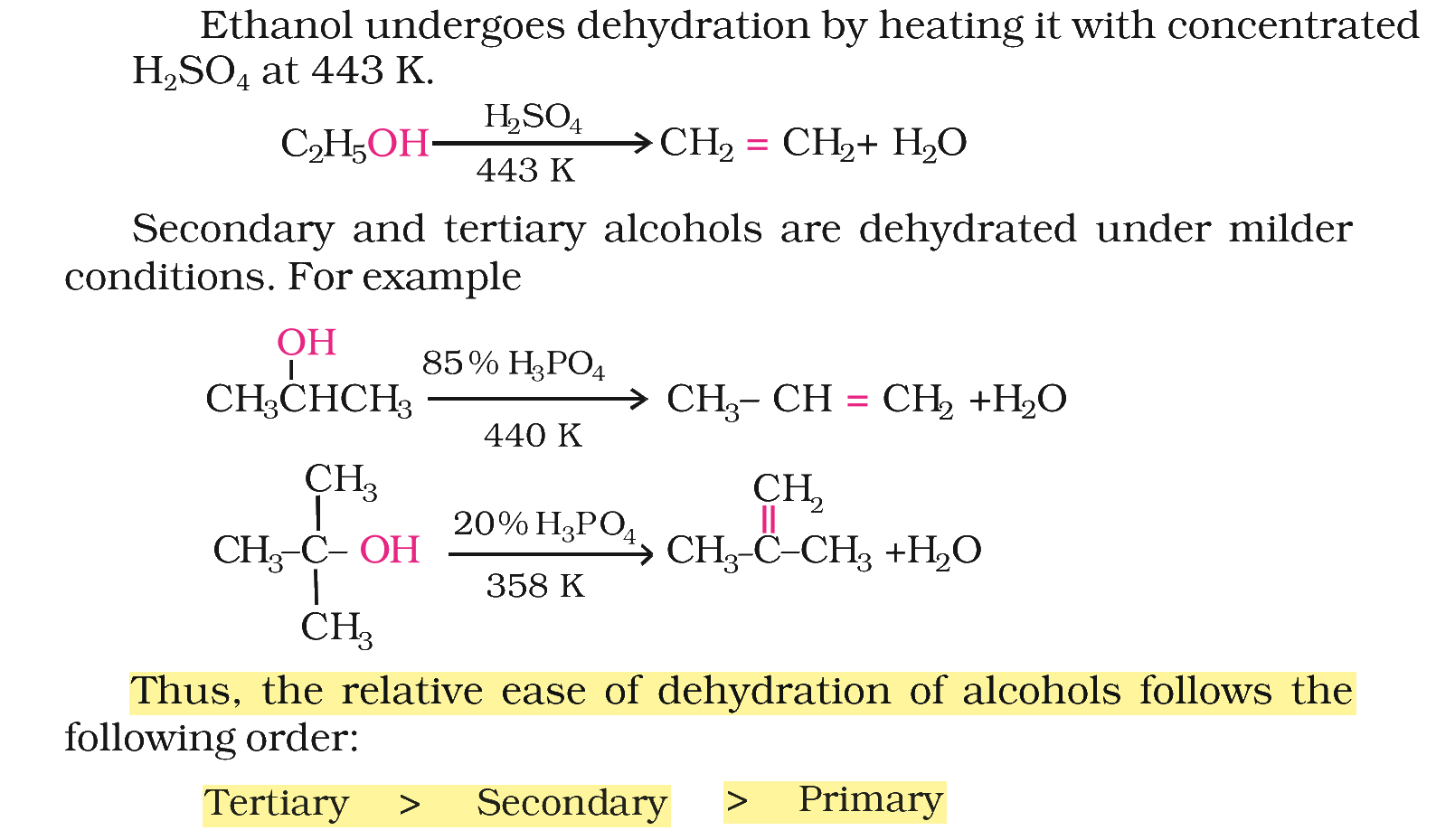
Alcohols lose water on heating with a protic acid (conc. \( \ce{H2SO4} \) or \( \ce{H3PO4} \)) to give alkenes. The mechanism goes through a carbocation:
the –OH group is protonated and leaves as water, forming a carbocation (slow step);
a proton is lost from the neighbouring carbon to form the C=C bond.
The more stable the carbocation, the easier the dehydration. Carbocation stability is 3° > 2° > 1° (more alkyl groups push electrons towards the positive carbon), so the ease of dehydration follows the same order, and the conditions needed become milder from 1° to 3°.
Matching the given alcohols:
(C) \( \ce{CH3CH2CH2} \)-OH: propan-1-ol (1°)
(B) \( \ce{(CH3)2CH} \)-OH: propan-2-ol (2°)
(A) \( \ce{(CH3)3C} \)-OH: 2-methylpropan-2-ol (3°)
Shortcut: The primary alcohol (C) is the hardest to dehydrate and the tertiary alcohol (A) the easiest. Only Option (3) starts with (C) and ends with (A).
NCERT (2026-27 edition):
Dehydration – …