Which of the following statements are correct for Hinsberg test for amines?
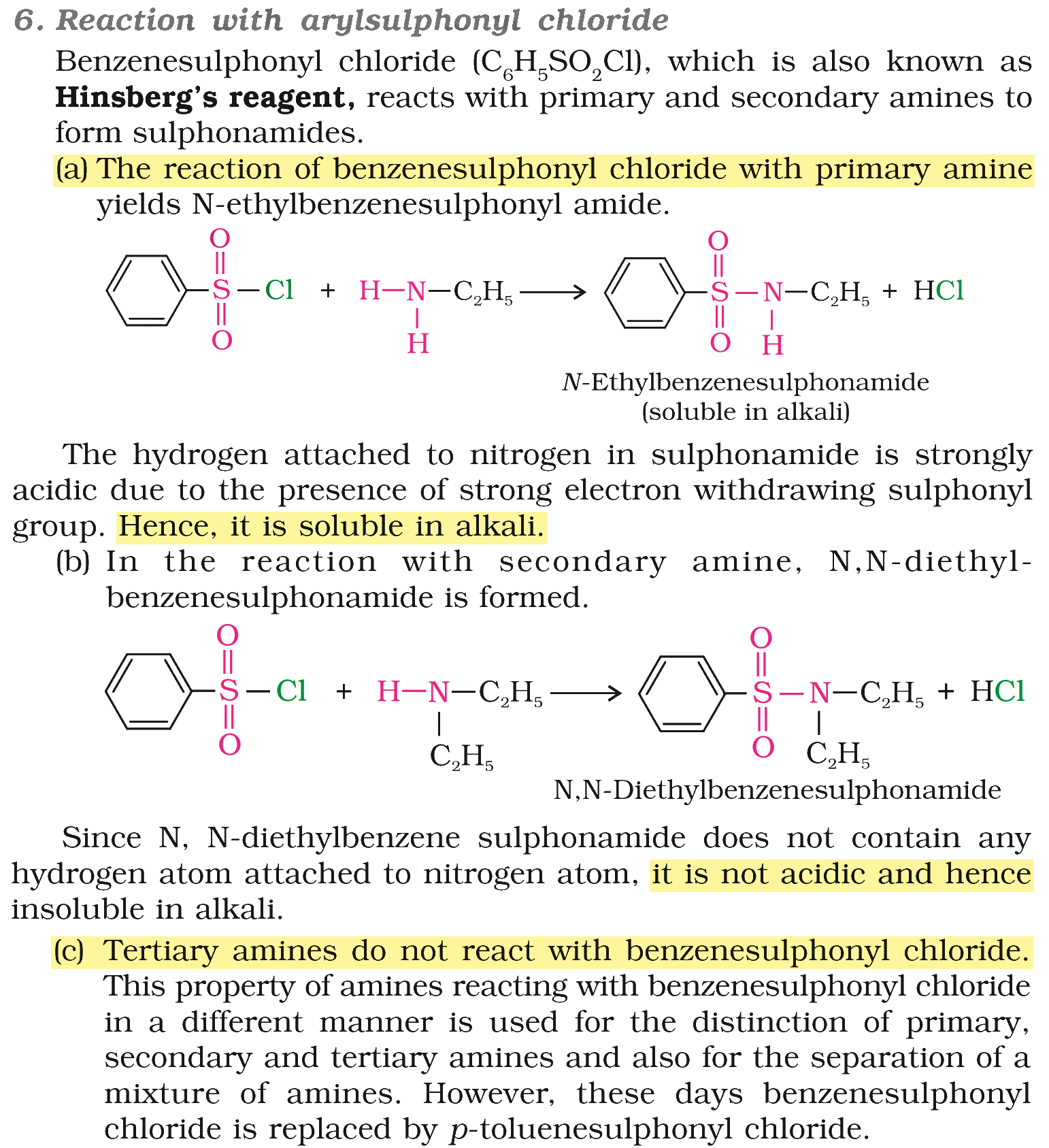
(A) The reaction of benzenesulphonyl chloride with primary amine yields alkali soluble N-ethylbenzenesulphonamide.
(B) The reaction of benzenesulphonyl chloride with secondary amine yields alkali soluble N,N-diethylbenzenesulphonamide.
(C) The reaction of benzenesulphonyl chloride with tertiary amine yields alkali soluble triethylbenzenesulphonamide.
(D) Tertiary amines do not react with benzenesulphonyl chloride.
Choose the correct answer from the options given below:
Answer & explanation
Correct answer: option 4
The correct answer is Option (4) → (A) and (D) only
In the Hinsberg test, amines are treated with benzenesulphonyl chloride, \( \ce{C6H5SO2Cl} \). The result depends on the number of hydrogen atoms on nitrogen. When a sulphonamide still has an H on nitrogen, the strongly electron withdrawing sulphonyl group makes this H acidic, so the sulphonamide dissolves in alkali. The statements use ethylamine, diethylamine and triethylamine as the examples.
(A) The reaction of benzenesulphonyl chloride with primary amine yields alkali soluble N-ethylbenzenesulphonamide. — Correct. The product still has one H on nitrogen, which is acidic, so it is soluble in alkali.
\( \displaystyle \ce{C6H5SO2Cl + H2N-C2H5 -> C6H5SO2NH-C2H5 + HCl} \)
(B) The reaction of benzenesulphonyl chloride with secondary amine yields alkali soluble N,N-diethylbenzenesulphonamide. — Incorrect. The product has no H on nitrogen, so it is not acidic and is insoluble in alkali.
\( \displaystyle \ce{C6H5SO2Cl + HN(C2H5)2 -> C6H5SO2N(C2H5)2 + HCl} \)
(C) The reaction of benzenesulphonyl chloride with tertiary amine yields alkali soluble triethylbenzenesulphonamide. — Incorrect. A tertiary amine has no H on nitrogen, so no sulphonamide is formed at all.
(D) Tertiary amines do not react with benzenesulphonyl chloride. — Correct. This is the basis for distinguishing tertiary amines in the test.
NCERT (2026-27 edition):
Reaction with Arylsulphonyl Chloride