Match List-I with List-II
| List-I | List-II | ||
| Approaches to Human Development | Characteristics | ||
| (A) | Income approach | (I) | Oldest approach to Human development |
| (B) | Welfare approach | (II) | Proposed by International Labour Organisation (ILO) |
| (C) | Basic needs approach | (III) | Associated with Prof. Amartya Sen |
| (D) | Capability approach | (IV) | Higher government expenditure on health and education |
Choose the correct answer from the options given below:
Answer & explanation
Correct answer: option 3
The correct answer is Option (3) → A-I, B-IV, C-II, D-III
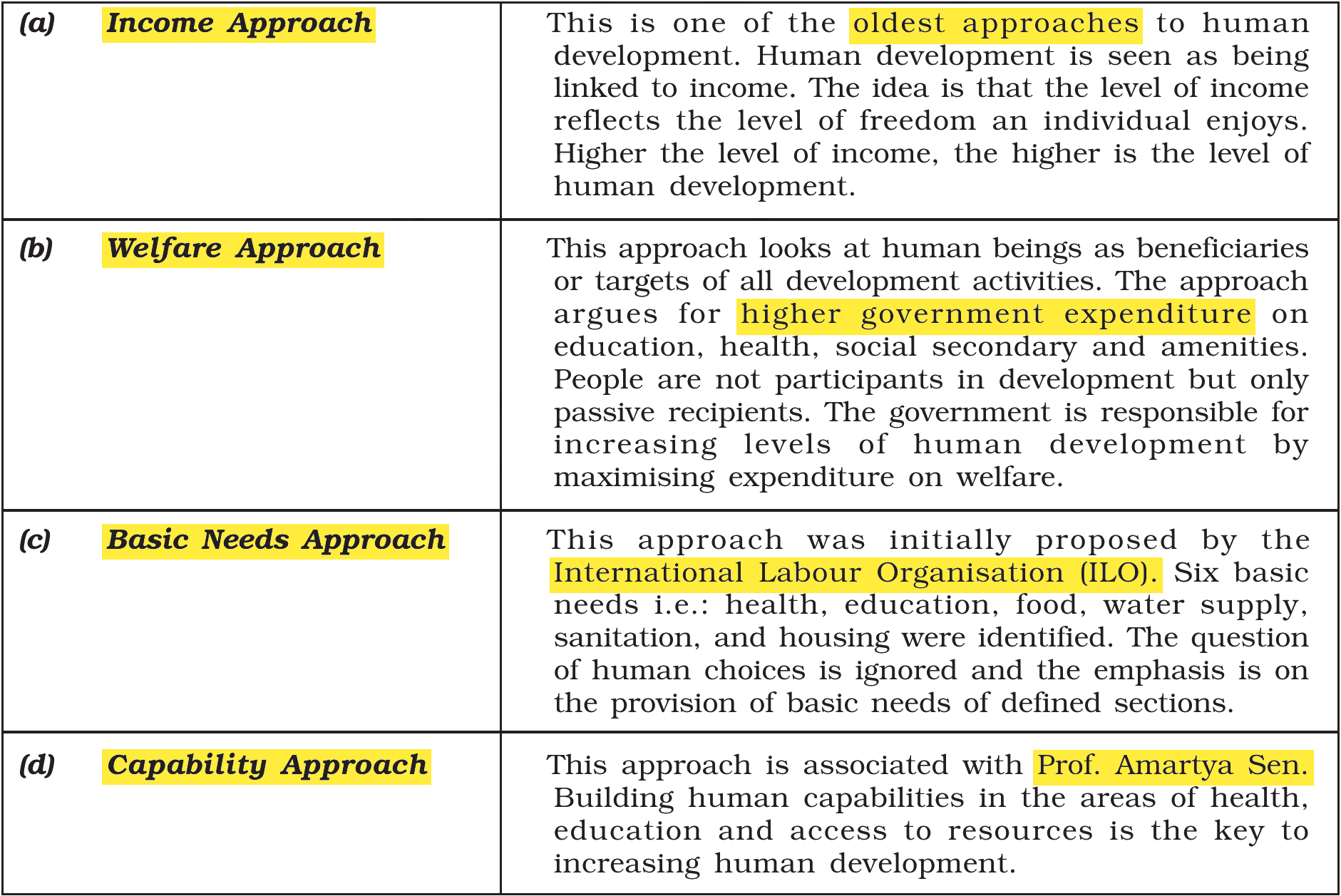
(A) Income approach — this matches (I) Oldest approach to Human development. It links human development to income: the higher the income, the higher the level of human development.
(B) Welfare approach — this matches (IV) Higher government expenditure on health and education. It sees people as beneficiaries of development and asks the government to spend more on their welfare.
(C) Basic needs approach — this matches (II) Proposed by International Labour Organisation (ILO). It identified six basic needs: health, education, food, water supply, sanitation and housing.
(D) Capability approach — this matches (III) Associated with Prof. Amartya Sen. It stresses building human capabilities in health, education and access to resources.
NCERT (2026-27): Fundamentals of Human Geography — Human Development
Table 3.1: Approaches to Human Development |