Which of the following ligands can show linkage isomerism?
Answer & explanation
Correct answer: option 3
The correct answer is Option (3) → NO2−
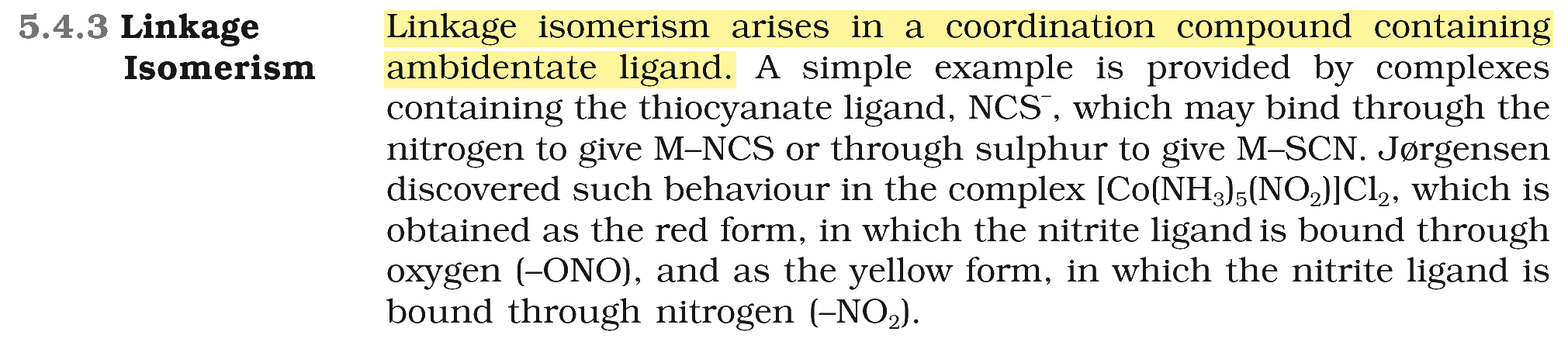
Linkage isomerism arises in a coordination compound that contains an ambidentate ligand, a ligand that can bind to the metal through two different donor atoms. The two isomers have the same formula but differ in the atom that is bonded to the metal. The common ambidentate ligands are:
NO2−: binds through N (nitrito-N) or through O (nitrito-O).
SCN−: binds through S (thiocyanato-S) or through N (thiocyanato-N).
For example, \( \ce{[Co(NH3)5(NO2)]Cl2} \) exists in a red form (nitrite bound through oxygen) and a yellow form (bound through nitrogen).
So the ligand that can show linkage isomerism is NO2−.
Why the other options are incorrect
Option (1) NO — Incorrect. Nitric oxide (nitrosyl) binds to the metal through one donor atom only, nitrogen, so it cannot give linkage isomers.
Option (2) NH3 — Incorrect. It has only one donor atom, nitrogen, so it is a simple unidentate ligand.
Option (4) NH4+ — Incorrect. Its nitrogen has no lone pair left, so it cannot act as a ligand at all.
NCERT (2026-27 edition):
Linkage Isomerism