
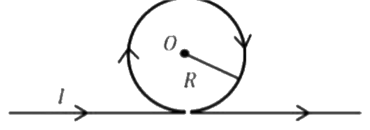
A thin long straight insulated copper wire carrying current I is given a circular bend as shown in the figure. The resultant magnetic field at the centre O is.
Answer & explanation
Correct answer: option 2
The correct answer is Option (2) → \( \displaystyle\frac{\mu_o I}{2R}\left(1 - \frac{1}{\pi}\right) \), normally inward at O.
The field at O is the vector sum of the fields due to the circular loop and the long straight wire. The wire is insulated, so the current goes all the way round the loop.
Circular loop, radius R (field at the centre of a loop):
\( \displaystyle B_1 = \frac{\mu_0 I}{2R} \)
The loop current is clockwise in the figure, so by the right-hand rule \( B_1 \) is normally inward at O.
Long straight wire at distance R from O:
\( \displaystyle B_2 = \frac{\mu_0 I}{2\pi R} \)
The current flows to the right below O, so \( B_2 \) is normally outward at O.
The two fields are opposite and \( B_1 \gt B_2 \), so the resultant is inward:
\( \displaystyle B = B_1 - B_2 = \frac{\mu_0 I}{2R} - \frac{\mu_0 I}{2\pi R} \)
\( \displaystyle B = \frac{\mu_0 I}{2R}\left(1 - \frac{1}{\pi}\right) \)