Which type of hybridisation is found in ammonia ?
Answer & explanation
Correct answer: option 1
The correct answer is Option (1) → sp3 hybridisation
The hybridisation of a central atom is decided by the number of electron pairs around it, counting both bond pairs (σ bonds) and lone pairs:
2 pairs: sp, linear (e.g. \( \ce{BeCl2} \))
3 pairs: sp2, trigonal planar (e.g. \( \ce{BF3} \))
4 pairs: sp3, tetrahedral arrangement (e.g. \( \ce{CH4} \), \( \ce{NH3} \), \( \ce{H2O} \))
5 pairs: sp3d, trigonal bipyramidal (e.g. \( \ce{PCl5} \))
6 pairs: sp3d2, octahedral (e.g. \( \ce{SF6} \))
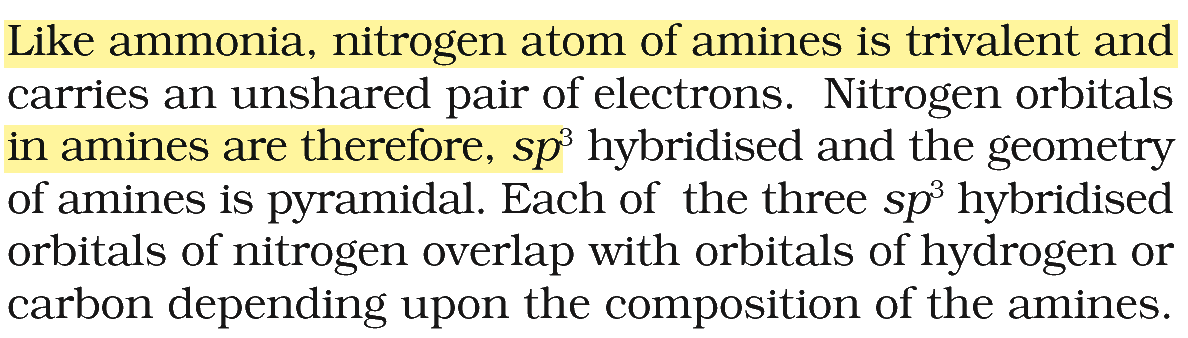
Nitrogen has five valence electrons. In \( \ce{NH3} \) it forms three N–H bonds and keeps one lone pair, so there are four electron pairs around it. The four pairs occupy four sp3 hybrid orbitals. Because the lone pair repels the bond pairs more strongly, the molecule is trigonal pyramidal with an H–N–H angle of about 107°, a little less than the tetrahedral 109.5°.
So the nitrogen in ammonia is sp3 hybridised.
Why the other options are incorrect
Option (2) sp2 hybridisation — Incorrect. It needs only three electron pairs, as in trigonal planar \( \ce{BF3} \); nitrogen in \( \ce{NH3} \) has four.
Option (3) sp hybridisation — Incorrect. It needs two electron pairs and gives a linear molecule such as \( \ce{BeCl2} \).
Option (4) sp3d2 hybridisation — Incorrect. It needs six electron pairs, as in \( \ce{SF6} \); nitrogen has no d orbitals in its valence shell.
NCERT (2026-27 edition):
Structure of Amines