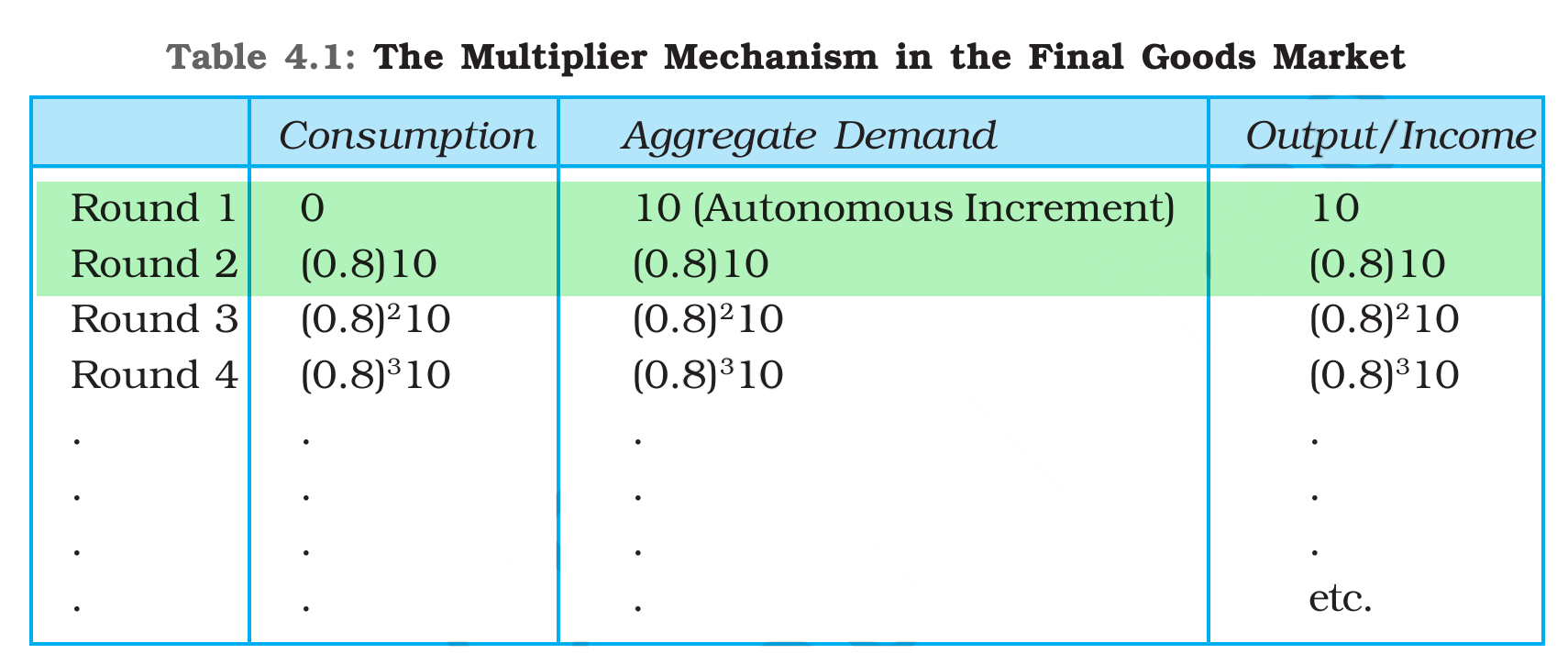
Statement I: In the round-by-round multiplier mechanism, the increment in aggregate demand in Round 2 is equal to the increment in consumption in Round 2.
Statement II: The total increment in output is the sum of an infinite geometric series, with the autonomous increment as first term and the mpc as common ratio.
Answer & explanation
Correct answer: option 1
The correct answer is Option (1) → Both Statement I and Statement II are true.
Statement I: In the round-by-round multiplier mechanism, the increment in aggregate demand in Round 2 is equal to the increment in consumption in Round 2. — Correct. In Round 2, both columns show (0.8)10: the extra demand is the extra consumption.
Statement II: The total increment in output is the sum of an infinite geometric series, with the autonomous increment as first term and the mpc as common ratio. — Correct. The series is 10 + (0.8)10 + (0.8)210 + …: first term 10 (the autonomous increment), common ratio 0.8 (the mpc).
NCERT (2026-27): “4.3.3 The Multiplier Mechanism … Let us register the changes in the values of aggregate demand and output at each round in Table 4.1. The last column measures the increments in the value of the output of final goods (and hence the income of the economy) in each round. The second and third columns measure the increments in total consumption expenditure in the economy and increments in the value of aggregate demand in a similar way. In order to find out the total increase in output of the final goods, we must add up the infinite geometric series in the last column, i.e.,”
|