
The figure shows an electrode set up under the conditions marked on it.
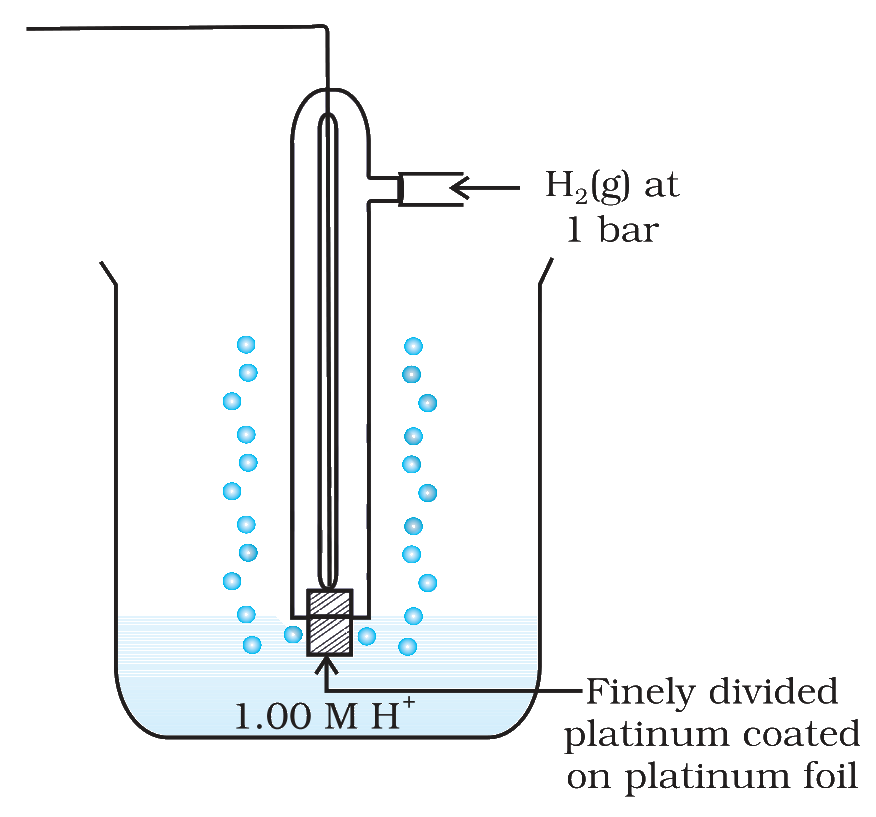
What potential is assigned to this electrode by convention?
Answer & explanation
Correct answer: option 3
The correct answer is Option (3) → Zero, at all temperatures
The figure shows hydrogen gas at 1 bar bubbled over platinum coated with finely divided platinum, dipping in a solution with 1.00 M H+. Both the oxidised and the reduced forms of hydrogen are at unity, so this is the standard hydrogen electrode (SHE).
The potential of a single half-cell cannot be measured, so by convention the SHE is assigned a zero potential at all temperatures, for the reaction:
\( \ce{H^+(aq) + e^- -> 1/2H2(g)} \)
Why the other options are incorrect
Option (1) 1.00 V, because the concentration of H+ ions is 1.00 M — Incorrect. The 1.00 M on the figure is the concentration of H+ ions, one of the standard conditions; it is not the potential of the electrode.
Option (2) Zero, but only at 298 K — Incorrect. The zero value is a convention that holds at all temperatures, not only at 298 K.
Option (4) 0.059 V at 298 K — Incorrect. 0.059 V is the value of 2.303RT/F at 298 K used in the Nernst equation; it is not the potential assigned to this electrode.
NCERT (2026-27 edition):
2.2.1 Measurement of Electrode Potential – “The potential of individual half-cell cannot be measured. …According to convention, a half-cell called standard hydrogen electrode (Fig. 2.3) represented by Pt(s)| H2(g)| H+(aq), is assigned a zero potential at all temperatures corresponding to the reaction”
H+(aq) + e– → ½ H2(g)
“The standard hydrogen electrode consists of a platinum electrode coated with platinum black. The electrode is dipped in an acidic solution and pure hydrogen gas is bubbled through it. The concentration of both the reduced and oxidised forms of hydrogen is maintained at unity (Fig. 2.3). This implies that the pressure of hydrogen gas is one bar and the concentration of hydrogen ion in the solution is one molar.”
Fig. 2.3: Standard Hydrogen Electrode (SHE).