
Read the passage carefully and answer the Questions.
Amines are classified as primary (1°), secondary (2°) and tertiary (3°) depending upon the number of hydrogen atoms replaced by alkyl or aryl groups in ammonia molecules. Aliphatic amines are a stronger bases due to +1 effect of an alkyl groups. Intermolecular hydrogen bonding in primary and secondary amines affects the boiling points of amines. The intermolecular association is more in primary amines than in secondary amines as there are more number of hydrogen atoms available for hydrogen bond formation. Nitro compounds are reduced to amines by passing hydrogen gas in the presence of finely divided nickel, palladium or platinum and also by reduction with metals in an acidic medium. Gabriel synthesis is used for the preparation of primary amines. Primary amines react with nitrous acid to give unstable diazonium-salts which can be used to synthesize a variety of compounds.
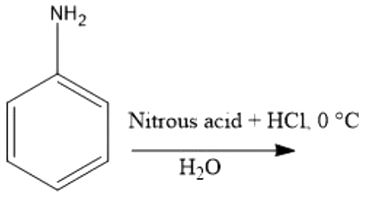
The product in the following reaction is
Answer & explanation
Correct answer: option 3
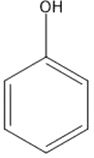
The correct answer is Option (3) →
Core Concept
Primary aromatic amines react with nitrous acid at 0–5°C to form diazonium salts, which on hydrolysis give phenols.
Reaction
C₆H₅NH₂ → (NaNO₂ + HCl, 0–5°C) → C₆H₅N₂⁺Cl⁻
C₆H₅N₂⁺Cl⁻ → (H₂O) → C₆H₅OH + N₂
Explanation of Each Option
1. Toluene is formed through reduction reactions, not through diazonium salt hydrolysis.
2. Chlorobenzene would form only if CuCl is present (Sandmeyer reaction), which is absent here.
3. Phenol is formed when benzene diazonium chloride undergoes hydrolysis with water.
4. N-phenylhydroxylamine is formed by partial reduction of nitrobenzene, not by diazotization.