
CUETMOCK
  • Pricing
  • Mentors
Log inStart freeStart free mocks→

First test, then trust

Try a free CUET mock test.

Join 5,00,000+ students who rehearsed exam day on the exact NTA screen before sitting CUET. On the web and on Android.

Start free mocks →Get the Android app
CUETMOCK

India's #1 CUET Mock Test Platform. Original NCERT-based questions on the exact NTA exam screen — trusted by 5,00,000+ students since CUET 2022.

Get it onGoogle PlayScan to download the CUETMOCK app

Mock tests

  • CUET mock test series
  • Commerce mocks
  • Humanities (Arts) mocks
  • Science mocks
  • Languages & GAT mocks
  • Free practice questions
  • Pricing

Resources

  • CUET exam guide
  • CUET syllabus
  • Universities accepting CUET
  • Expert blogs
  • News & notifications
  • Webinars & counselling
  • CUET score calculator
  • How we estimate your rank
  • FAQs

Company

  • About us
  • Our leadership & team
  • Our toppers
  • Mentors
  • For schools
  • Contact us
  • Terms
  • Privacy
  • Refund policy

Talk to us

+91 7696 6630 56info@cuetmock.comWhatsApp us

Our other platforms

  • JEE Mock — For IIT-JEE aspirants
  • NEET Mock — For NEET aspirants

Newsletter

Exam updates, study material and offers — no spam.

© 2026 NYC Ventures Pvt. Ltd.

701-702, Royal Business Park, Zirakpur, Punjab - 140603

  • Terms of use
  • Privacy policy
  • Refund policy
  • Contact us

iCUETMOCK is an independent preparation platform, not affiliated with the National Testing Agency (NTA). Always check exam details on the official NTA website.

  • Home
  • Mock tests
  • CUET guide
  • Pricing
  • Log in
Home/Practice questions/Chemistry
ChemistryOrganic: Aldehydes, Ketones and Carboxylic Acids

Which of the compound is formed by the oxidation of compound A?

Carbonyl Compounds

2,4-dinitrophenylhydrazine (2,4-DNP) which is also known as Brady’s reagent is used to identify the presence of carbonyl group in aliphatic as well as aromatic compounds. A solution of 2,4-DNP in sulphuric acid is added to the alcoholic solution of an organic compound (A) with molecular formula C4H8O. An orange-red precipitate is obtained. On warming Compound A with freshly prepared ammoniacal silver nitrate solution, a bright silver mirror is produced due to the formation of silver metal. Compound A is easily oxidised to carboxylic acid B with molecular formula C4H8O2 on treatment with common oxidising agents like nitric acid, potassium permanganate, potassium dichromate, etc. A on catalytic hydrogenation give a straight chain alcohol. Two moles of compound A in the presence of dilute alkali form a β-hydroxy aldehyde C which readily loses water to give α,β-unsaturated carbonyl compound D.

Which of the compound is formed by the oxidation of compound A?

Answer & explanation+

Correct answer: option 2

The correct answer is Option (2) → Butanoic acid

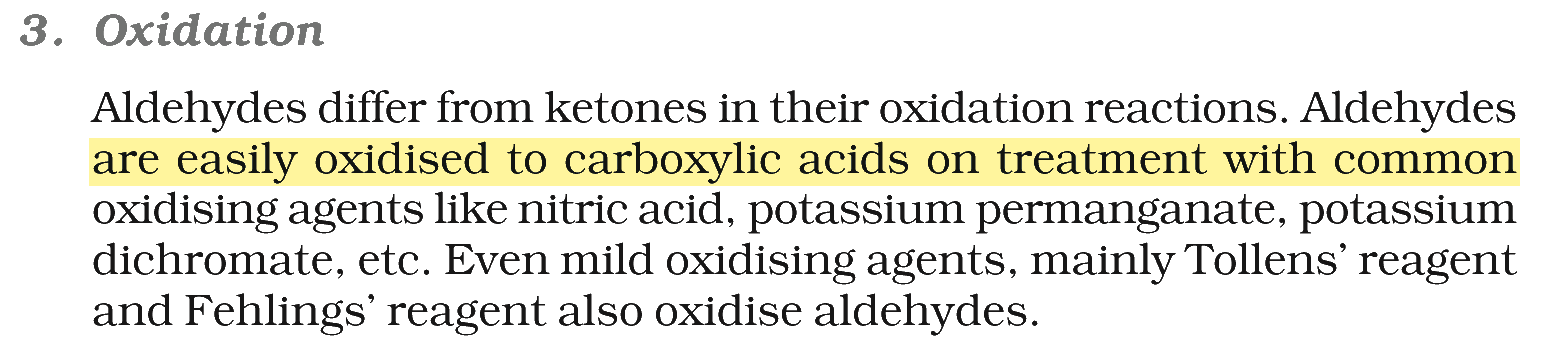
Aldehydes are easily oxidised to carboxylic acids with the same number of carbon atoms, because the carbonyl carbon carries a hydrogen atom. Even mild oxidising agents such as Tollens’ reagent can do this; ketones are oxidised only under vigorous conditions, with breaking of C–C bonds.

From the passage, compound A (\( \ce{C4H8O} \)) gives an orange-red precipitate with 2,4-DNP (a carbonyl compound), a silver mirror with Tollens’ reagent (an aldehyde), and a straight-chain alcohol on hydrogenation. So A is butanal, and its oxidation gives compound B:

    \( \displaystyle \ce{CH3CH2CH2CHO} \xrightarrow{[\ce{O}]} \ce{CH3CH2CH2COOH} \)

So the compound formed is butanoic acid, \( \ce{C4H8O2} \), as the passage states.

Why the other options are incorrect

  • Option (1) 2-hydroxybenzoic acid — Incorrect. Salicylic acid is an aromatic acid, \( \ce{C7H6O3} \), and cannot come from a four-carbon aldehyde.

  • Option (3) Propanoic acid — Incorrect. It has only three carbon atoms, while the oxidation of an aldehyde keeps all its carbon atoms.

  • Option (4) Butanol — Incorrect. Butan-1-ol is the product of reduction (catalytic hydrogenation) of butanal, not of oxidation.

NCERT (2026-27 edition):
Oxidation
Textbook extract

Advertisement

Practise more on Organic: Aldehydes, Ketones and Carboxylic Acids

Chapter-wise mocks on the real NTA exam screen, with solutions and your rank. Your first mocks are free.

Start free mocks →

Advertisement

Next questions

  1. The number of wedding cards, in thousands, distributed in a certain city on each day for a week is given as follows:-21, 35, 19, 27, 32, 22…Applied Maths. Section B2 · Time Based Data
  2. Arrange the following in the increasing order of their reactivity towards SN1 mechanism:(A) (CH3)2CHCH2Br(B) (CH3)3CBr(C) CH3CH2CH2CH2Br(D)…Chemistry · Organic: Haloalkanes and Haloarenes
  3. ‘Zamindars’ were not responsible for __________.History · Modern India: Colonialism and the Countryside
  4. Which territory was not under British control in 1857?History · Modern India: Rebels and the Raj
  5. What is the maximum kinetic energy of the emitted photoelectrons, when frequency of the incident radiation in a photoelectric effect experi…Physics · Dual Nature of Radiation and Matter
  6. Match List-I with List-II.List-IList-II(A)Depreciation using Straight Line Method(I)=PMT(Rate, Nper, Pv, Fv, Type)(B)Depreciation using Wri…Accountancy Part C · Use of Spreadsheet in Business Applications
  7. Which social group is the subject of concern to the speaker?History · Modern India: Framing the Constitution
  8. Fill in the blanks with the suitable word from the options given below:__________ much I tried, I couldn't help her.English · Grammar: Conjunction
  9. At maturity, a typical angiosperm embryo sac is:Biology · Sexual Reproduction in Flowering Plants
  10. What does not pertain to India’s Second Five-Year Plan?Political Science · Politics in India Since Independence: Politics of Planned Development