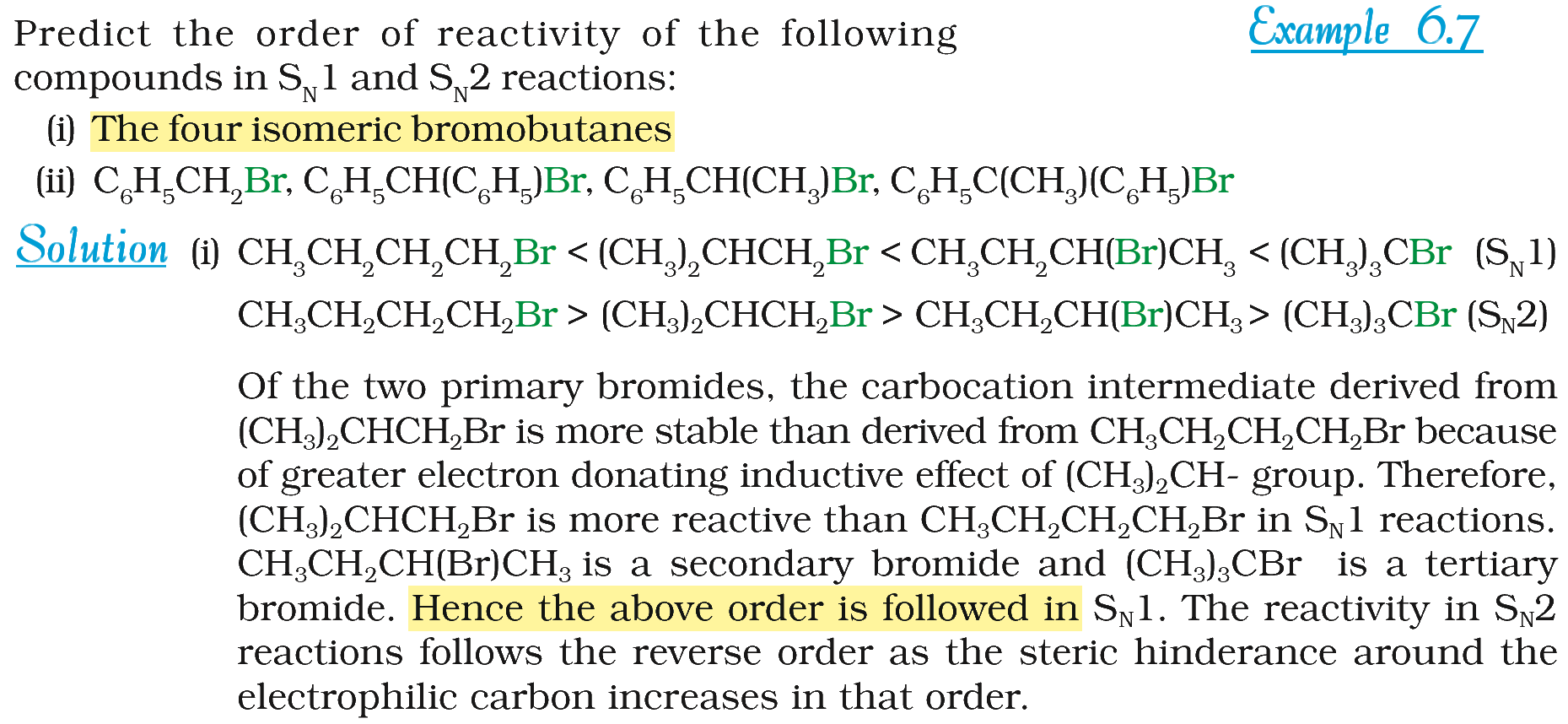
Arrange the following in the increasing order of their reactivity towards SN1 mechanism:
(A) (CH3)2CHCH2Br
(B) (CH3)3CBr
(C) CH3CH2CH2CH2Br
(D) CH3CH2CH(Br)CH3
Choose the correct answer from the options given below:
Answer & explanation
Correct answer: option 4
The correct answer is Option (4) → (C), (A), (D), (B)
An SN1 reaction takes place in two steps. The slow step is the loss of the halide ion to form a carbocation, so the rate depends on how stable that carbocation is. Alkyl groups stabilise a carbocation by the +I effect and hyperconjugation, so:
\( \displaystyle 3^\circ > 2^\circ > 1^\circ \)
Matching the given compounds:
(C) \( \ce{CH3CH2CH2CH2Br} \): 1-bromobutane (1°, straight chain)
(A) \( \ce{(CH3)2CHCH2Br} \): 1-bromo-2-methylpropane (1°, branched)
(D) \( \ce{CH3CH2CH(Br)CH3} \): 2-bromobutane (2°)
(B) \( \ce{(CH3)3CBr} \): 2-bromo-2-methylpropane (3°)
The tertiary bromide (B) reacts fastest and the secondary bromide (D) comes next. Both (A) and (C) are primary and react very slowly. Of these two, (A) reacts slightly faster.
Shortcut: The tertiary bromide (B) must be last and the secondary bromide (D) just before it. Only Option (4) ends with (D), (B).
NCERT (2026-27 edition):
Reactions of Haloalkanes – …