CUETMOCK
  • Pricing
  • Mentors
Log inStart freeStart free mocks→

First test, then trust

Try a free CUET mock test.

Join 5,00,000+ students who rehearsed exam day on the exact NTA screen before sitting CUET. On the web and on Android.

Start free mocks →Get the Android app
CUETMOCK

India's #1 CUET Mock Test Platform. Original NCERT-based questions on the exact NTA exam screen — trusted by 5,00,000+ students since CUET 2022.

Get it onGoogle PlayScan to download the CUETMOCK app

Mock tests

  • CUET mock test series
  • Browse all papers
  • Commerce mocks
  • Humanities (Arts) mocks
  • Science mocks
  • Languages & GAT mocks
  • Free practice questions
  • Pricing

Resources

  • CUET exam guide
  • CUET syllabus
  • Universities accepting CUET
  • Expert blogs
  • News & notifications
  • Webinars & counselling
  • CUET score calculator
  • How we estimate your rank
  • FAQs

Company

  • About us
  • Our leadership & team
  • Our toppers
  • Mentors
  • For schools
  • Contact us
  • Terms
  • Privacy
  • Refund policy

Talk to us

+91 7696 6630 56info@cuetmock.comWhatsApp us

Our other platforms

  • JEE Mock — For IIT-JEE aspirants
  • NEET Mock — For NEET aspirants

Newsletter

Exam updates, study material and offers — no spam.

© 2026 NYC Ventures Pvt. Ltd.

701-702, Royal Business Park, Zirakpur, Punjab - 140603

  • Terms of use
  • Privacy policy
  • Refund policy
  • Contact us

iCUETMOCK is an independent preparation platform, not affiliated with the National Testing Agency (NTA). Always check exam details on the official NTA website.

  • Home
  • Mock tests
  • CUET guide
  • Pricing
  • Log in
Home/Practice questions/History
HistoryModern India: Colonialism and the Countryside

‘Zamindars’ were not responsible for __________.

‘Zamindars’ were not responsible for __________.

Answer & explanation+

Correct answer: option 4

The correct answer is Option (4) → Gave out loans to other ryots

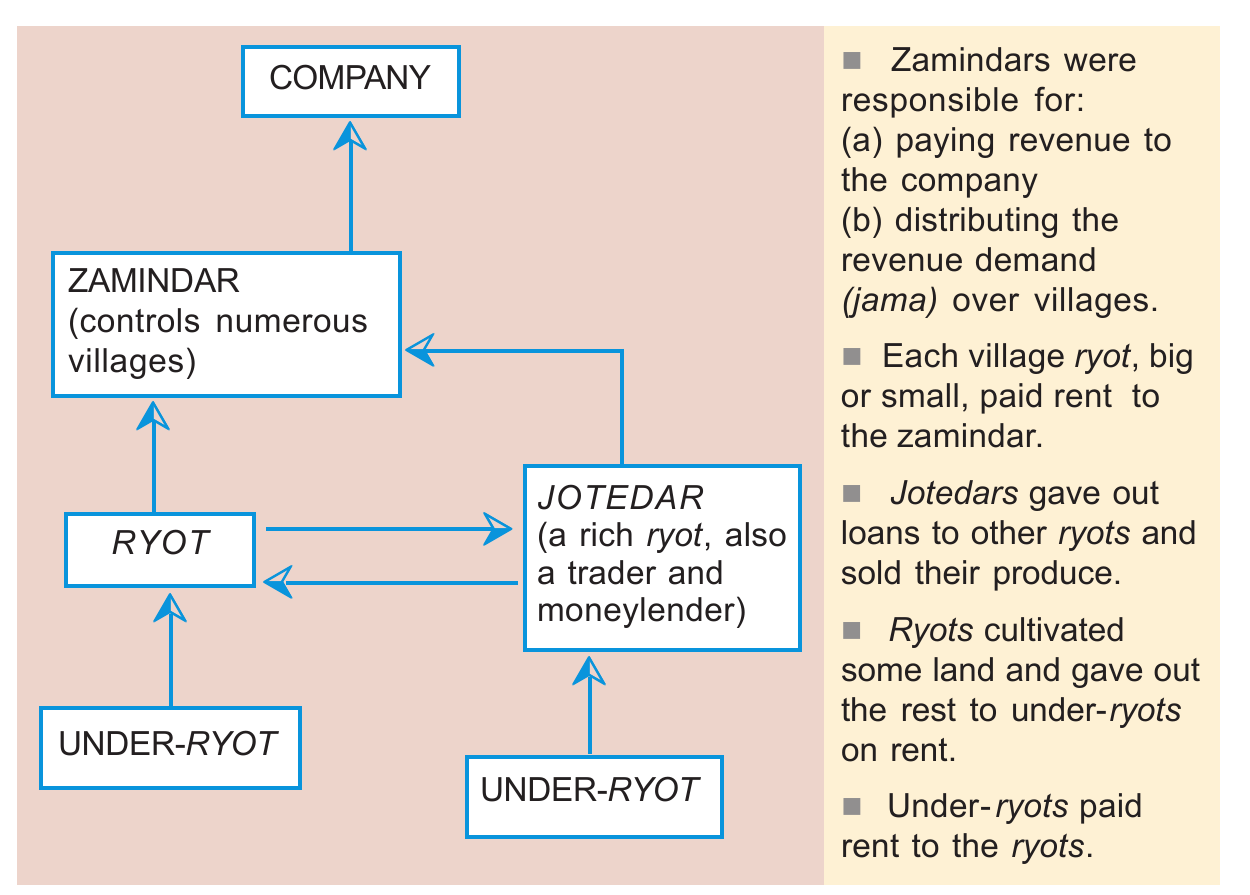
Under the Permanent Settlement the zamindar stood between the Company and the villages. He paid the revenue to the Company, distributed the revenue demand (jama) over his villages, and collected rent from the ryots of each village, keeping the difference as his income. So Options (1), (2) and (3) were all his duties.

Giving loans was not. In rural Bengal it was the jotedar, a rich ryot who was also a trader and moneylender, who gave out loans to other ryots and sold their produce. By the early nineteenth century the jotedars controlled local trade and moneylending in the villages, and their power was often greater than that of the zamindars.


NCERT (2025-26): “1.2 The problem of unpaid revenue … Zamindars had several (sometimes as many as 400) villages under them. In Company calculations the villages within one zamindari formed one revenue estate. The Company fixed the total demand over the entire estate whose revenue the zamindar contracted to pay. The zamindar collected rent from the different villages, paid the revenue to the Company, and retained the difference as his income. He was expected to pay the Company regularly, failing which his estate could be auctioned.…

1.4 The rise of the jotedars … By the early nineteenth century, jotedars had acquired vast areas of land – sometimes as much as several thousand acres. They controlled local trade as well as moneylending, exercising immense power over the poorer cultivators of the region.…

Zamindars were responsible for:
(a) paying revenue to the company
(b) distributing the revenue demand (jama) over villages.

Each village ryot, big or small, paid rent to the zamindar.

Jotedars gave out loans to other ryots and sold their produce.

Ryots cultivated some land and gave out the rest to under-ryots on rent.

Under-ryots paid rent to the ryots.”

NCERT extract

Fig. 9.5 Power in rural Bengal

Advertisement

Practise more on Modern India: Colonialism and the Countryside

Chapter-wise mocks on the real NTA exam screen, with solutions and your rank. Your first mocks are free.

Start free mocks →

Advertisement

Next questions

  1. Which territory was not under British control in 1857?History · Modern India: Rebels and the Raj
  2. What is the maximum kinetic energy of the emitted photoelectrons, when frequency of the incident radiation in a photoelectric effect experi…Physics · Dual Nature of Radiation and Matter
  3. Match List-I with List-II.List-IList-II(A)Depreciation using Straight Line Method(I)=PMT(Rate, Nper, Pv, Fv, Type)(B)Depreciation using Wri…Accountancy Part C · Use of Spreadsheet in Business Applications
  4. Which social group is the subject of concern to the speaker?History · Modern India: Framing the Constitution
  5. Fill in the blanks with the suitable word from the options given below:__________ much I tried, I couldn't help her.English · Grammar: Conjunction
  6. At maturity, a typical angiosperm embryo sac is:Biology · Sexual Reproduction in Flowering Plants
  7. What does not pertain to India’s Second Five-Year Plan?Political Science · Politics in India Since Independence: Politics of Planned Development
  8. The new partner is required to compensate the old partners for their loss of share in the super profits of the firm for which he brings in…Accountancy Part A · Admission of a Partner
  9. ABC Ltd. has a partnership deed as per which interest on drawing is to be charged @ 9% p.a and the total interest on drawings of Aman (part…Accountancy Part A · Accounting for Partnership
  10. Match the LIST-I with LIST-IILIST-I(Types of port)LIST-II(Example)A.Ports of CallI.RotterdamB.Packet StationII.KarwarC.Entrepot PortsIII.Ad…Geography · Fundamentals of Human Geography: International Trade