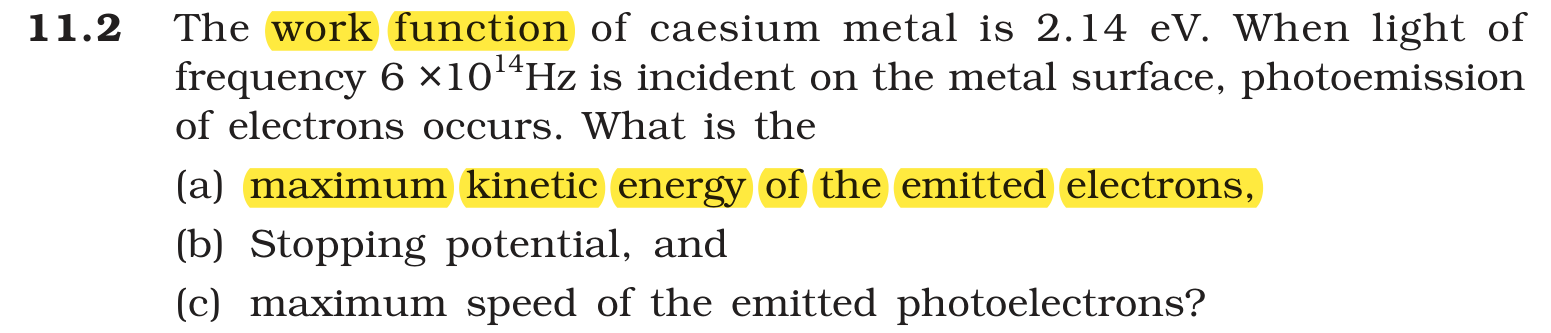
What is the maximum kinetic energy of the emitted photoelectrons, when frequency of the incident radiation in a photoelectric effect experiment is \( 6.4\times10^{14} \) Hz and the work function of the metal is \( 2.3 \) eV?
(Given: \( h=6.63\times10^{-34} \) J s, charge of electron \( =1.6\times10^{-19} \) C)?
Answer & explanation
Correct answer: option 4
The correct answer is Option (4) → \( \sim 5.63\times10^{-20} \) J
By Einstein’s photoelectric equation, the photon energy is used to overcome the work function and the rest appears as the maximum kinetic energy of the photoelectron:
\( K_{\max} = h\nu-\phi_0 \)
\( h\nu = 6.63\times10^{-34}\times6.4\times10^{14} = 4.243\times10^{-19}\,\mathrm{J} \)
\( \phi_0 = 2.3\,\mathrm{eV} = 2.3\times1.6\times10^{-19} = 3.68\times10^{-19}\,\mathrm{J} \)
\( K_{\max} = 4.243\times10^{-19}-3.68\times10^{-19} = 0.563\times10^{-19}\,\mathrm{J} \)
\( K_{\max} \approx 5.63\times10^{-20}\,\mathrm{J} \)
Note: NTA picked this question from an NCERT (2026-27) exercise and changed the figures. Do not ignore NCERT while practising numericals.
NCERT (2026-27):
Exercises – …