
CUETMOCK
  • Pricing
  • Mentors
Log inStart freeStart free mocks→

First test, then trust

Try a free CUET mock test.

Join 5,00,000+ students who rehearsed exam day on the exact NTA screen before sitting CUET. On the web and on Android.

Start free mocks →Get the Android app
CUETMOCK

India's #1 CUET Mock Test Platform. Original NCERT-based questions on the exact NTA exam screen — trusted by 5,00,000+ students since CUET 2022.

Get it onGoogle PlayScan to download the CUETMOCK app

Mock tests

  • CUET mock test series
  • Commerce mocks
  • Humanities (Arts) mocks
  • Science mocks
  • Languages & GAT mocks
  • Free practice questions
  • Pricing

Resources

  • CUET exam guide
  • CUET syllabus
  • Universities accepting CUET
  • Expert blogs
  • News & notifications
  • Webinars & counselling
  • CUET score calculator
  • How we estimate your rank
  • FAQs

Company

  • About us
  • Our leadership & team
  • Our toppers
  • Mentors
  • For schools
  • Contact us
  • Terms
  • Privacy
  • Refund policy

Talk to us

+91 7696 6630 56info@cuetmock.comWhatsApp us

Our other platforms

  • JEE Mock — For IIT-JEE aspirants
  • NEET Mock — For NEET aspirants

Newsletter

Exam updates, study material and offers — no spam.

© 2026 NYC Ventures Pvt. Ltd.

701-702, Royal Business Park, Zirakpur, Punjab - 140603

  • Terms of use
  • Privacy policy
  • Refund policy
  • Contact us

iCUETMOCK is an independent preparation platform, not affiliated with the National Testing Agency (NTA). Always check exam details on the official NTA website.

  • Home
  • Mock tests
  • CUET guide
  • Pricing
  • Log in
Home/Practice questions/Chemistry
ChemistryPhysical: Chemical Kinetics

For the reaction, 2HI(g) → H2 (g) + I2 (g), the rate of reaction can…

For the reaction, 2HI(g) → H2 (g) + I2 (g), the rate of reaction can be represented as:

Answer & explanation+

Correct answer: option 4

The correct answer is Option (4) → \( -\frac{\Delta[HI]}{\Delta t}=2\frac{\Delta[H_2]}{\Delta t}=2\frac{\Delta[I_2]}{\Delta t} \)

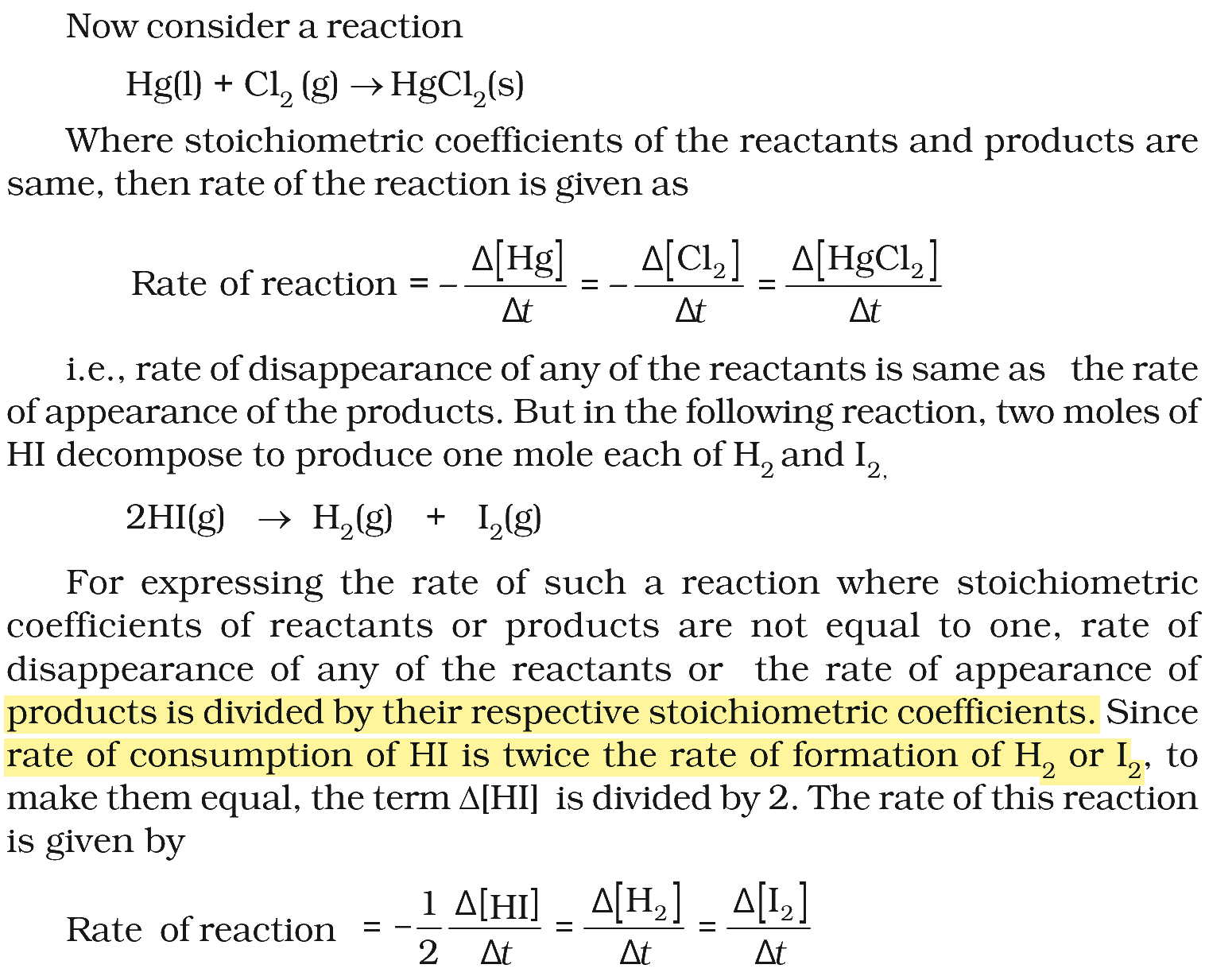
When the coefficients in a balanced equation are not all equal, the reactants and products change concentration at different speeds. To get one rate for the whole reaction, each rate of change is divided by the coefficient of that species, and reactants take a minus sign (their concentration falls). For a general reaction:

    \( \displaystyle a\mathrm{A}+b\mathrm{B}\rightarrow c\mathrm{C}+d\mathrm{D} \)

    \( \displaystyle \text{Rate}=-\frac{1}{a}\frac{\Delta[\mathrm{A}]}{\Delta t}=-\frac{1}{b}\frac{\Delta[\mathrm{B}]}{\Delta t}=+\frac{1}{c}\frac{\Delta[\mathrm{C}]}{\Delta t}=+\frac{1}{d}\frac{\Delta[\mathrm{D}]}{\Delta t} \)

For 2HI(g) → H2(g) + I2(g), the coefficients are 2 for HI and 1 each for \( \ce{H2} \) and \( \ce{I2} \):

    \( \displaystyle \text{Rate}=-\frac{1}{2}\frac{\Delta[HI]}{\Delta t}=\frac{\Delta[H_2]}{\Delta t}=\frac{\Delta[I_2]}{\Delta t} \)

Multiplying every term by 2:

    \( \displaystyle -\frac{\Delta[HI]}{\Delta t}=2\frac{\Delta[H_2]}{\Delta t}=2\frac{\Delta[I_2]}{\Delta t} \)

This says that HI is used up twice as fast as \( \ce{H2} \) or \( \ce{I2} \) is formed, which is what the equation shows. So the correct expression is Option (4).

Why the other options are incorrect

  • Option (1) \( \frac{\Delta[HI]}{\Delta t}=\frac{\Delta[H_2]}{\Delta t}=\frac{\Delta[I_2]}{\Delta t} \) — Incorrect. It has no minus sign for the reactant, which would make the rate negative, and it ignores the coefficient 2 of HI.

  • Option (2) \( -\frac{\Delta[HI]}{\Delta t}=\frac{1}{2}\frac{\Delta[H_2]}{\Delta t}=\frac{\Delta[I_2]}{\Delta t} \) — Incorrect. The factor 1/2 is on the wrong side. It would mean \( \ce{H2} \) forms twice as fast as HI disappears.

  • Option (3) \( -\frac{\Delta[HI]}{\Delta t}=2\frac{\Delta[H_2]}{\Delta t}=\frac{\Delta[I_2]}{\Delta t} \) — Incorrect. \( \ce{H2} \) and \( \ce{I2} \) are formed in equal amounts, so they must carry the same factor; here only \( \ce{H2} \) has the factor 2.

NCERT (2026-27 edition):
Rate of a Chemical Reaction – …
Textbook extract

Note: The same/similar question has been asked in different years by NTA as per the details given below:

20262025202420232022
26-05 S1
24-05 S2
––––

Advertisement

Practise more on Physical: Chemical Kinetics

Chapter-wise mocks on the real NTA exam screen, with solutions and your rank. Your first mocks are free.

Start free mocks →

Advertisement

Next questions

  1. The galvanometer G, in each of the two circuits as shown, shows null deflection. The ratio of the resistors R_1 and R_2 used in these two c…Physics · Current Electricity
  2. Match the LIST-I with LIST-IILIST-ILIST-II(Personnel)(Type of work)A. Gang bossI. Timely and accurate completion of jobB. Speed bossII. Che…Business Studies · Principles of Management
  3. Arrange the following in the correct sequence of liquidity:A. Prepaid expensesB. Work in progressC. DebtorsD. Bills receivablesChoose the c…Business Studies · Financial Management
  4. Which of the following factors do not affect the choice of capital structure?Business Studies · Financial Management
  5. Which of the following is not a task of the middle level management?Business Studies · Nature and significance of Management
  6. Which one of the following metal ions will exhibit highest value of calculated magnetic moment (spin-only)?Chemistry · Inorganic: D and F Block Elements
  7. A simple random sample of 49 items from a population with standard deviation, σ = 6 resulted in a sample mean of 32. At 95% confidence leve…Applied Maths. Section B2 · Inferential Statistics
  8. A LCR series circuit has the following parameters: L = 25 mH, C = 1.6 μF and R = 10 Ω. The circuit will be resonant at frequencyPhysics · Alternating Current
  9. Who argued that the nature of urban impact varies according to the kind of relation a village has with a city or town?Sociology · Social Change and Development in India: Structural Change
  10. Arrange the following early-states from north to south:A. AshmakaB. MatsyaC. GandharaD. AvantiChoose the correct answer from the options gi…History · Ancient India: Kings, Farmers and Towns