
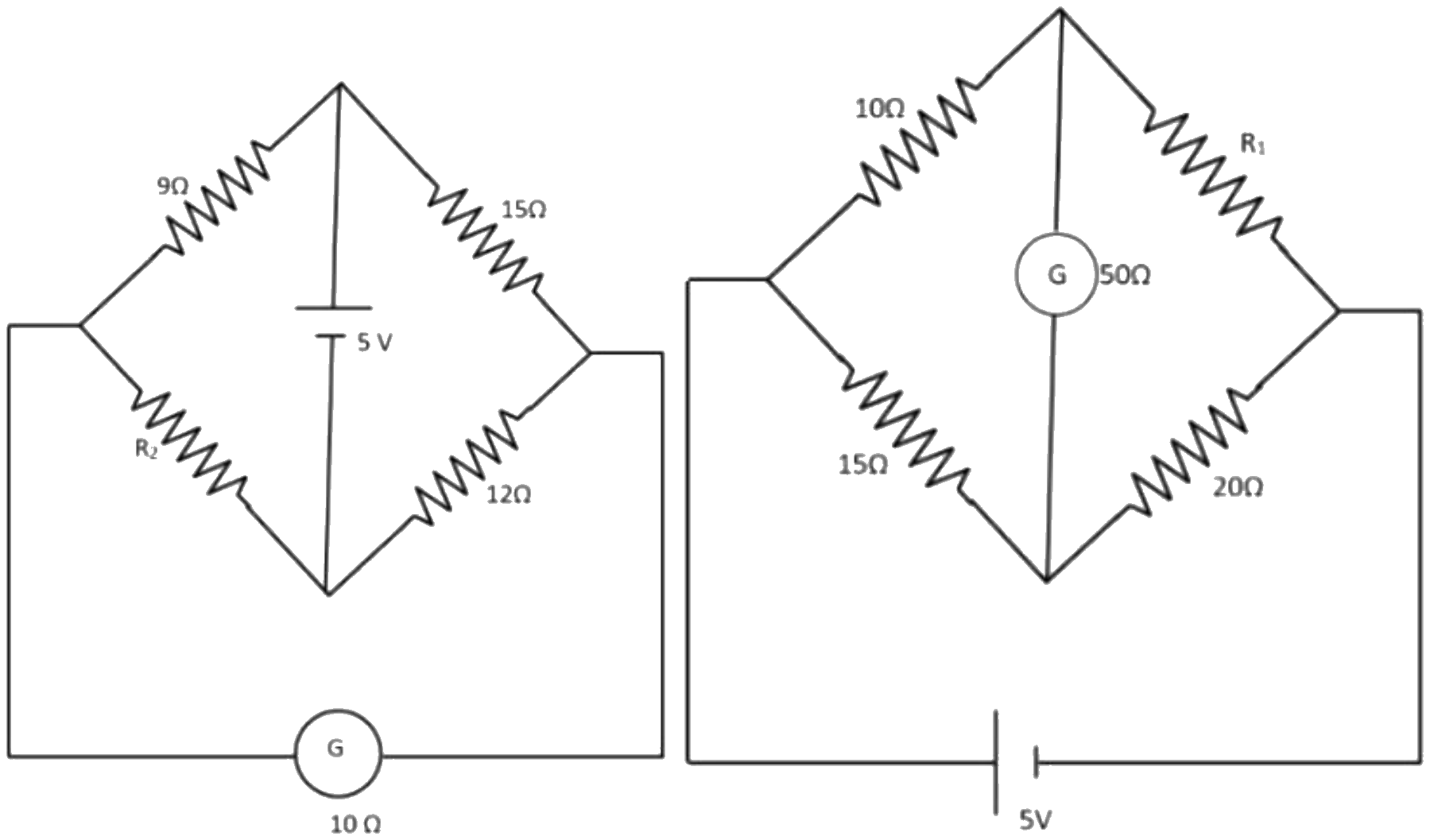
The galvanometer G, in each of the two circuits as shown, shows null deflection. The ratio of the resistors \( R_{1} \) and \( R_{2} \) used in these two circuits is:
Answer & explanation
Correct answer: option 3
The correct answer is Option (3) → \( 50/27 \)
A Wheatstone bridge is balanced (null deflection) when the ratio of the two resistances on one side of the galvanometer equals the ratio on the other side, measured from the same battery terminal. Then no current flows through the galvanometer, whatever its resistance.
Left circuit: the battery is across the top and bottom corners and the galvanometer across the left and right corners. Going from the top corner, the left side has \( 9\ \Omega \) then \( R_{2} \); the right side has \( 15\ \Omega \) then \( 12\ \Omega \).
\( \displaystyle \frac{9}{R_{2}} = \frac{15}{12} \)
\( \displaystyle R_{2} = \frac{9 \times 12}{15} = 7.2\ \Omega \)
Right circuit: the battery is across the left and right corners and the galvanometer across the top and bottom corners. Going from the left corner, the upper path has \( 10\ \Omega \) then \( R_{1} \); the lower path has \( 15\ \Omega \) then \( 20\ \Omega \).
\( \displaystyle \frac{10}{R_{1}} = \frac{15}{20} \)
\( \displaystyle R_{1} = \frac{10 \times 20}{15} = \frac{40}{3}\ \Omega \)
Ratio:
\( \displaystyle \frac{R_{1}}{R_{2}} = \frac{40/3}{7.2} = \frac{40}{21.6} = \frac{50}{27} \)