
CUETMOCK
  • Pricing
  • Mentors
Log inStart freeStart free mocks→

First test, then trust

Try a free CUET mock test.

Join 5,00,000+ students who rehearsed exam day on the exact NTA screen before sitting CUET. On the web and on Android.

Start free mocks →Get the Android app
CUETMOCK

India's #1 CUET Mock Test Platform. Original NCERT-based questions on the exact NTA exam screen — trusted by 5,00,000+ students since CUET 2022.

Get it onGoogle PlayScan to download the CUETMOCK app

Mock tests

  • CUET mock test series
  • Commerce mocks
  • Humanities (Arts) mocks
  • Science mocks
  • Languages & GAT mocks
  • Free practice questions
  • Pricing

Resources

  • CUET exam guide
  • CUET syllabus
  • Universities accepting CUET
  • Expert blogs
  • News & notifications
  • Webinars & counselling
  • CUET score calculator
  • How we estimate your rank
  • FAQs

Company

  • About us
  • Our leadership & team
  • Our toppers
  • Mentors
  • For schools
  • Contact us
  • Terms
  • Privacy
  • Refund policy

Talk to us

+91 7696 6630 56info@cuetmock.comWhatsApp us

Our other platforms

  • JEE Mock — For IIT-JEE aspirants
  • NEET Mock — For NEET aspirants

Newsletter

Exam updates, study material and offers — no spam.

© 2026 NYC Ventures Pvt. Ltd.

701-702, Royal Business Park, Zirakpur, Punjab - 140603

  • Terms of use
  • Privacy policy
  • Refund policy
  • Contact us

iCUETMOCK is an independent preparation platform, not affiliated with the National Testing Agency (NTA). Always check exam details on the official NTA website.

  • Home
  • Mock tests
  • CUET guide
  • Pricing
  • Log in
Home/Practice questions/Chemistry
ChemistryOrganic: Alcohols, Phenols and Ethers

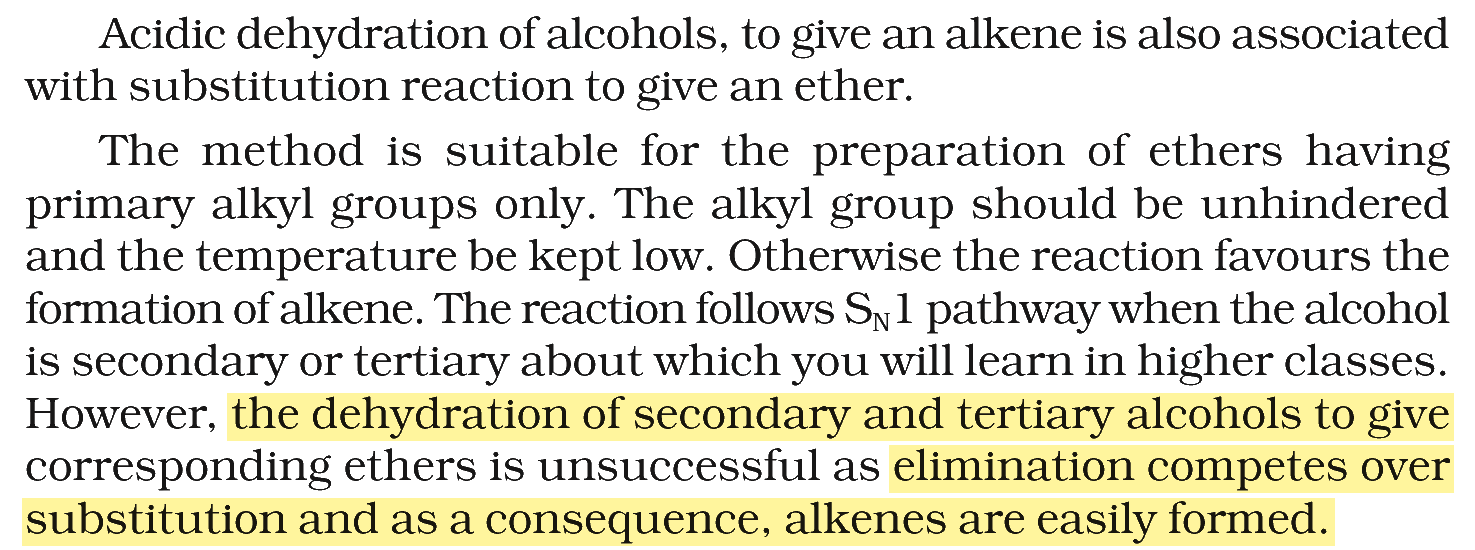
Secondary and tertiary alcohols are not favoured for the preparation…

Secondary and tertiary alcohols are not favoured for the preparation of ether via dehydration at elevated temperature in the presence of sulfuric acid because

Answer & explanation+

Correct answer: option 1

The correct answer is Option (1) → elimination reaction competes over substitution reaction.

Ethers can be made by heating an alcohol with concentrated sulphuric acid at about 413 K. One alcohol molecule attacks another protonated alcohol molecule in an SN2 step, and water is lost:

    \( \displaystyle \ce{CH3CH2-OH + H^{+} -> CH3CH2-OH2^{+}} \)

    \( \displaystyle \ce{CH3CH2-OH + CH3CH2-OH2^{+} -> CH3CH2-O-CH2CH3 + H2O + H^{+}} \)

    \( \displaystyle \text{Net: }\ce{2CH3CH2OH} \xrightarrow[\text{413 K}]{\ce{H2SO4}} \ce{CH3CH2-O-CH2CH3 + H2O} \)

The same acid can instead remove water from a single molecule to give an alkene, an elimination reaction. For ethanol this happens at a higher temperature:

    \( \displaystyle \ce{CH3CH2OH} \xrightarrow[\text{443 K}]{\ce{H2SO4}} \ce{CH2=CH2 + H2O} \)

With secondary and tertiary alcohols, the carbon carrying the –OH group is crowded by alkyl groups, which hinders the SN2 attack. These alcohols also form stable carbocations that lose \( \ce{H^{+}} \) very easily. So elimination is faster than substitution, and the alkene becomes the main product instead of the ether, for example:

    \( \displaystyle \ce{(CH3)3C-OH} \xrightarrow{\ce{H2SO4}} \ce{(CH3)2C=CH2 + H2O} \)

Why the other options are incorrect

  • Option (2) substitution reaction competes over elimination reaction — Incorrect. This is the reverse. For secondary and tertiary alcohols, elimination wins over substitution.

  • Option (3) substitution reaction can not occur with secondary and tertiary alcohols. — Incorrect. Substitution does occur with these alcohols. For example, tertiary alcohols react with HCl fastest of all.

  • Option (4) an elimination reaction can not occur with secondary or tertiary alcohols. — Incorrect. Elimination is actually easiest for these alcohols; the ease of dehydration is 3° > 2° > 1°.

NCERT (2026-27 edition):
Preparation of Ethers – …
Textbook extract

Advertisement

Practise more on Organic: Alcohols, Phenols and Ethers

Chapter-wise mocks on the real NTA exam screen, with solutions and your rank. Your first mocks are free.

Start free mocks →

Advertisement

Next questions

  1. What does the Biological Weapons Convention (BWC) mandate?Political Science · Contemporary World Politics: Security in the Contemporary World
  2. The energy required to set an electron free in an n-type semiconductor made by doping a silicon crystal with a pentavalent element is:Physics · Semiconductors and Electronic Devices
  3. Identify the step, not involved in polymerase chain reaction.Biology · Biotechnology -Principles and Processes
  4. Rearrange the following parts of a sentence to complete the given prompt:India has been a land-----(A) but in the sense that learning has a…English · Arrange in Meaningful Sequence
  5. Which of the following programme aims to improve the child sex ratio?Geography · Fundamentals of Human Geography: Human Development
  6. The following particles have the same kinetic energy. Arrange them in the ascending order of their de-Broglie wavelengths.(A) Proton(B) Neu…Physics · Dual Nature of Radiation and Matter
  7. In partnership, a minor can be partner:Accountancy Part A · Accounting for Partnership
  8. The underground mining method is risky:Geography · Fundamentals of Human Geography: Primary Activities
  9. Identify the change when DNA from smooth walled strain of Pneumococcus bacteria digested with DNAase and introduced into rough walled bacte…Biology · Molecular Basis of Inheritance
  10. Match the complex given in List-I with their hybridization and magnetic behavior in List-IIList-IList-IIMetal ComplexHybridization/Magnetic…Chemistry · Inorganic: Coordination Compounds