Read the passage and answer the questions:
Methods of Mining
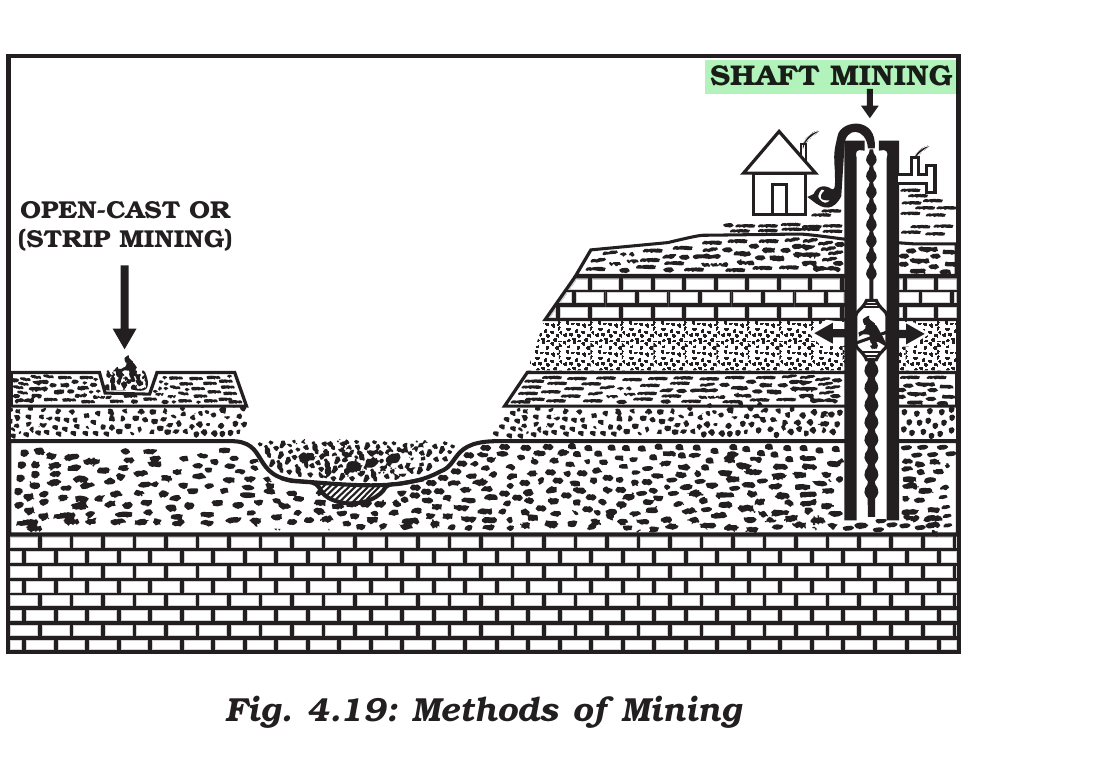
The discovery of minerals in the history of human development, is reflected in many stages in terms of copper age, bronze age and iron age. The use of minerals in ancient times was largely confined to the making of tools, utensils and weapons. The actual development of mining began with the industrial revolution and its importance is continuously increasing. Depending on the mode of occurrence and the nature of the ore, mining is of two types: surface and underground mining. The surface mining also known as open-cast mining is the easiest and the cheapest way of mining minerals that occur close to the surface. Overhead costs such as safety precautions and equipment is relatively low in this method. The output is both large and rapid. When the ore lies deep below the surface, underground mining method or shaft method has to be used. In this method, vertical shafts have to be sunk, from where underground galleries radiate to reach the minerals. Minerals are extracted and transported to the surface through these passages. It requires specially designed lifts, drills, haulage vehicles, ventilation system for safety and efficient movement of people and material. This method is risky. Poisonous gases, fires, floods and caving in lead to fatal accidents. Have you ever read about mine fires and flooding of coal mines in India? The developed economies are retreating from mining, processing and refining stages of production due to high labour costs, while the developing countries with large labour force and striving for higher standard of living are becoming more important. Several countries of Africa and few of south America and Asia have over fifty per cent of the earnings from minerals alone.
The underground mining method is risky:
Answer & explanation
Correct answer: option 2
The correct answer is Option (2) → Because of poisonous gases, fires, floods and caving lead to fatal accidents.
Option (1) Because it employs smaller labour force and high technology. — Incorrect. The size of the labour force does not make a mine dangerous; conditions underground do.
Option (2) Because of poisonous gases, fires, floods and caving lead to fatal accidents. — Correct. Underground (shaft) mining works deep below the surface, in shafts and galleries cut through the rock. Gases can collect there, water can seep in and the roof can give way, while the workers are far from the open air with only the shafts to get out by. So poisonous gases, fires, floods and caving in lead to fatal accidents, which makes the method risky.
Option (3) Because it takes place at a shallow depth. — Incorrect. Underground mining works deep below the surface; shallow ores are mined from the surface.
Option (4) Because for it no subsidy is provided by the government. — Incorrect. A subsidy has no bearing on the physical dangers underground.
NCERT (2025-26): “Methods of Mining … Depending on the mode of occurrence and the nature of the ore, mining is of two types: surface and underground mining. The surface mining also known as open-cast mining is the easiest and the cheapest way of mining minerals that occur close to the surface. Overhead costs such as safety precautions and equipment is relatively low in this method. The output is both large and rapid.…” “Methods of Mining … When the ore lies deep below the surface, underground mining method (shaft method) has to be used. In this method, vertical shafts have to be sunk, from where underground galleries radiate to reach the minerals. Minerals are extracted and transported to the surface through these passages. It requires specially designed lifts, drills, haulage vehicles, ventilation system for safety and efficient movement of people and material. This method is risky. Poisonous gases, fires, floods and caving in lead to fatal accidents. Have you ever read about mine fires and flooding of coal mines in India?…” “Methods of Mining … The developed economies are retreating from mining, processing and refining stages of production due to high labour costs, while the developing countries with large labour force and striving for higher standard of living are becoming more important.…”
|