TRANSFORMING PRINCIPLE
Read the following passage carefully and answer the given questions.
When Streptococcus pneumoniae bacteria are grown on a culture plate, some produce smooth shiny colonies while others produce rough colonies. This is because the S strain bacteria have a mucous coat, while R strain does not. Mice infected with the S strain die from pneumonia infection but mice infected with the R strain do not develop pneumonia. Griffith concluded that the R strain bacteria had somehow been transformed by the heat-killed S strain bacteria. Some ‘transforming principle’, transferred from the heat-killed S strain, had enabled the R strain to synthesise a smooth polysaccharide coat and become virulent. This must be due to the transfer of the genetic material. However, the biochemical nature of genetic material was not defined from his experiments.
Identify the change when DNA from smooth walled strain of Pneumococcus bacteria digested with DNAase and introduced into rough walled bacteria.
Answer & explanation
Correct answer: option 2
The correct answer is Option (2) → No change was found in rough walled bacteria
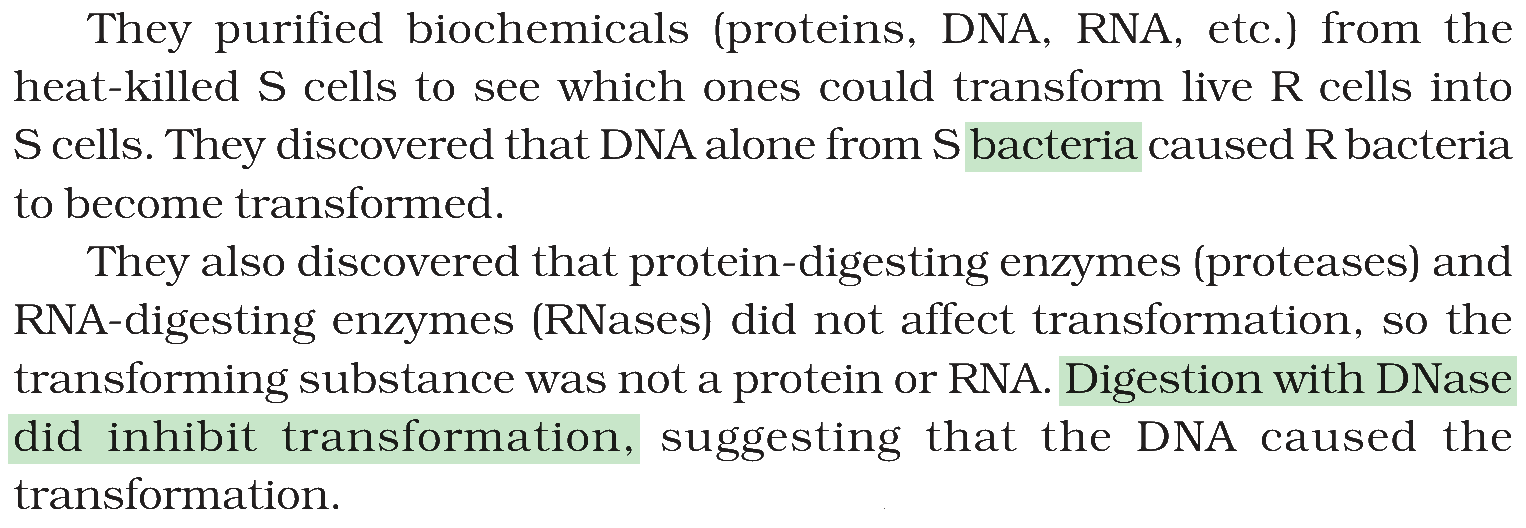
In Griffith’s experiment, the “transforming principle” of the S (smooth) strain changes R (rough) bacteria into S bacteria. The later work showed that this principle is DNA. The enzyme DNase digests DNA. After the DNA of the S strain has been digested, nothing is left to cause the change.
(1) Rough walled bacteria changed into smooth walled bacteria — Incorrect. This happens only when the DNA of the S strain is intact. Here it has been digested.
(2) No change was found in rough walled bacteria — Correct. Digestion with DNase stopped the transformation.
(3) Smooth walled bacteria changed into rough walled bacteria — Incorrect. The DNA was added to rough bacteria. Smooth bacteria were not involved.
(4) Rough walled bacteria changed into shiny walled bacteria — Incorrect. No such type of bacteria is described.
Note: The passage is taken from NCERT. NTA has put lines of the NCERT text together to make it. Most CUET (UG) questions come straight from NCERT, so study the book line by line, including figures and their titles.
NCERT Extract:
The Search for Genetic Material – …