Match List-I with List-II
| List-I | List-II |
| Electromagnetic Waves | Production |
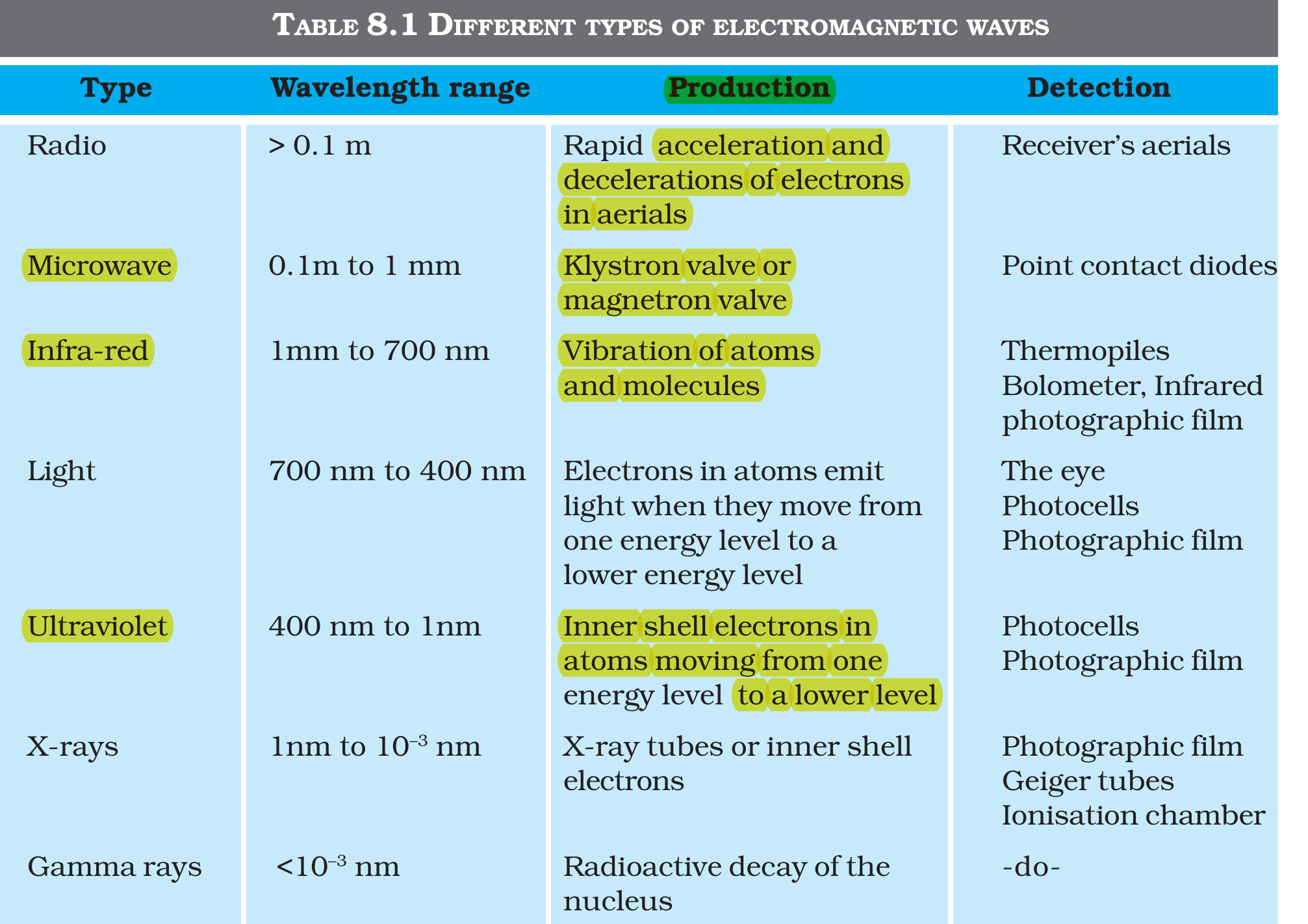
| (A) Microwave | (I) Rapid acceleration and deceleration of electrons in aerials. |
| (B) Infra-red wave | (II) Inner shell electrons in atoms moving from one energy level to a lower level. |
| (C) Radio wave | (III) Klystron valve or magnetron valve. |
| (D) Ultraviolet ray | (IV) Vibration of atoms and molecules |
Choose the correct answer from the options given below:
Answer & explanation
Correct answer: option 4
The correct answer is Option (4) → (A) - (III), (B) - (IV), (C) - (I), (D) - (II)
Each band of the electromagnetic spectrum is produced by a different process, and the energy of the process matches the frequency of the wave.
(A) Microwave — this matches (III) Klystron valve or magnetron valve. These vacuum tubes produce microwaves for radar and microwave ovens.
(B) Infra-red wave — this matches (IV) Vibration of atoms and molecules. Hot bodies emit infrared because their atoms and molecules are in thermal vibration.
(C) Radio wave — this matches (I) Rapid acceleration and deceleration of electrons in aerials. Accelerated charges radiate, and the oscillating current in an antenna radiates at radio frequencies.
(D) Ultraviolet ray — this matches (II) Inner shell electrons in atoms moving from one energy level to a lower level. Such transitions involve larger energy gaps than those of visible light, so the photons lie in the ultraviolet.
NCERT (2026-27):
Gamma Rays – …