CUETMOCK
  • Pricing
  • Mentors
Log inStart freeStart free mocks→

First test, then trust

Try a free CUET mock test.

Join 5,00,000+ students who rehearsed exam day on the exact NTA screen before sitting CUET. On the web and on Android.

Start free mocks →Get the Android app
CUETMOCK

India's #1 CUET Mock Test Platform. Original NCERT-based questions on the exact NTA exam screen — trusted by 5,00,000+ students since CUET 2022.

Get it onGoogle PlayScan to download the CUETMOCK app

Mock tests

  • CUET mock test series
  • Commerce mocks
  • Humanities (Arts) mocks
  • Science mocks
  • Languages & GAT mocks
  • Free practice questions
  • Pricing

Resources

  • CUET exam guide
  • CUET syllabus
  • Universities accepting CUET
  • Expert blogs
  • News & notifications
  • Webinars & counselling
  • CUET score calculator
  • How we estimate your rank
  • FAQs

Company

  • About us
  • Our leadership & team
  • Our toppers
  • Mentors
  • For schools
  • Contact us
  • Terms
  • Privacy
  • Refund policy

Talk to us

+91 7696 6630 56info@cuetmock.comWhatsApp us

Our other platforms

  • JEE Mock — For IIT-JEE aspirants
  • NEET Mock — For NEET aspirants

Newsletter

Exam updates, study material and offers — no spam.

© 2026 NYC Ventures Pvt. Ltd.

701-702, Royal Business Park, Zirakpur, Punjab - 140603

  • Terms of use
  • Privacy policy
  • Refund policy
  • Contact us

iCUETMOCK is an independent preparation platform, not affiliated with the National Testing Agency (NTA). Always check exam details on the official NTA website.

  • Home
  • Mock tests
  • CUET guide
  • Pricing
  • Log in
Home/Practice questions/Chemistry
ChemistryPhysical: Electro Chemistry

A galvanic cell has electrical potential 1.1V, on applying external p…

ELECTROCHEMICAL PROCESSES

The standard electrode potentials are very important and we can extract a lot of useful information from them. If the standard electrode potential of an electrode is greater than zero then its reduced form is more stable compared to hydrogen gas. Similarly, if the standard electrode potential is negative then hydrogen gas is more stable than the reduced form of the species. Electrochemical cells are extensively used for determining the pH of solutions, solubility product, equilibrium constant, thermodynamic properties and for potentiometric titrations. The potential of individual half-cell cannot be measured. We can measure only the difference between the two half-cell potentials that gives the emf of the cell. If we arbitrarily choose the potential of one electrode (half-cell) then that of the other can be determined with respect to this. According to convention, a half-cell called the Standard Hydrogen Electrode (SHE) is assigned a zero potential at all temperatures corresponding to the reaction \( \mathrm{H^{+}_{(aq)}+e^{-}\rightarrow \frac{1}{2}H_2(g)} \)

A galvanic cell has electrical potential 1.1V, on applying external potential greater than 1.1 V the cell will

Answer & explanation+

Correct answer: option 3

The correct answer is Option (3) → converts to an electrolytic cell.

Consider the Daniell cell, whose standard emf is 1.1 V:

    \( \displaystyle \ce{Zn(s) + Cu^2+(aq) -> Zn^2+(aq) + Cu(s)}\quad E^{\circ}_{\text{cell}}=1.1\ \text{V} \)

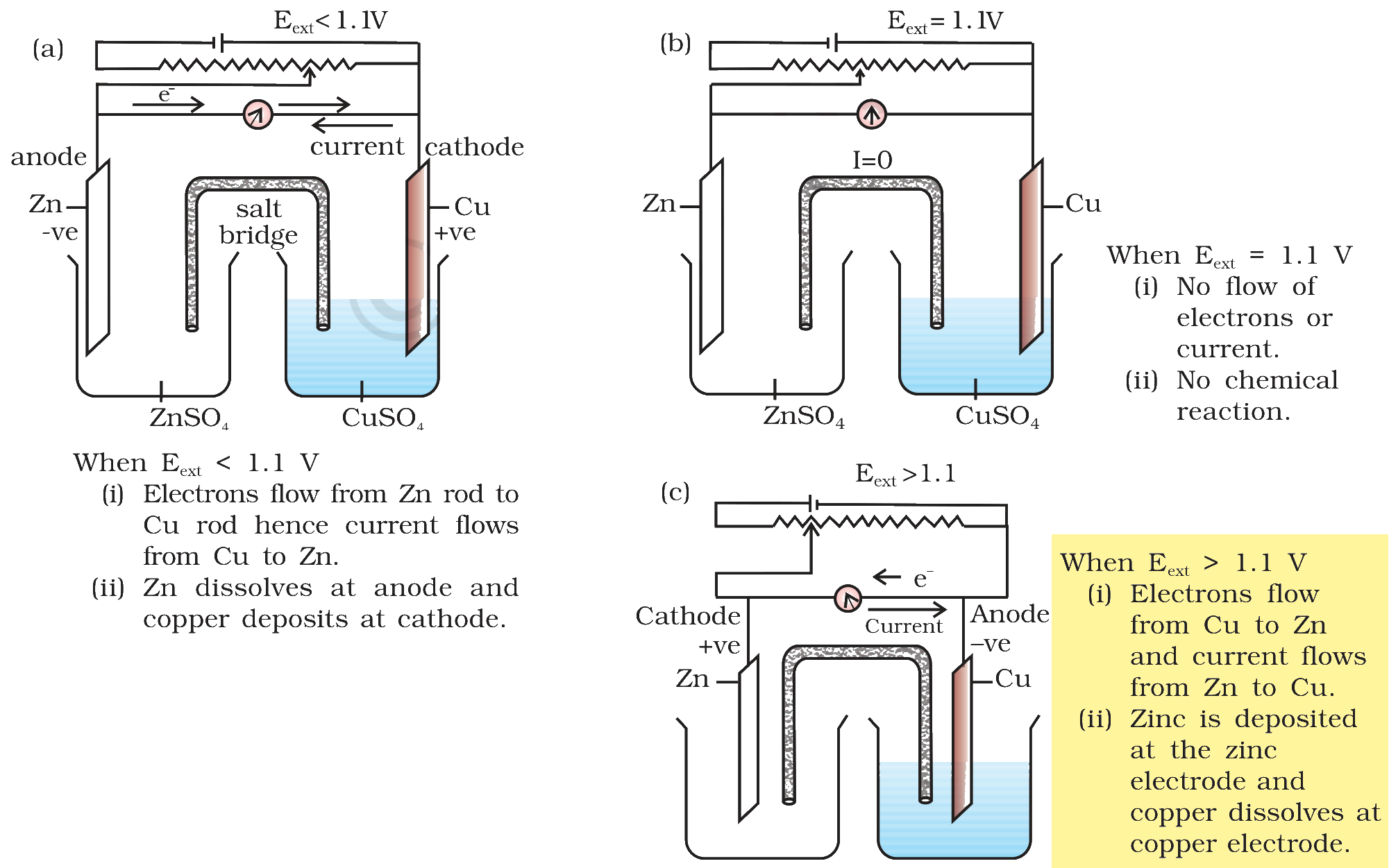
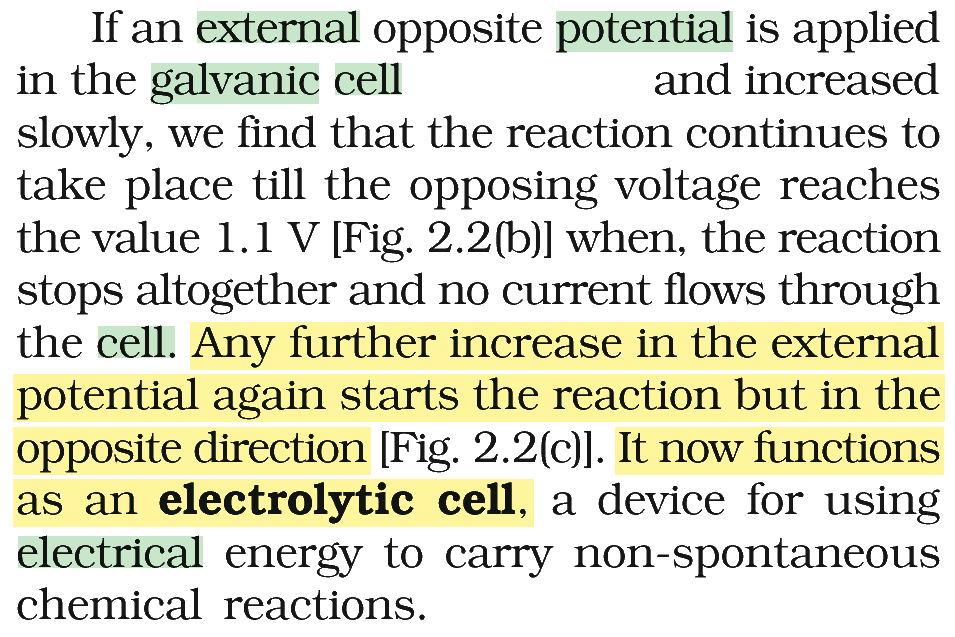
If an opposing external potential greater than 1.1 V is applied, the current flows in the opposite direction and the reaction is reversed: zinc is deposited at the zinc electrode and copper dissolves at the copper electrode.

    \( \displaystyle \text{Zn electrode (now the cathode): }\ce{Zn^2+(aq) + 2e^- -> Zn(s)} \)

    \( \displaystyle \text{Cu electrode (now the anode): }\ce{Cu(s) -> Cu^2+(aq) + 2e^-} \)

    \( \displaystyle \text{Cell reaction: }\ce{Zn^2+(aq) + Cu(s) -> Zn(s) + Cu^2+(aq)} \)

Now electrical energy from outside drives a non-spontaneous reaction. So the cell converts to an electrolytic cell.

Why the other options are incorrect

  • Option (1) stops working as no current flows through it — Incorrect. This happens only when the external potential is equal to 1.1 V.

  • Option (2) works longer as an electrochemical cell — Incorrect. Above 1.1 V the cell no longer works as a galvanic cell at all; its reaction is reversed.

  • Option (4) carry out spontaneous reaction at double rate — Incorrect. The original spontaneous reaction stops; the reaction that now runs is non-spontaneous and is driven by the external source.

NCERT (2026-27 edition):
Electrochemical Cells – …
Textbook extract

Textbook figure

Advertisement

Practise more on Physical: Electro Chemistry

Chapter-wise mocks on the real NTA exam screen, with solutions and your rank. Your first mocks are free.

Start free mocks →

Advertisement

Next questions

  1. Four numbers are given out of which three are alike in some manner while one is different. Choose the combination which follows the same pa…General Aptitude Test · Verbal Reasoning
  2. Which of the following has revolutionised the urban transport system in India?Geography · India-People and Economy: Transport and Communcation
  3. Which Indian Union Territory spreads in more than one state?General Aptitude Test · General Knowledge
  4. Four resistors, AB = 2 Ω, BC = 3 Ω, CD = 2 Ω, and DA = 3 Ω are connected in the form of a closed loop. A current of 2 A is flowing through…Physics · Current Electricity
  5. Read the given passage carefully and organise the following options in the chronological order of their occurrence.(A) The rendering of lan…English · Comprehension - (Narrative / Factual)
  6. ∫(x-1)/(x(x-log x))dx equals :( consider: log x=log_e x )Applied Maths. Section B2 · Calculus
  7. On Bearer debentures, Interest is paid to a person who produces the ................ attached to such debentures?Accountancy Part A · Issue and Redemption of Debentures
  8. In Δ ABC , Which of the following are True?(A) AB+BC+CA=0 (B) AB+BC-AC=0 (C) AB+BC-CA=0 (D) AB-CB+CA=0 Choose the correct answer from the o…Maths. Section B1 · Vectors
  9. The _______ leads to the creation of an organisational structure which includes the designing of roles to be filled by suitably skilled peo…Business Studies · Organising
  10. If m and n are the order and degree of the differential equation 9(d^3y)/(dx^3)=≤ft1+≤ft(displaystyledy/dx)^2^5/2 , then the value of 2m+3n…Applied Maths. Section B2 · Calculus