
In \( \Delta ABC \), Which of the following are True?
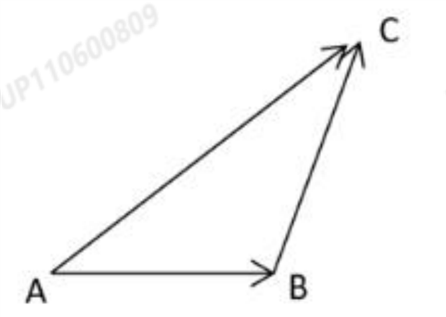
(A) \( \overrightarrow{AB}+\overrightarrow{BC}+\overrightarrow{CA}=\vec{0} \)
(B) \( \overrightarrow{AB}+\overrightarrow{BC}-\overrightarrow{AC}=\vec{0} \)
(C) \( \overrightarrow{AB}+\overrightarrow{BC}-\overrightarrow{CA}=\vec{0} \)
(D) \( \overrightarrow{AB}-\overrightarrow{CB}+\overrightarrow{CA}=\vec{0} \)
Choose the correct answer from the options given below:
Answer & explanation
Correct answer: option 1
The correct answer is Option (1) → (A), (B) and (D) only
By the triangle law of vector addition,
\( \displaystyle \overrightarrow{AB}+\overrightarrow{BC}=\overrightarrow{AC} \)
Reversing a vector changes its sign:
\( \displaystyle \overrightarrow{CA}=-\overrightarrow{AC} \)
\( \displaystyle \overrightarrow{CB}=-\overrightarrow{BC} \)
So \( \overrightarrow{AB}+\overrightarrow{BC}=\overrightarrow{AC} \), \( \overrightarrow{CA}=-\overrightarrow{AC} \) and \( -\overrightarrow{CB}=\overrightarrow{BC} \).
Checking the statements
(A) \( \overrightarrow{AB}+\overrightarrow{BC}+\overrightarrow{CA}=\vec{0} \) — Correct. The sum is \( \overrightarrow{AC}+\overrightarrow{CA}=\overrightarrow{AC}-\overrightarrow{AC}=\vec{0} \).
(B) \( \overrightarrow{AB}+\overrightarrow{BC}-\overrightarrow{AC}=\vec{0} \) — Correct. The sum is \( \overrightarrow{AC}-\overrightarrow{AC}=\vec{0} \).
(C) \( \overrightarrow{AB}+\overrightarrow{BC}-\overrightarrow{CA}=\vec{0} \) — Incorrect. The sum is \( \overrightarrow{AC}+\overrightarrow{AC}=2\overrightarrow{AC}\ne\vec{0} \).
(D) \( \overrightarrow{AB}-\overrightarrow{CB}+\overrightarrow{CA}=\vec{0} \) — Correct. With \( -\overrightarrow{CB}=\overrightarrow{BC} \) it is \( \overrightarrow{AB}+\overrightarrow{BC}+\overrightarrow{CA}=\vec{0} \).