Match the LIST-I with LIST-II.
| LIST-I (Complex ions) | LIST-II (Magnetic Moment) |
| (A) [Fe(H2O)6]2+ | (I) 2.84 BM |
| (B) [Mn(H2O)6]2+ | (II) 3.87 BM |
| (C) [Ni(H2O)6]2+ | (III) 4.90 BM |
| (D) [Co(H2O)6]2+ | (IV) 5.92 BM |
Choose the correct answer from the options given below:
Answer & explanation
Correct answer: option 3
The correct answer is Option (3) → (A) - (III), (B) - (IV), (C) - (I), (D) - (II)
The spin-only magnetic moment depends on the number of unpaired electrons (n):
\( \displaystyle \mu=\sqrt{n(n+2)}\ \mathrm{BM} \)
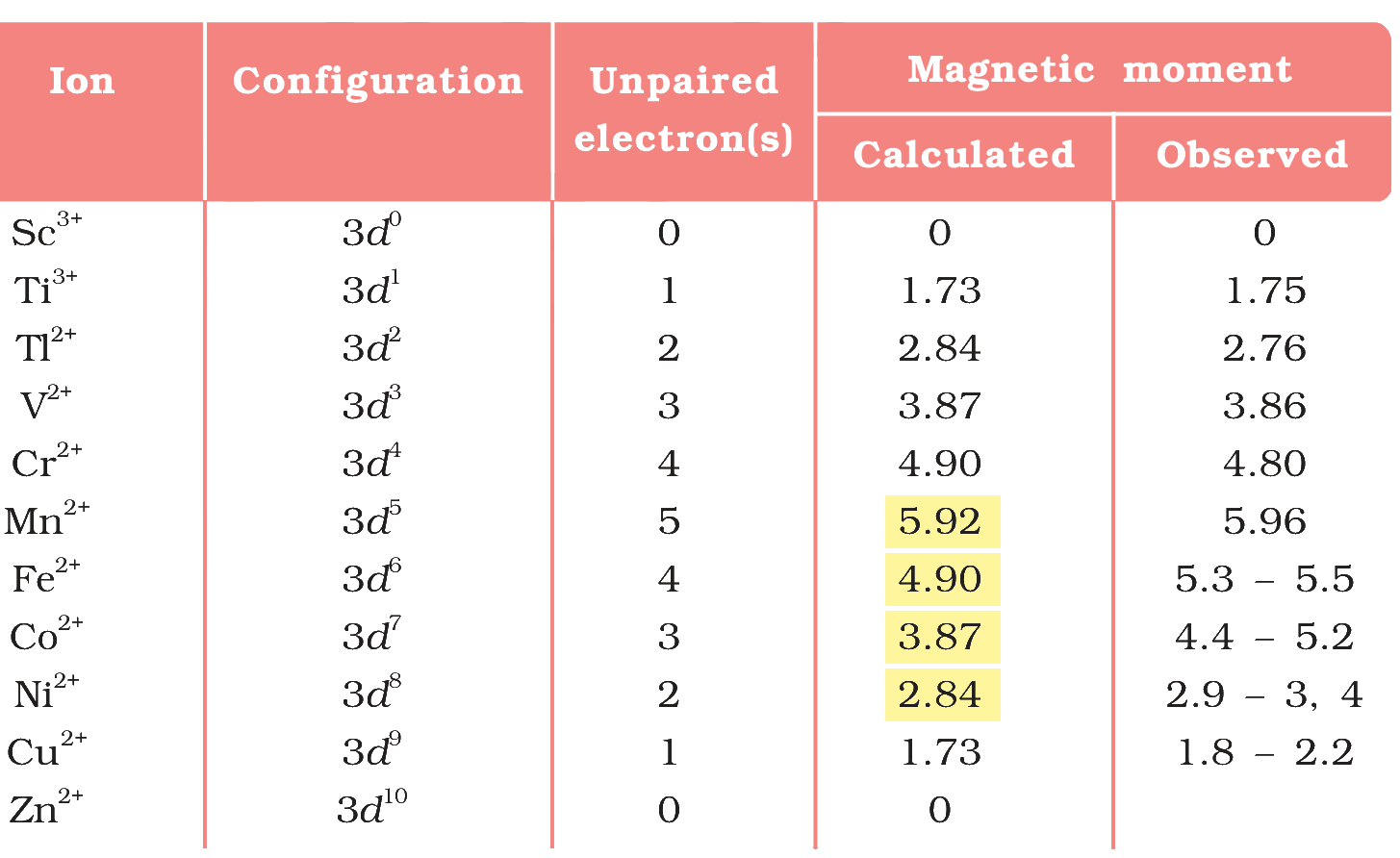
n = 1: 1.73 BM, n = 2: 2.84 BM, n = 3: 3.87 BM, n = 4: 4.90 BM, n = 5: 5.92 BM
All four complexes carry the M2+ ion and H2O, a weak field ligand, so no pairing is forced: the electrons occupy the five 3d orbitals by Hund’s rule (singly first, pairing only after every orbital has one). An M2+ ion is formed by removing the two 4s electrons.
(A) \( \ce{[Fe(H2O)6]^{2+}} \) — This matches (III) 4.90 BM. Fe (Z = 26) is [Ar]3d64s2; \( \ce{Fe^{2+}} \) is 3d6: ↑↓ ↑ ↑ ↑ ↑ gives n = 4, μ = √24 = 4.90 BM.
(B) \( \ce{[Mn(H2O)6]^{2+}} \) — This matches (IV) 5.92 BM. Mn (Z = 25) is [Ar]3d54s2; \( \ce{Mn^{2+}} \) is 3d5: ↑ ↑ ↑ ↑ ↑ gives n = 5, μ = √35 = 5.92 BM.
(C) \( \ce{[Ni(H2O)6]^{2+}} \) — This matches (I) 2.84 BM. Ni (Z = 28) is [Ar]3d84s2; \( \ce{Ni^{2+}} \) is 3d8: ↑↓ ↑↓ ↑↓ ↑ ↑ gives n = 2, μ = √8 = 2.84 BM.
(D) \( \ce{[Co(H2O)6]^{2+}} \) — This matches (II) 3.87 BM. Co (Z = 27) is [Ar]3d74s2; \( \ce{Co^{2+}} \) is 3d7: ↑↓ ↑↓ ↑ ↑ ↑ gives n = 3, μ = √15 = 3.87 BM.
Shortcut: (B)–(IV) and (C)–(I) together appear only in Option (3).
Note: The NCERT table below (Table 4.7) prints Tl2+ where it should read Ti2+ (3d2), and the observed moment of Ni2+ as 2.9 – 3, 4 where it should read 2.9 – 3.4.
NCERT (2026-27 edition):
Magnetic Properties – …