
CUETMOCK
  • Pricing
  • Mentors
Log inStart freeStart free mocks→

First test, then trust

Try a free CUET mock test.

Join 5,00,000+ students who rehearsed exam day on the exact NTA screen before sitting CUET. On the web and on Android.

Start free mocks →Get the Android app
CUETMOCK

India's #1 CUET Mock Test Platform. Original NCERT-based questions on the exact NTA exam screen — trusted by 5,00,000+ students since CUET 2022.

Get it onGoogle PlayScan to download the CUETMOCK app

Mock tests

  • CUET mock test series
  • Commerce mocks
  • Humanities (Arts) mocks
  • Science mocks
  • Languages & GAT mocks
  • Free practice questions
  • Pricing

Resources

  • CUET exam guide
  • CUET syllabus
  • Universities accepting CUET
  • Expert blogs
  • News & notifications
  • Webinars & counselling
  • CUET score calculator
  • How we estimate your rank
  • FAQs

Company

  • About us
  • Our leadership & team
  • Our toppers
  • Mentors
  • For schools
  • Contact us
  • Terms
  • Privacy
  • Refund policy

Talk to us

+91 7696 6630 56info@cuetmock.comWhatsApp us

Our other platforms

  • JEE Mock — For IIT-JEE aspirants
  • NEET Mock — For NEET aspirants

Newsletter

Exam updates, study material and offers — no spam.

© 2026 NYC Ventures Pvt. Ltd.

701-702, Royal Business Park, Zirakpur, Punjab - 140603

  • Terms of use
  • Privacy policy
  • Refund policy
  • Contact us

iCUETMOCK is an independent preparation platform, not affiliated with the National Testing Agency (NTA). Always check exam details on the official NTA website.

  • Home
  • Mock tests
  • CUET guide
  • Pricing
  • Log in
Home/Practice questions/Chemistry
ChemistryOrganic: Alcohols, Phenols and Ethers

The structures of Compound A and Compound B, respectively are

Aspirin is a commonly used non-steroidal anti-inflammatory drug which reduces fever, relieves mild pain and decreases swelling. It is prepared by numerous synthetic methods; of which the acetylation of Compound A with acetyl chloride is one of the easiest methods. However, Compound A itself needs to be prepared from Compound B under basic conditions by using carbon dioxide as a reagent. Interestingly, Compound B along with Compound C can be obtained by the air oxidation of Compound D. Compound C is a commonly used industrial solvent and gives a positive iodoform test and a negative Tollen’s test. Compound C easily forms 2,4-DNP derivative (Compound E). Compound C on reaction with Ba(OH)2 under heating conditions produces Compound F whose molecular formula is C6H10O.

The structures of Compound A and Compound B, respectively are

Answer & explanation+

Correct answer: option 1

The correct answer is Option (1) → salicylic acid (Compound A) and phenol (Compound B)

The passage describes a chain of reactions leading to aspirin:

  • Aspirin is made by acetylating Compound A, so A is salicylic acid (2-hydroxybenzoic acid).

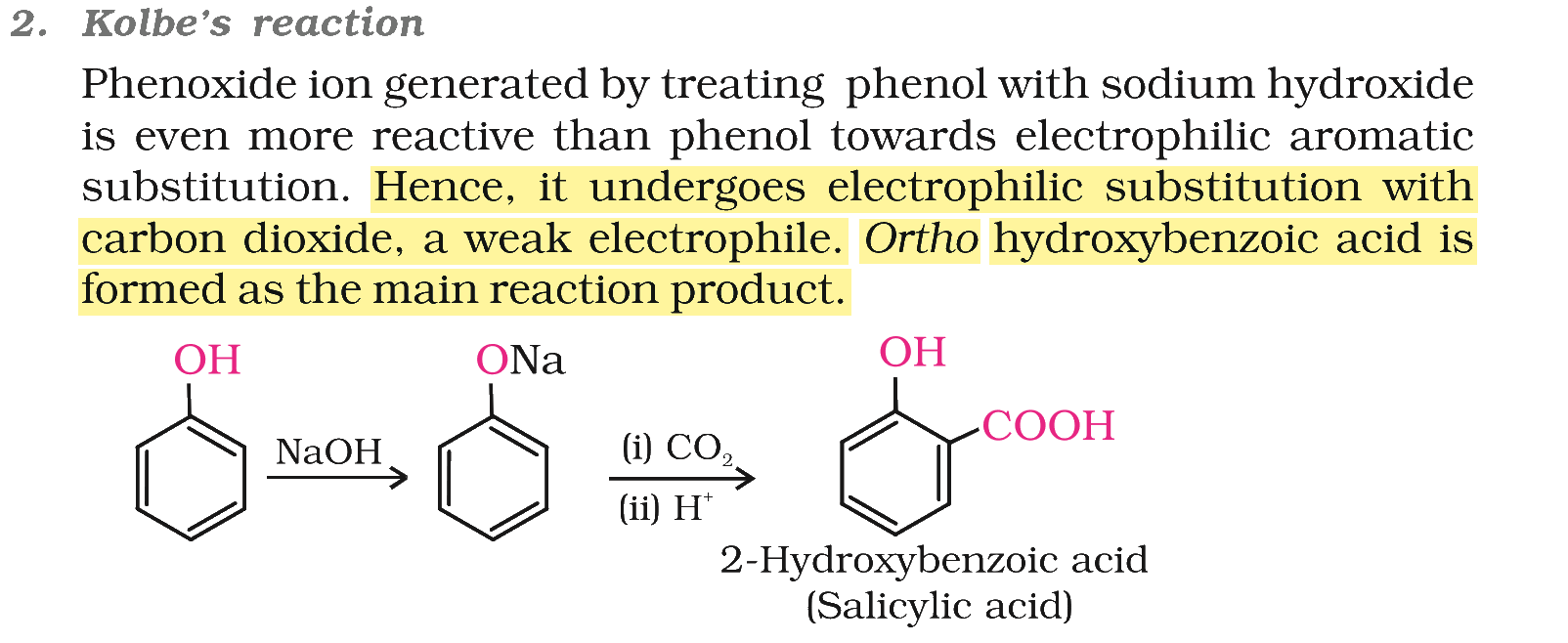
  • A is made from Compound B under basic conditions with carbon dioxide. This is the Kolbe reaction: sodium phenoxide reacts with \( \ce{CO2} \), and acidification gives salicylic acid. So B is phenol.

    \( \displaystyle \ce{C6H5OH} \xrightarrow{\ce{NaOH}} \ce{C6H5ONa} \xrightarrow[\text{(ii) }\ce{H+}]{\text{(i) }\ce{CO2}} \ce{2-HOC6H4COOH} \)

The phenoxide ion is even more reactive than phenol towards electrophiles, so it reacts with the weak electrophile \( \ce{CO2} \), mainly at the ortho position. So A is salicylic acid and B is phenol.

Why the other options are incorrect

  • Option (2) phenol (A) and salicylic acid (B) — Incorrect. The two compounds are the right ones but in reverse order; phenol is the starting material and salicylic acid is the product acetylated to aspirin.

  • Option (3) phenol (A) and salicylaldehyde (B) — Incorrect. Salicylaldehyde is formed from phenol with \( \ce{CHCl3} \) and NaOH (Reimer–Tiemann reaction), not with \( \ce{CO2} \), and phenol is not acetylated to aspirin.

        \( \displaystyle \ce{C6H5OH} \xrightarrow[\text{(ii) }\ce{H+}]{\text{(i) }\ce{CHCl3}\text{, aq. NaOH}} \ce{2-HOC6H4CHO} \)

  • Option (4) salicylaldehyde (A) and phenol (B) — Incorrect. Acetylating salicylaldehyde would give an aldehyde, not aspirin, and the \( \ce{CO2} \) reaction gives an acid, not an aldehyde.

NCERT (2026-27 edition):
Kolbe’s Reaction
Textbook extract

Advertisement

Practise more on Organic: Alcohols, Phenols and Ethers

Chapter-wise mocks on the real NTA exam screen, with solutions and your rank. Your first mocks are free.

Start free mocks →

Advertisement

Next questions

  1. -OH group at which carbon center of glucose form a pyranose ring structure?Chemistry · Organic: Biomolecules
  2. The final product in the following reaction isChemistry · Organic: Alcohols, Phenols and Ethers
  3. The median of class frequency distribution is:Class:0 – 2525 – 5050 – 7575 – 100TotalFrequency:2532151688General Aptitude Test · Numerical Ability
  4. Under fluctuating capital method,(A) Only one account, i.e., a capital account is maintained for each partner(B) All the adjustments such a…Accountancy Part A · Accounting for Partnership
  5. If K and U represent kinetic and potential energies of an electron in an orbit of a hydrogen atom, thenPhysics · Atoms
  6. Match List-I with List-IIList-IList-II(Philosophies of Marketing Management)(Description)(A) The Production Concept(I) The basic role of a…Business Studies · Marketing
  7. Match the idioms given in List-I with their meanings given in List-II.LIST-IIdiomsLIST-IIMeaningA. Take something at face valueI. To take s…English · Grammar: Idioms
  8. Choose the appropriate word from the options given below to complete the following sentence:The Public Inquiry ___________ him from all bla…English · Fill Blanks
  9. Two dice are thrown simultaneously. If X denotes the number of sixes, then the mean of X is:Applied Maths. Section B2 · Probability Distributions
  10. Who compiled Baba Guru Nanak’s hymns along with those of his four successors and other religious poets?History · Medieval India: Bhakti Sufi Traditions