-OH group at which carbon center of glucose form a pyranose ring structure?
Answer & explanation
Correct answer: option 4
The correct answer is Option (4) → C5
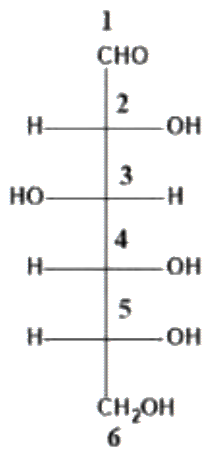
In the cyclic structure of glucose, an –OH group inside the same molecule adds to the –CHO group and forms a cyclic hemiacetal. In glucose it is the –OH group at C5 that adds to C1:
The ring contains C1, C2, C3, C4, C5 and the ring oxygen, so it is six-membered.
A six-membered ring with one oxygen is similar to pyran, so this form is called the pyranose structure.
C1 becomes a new chiral centre, which gives the two cyclic forms, α-D-glucopyranose and β-D-glucopyranose (the anomers).
So the pyranose ring is formed by the –OH group at C5.
Why the other options are incorrect
Option (1) C6 — Incorrect. Using the C6 –OH would give a seven-membered ring; in the pyranose form C6 stays outside the ring as –\( \ce{CH2OH} \).
Option (2) C4 — Incorrect. Using the C4 –OH would give a five-membered (furanose-type) ring, not a pyranose ring.
Option (3) C3 — Incorrect. Using the C3 –OH would give a strained four-membered ring, which does not form.
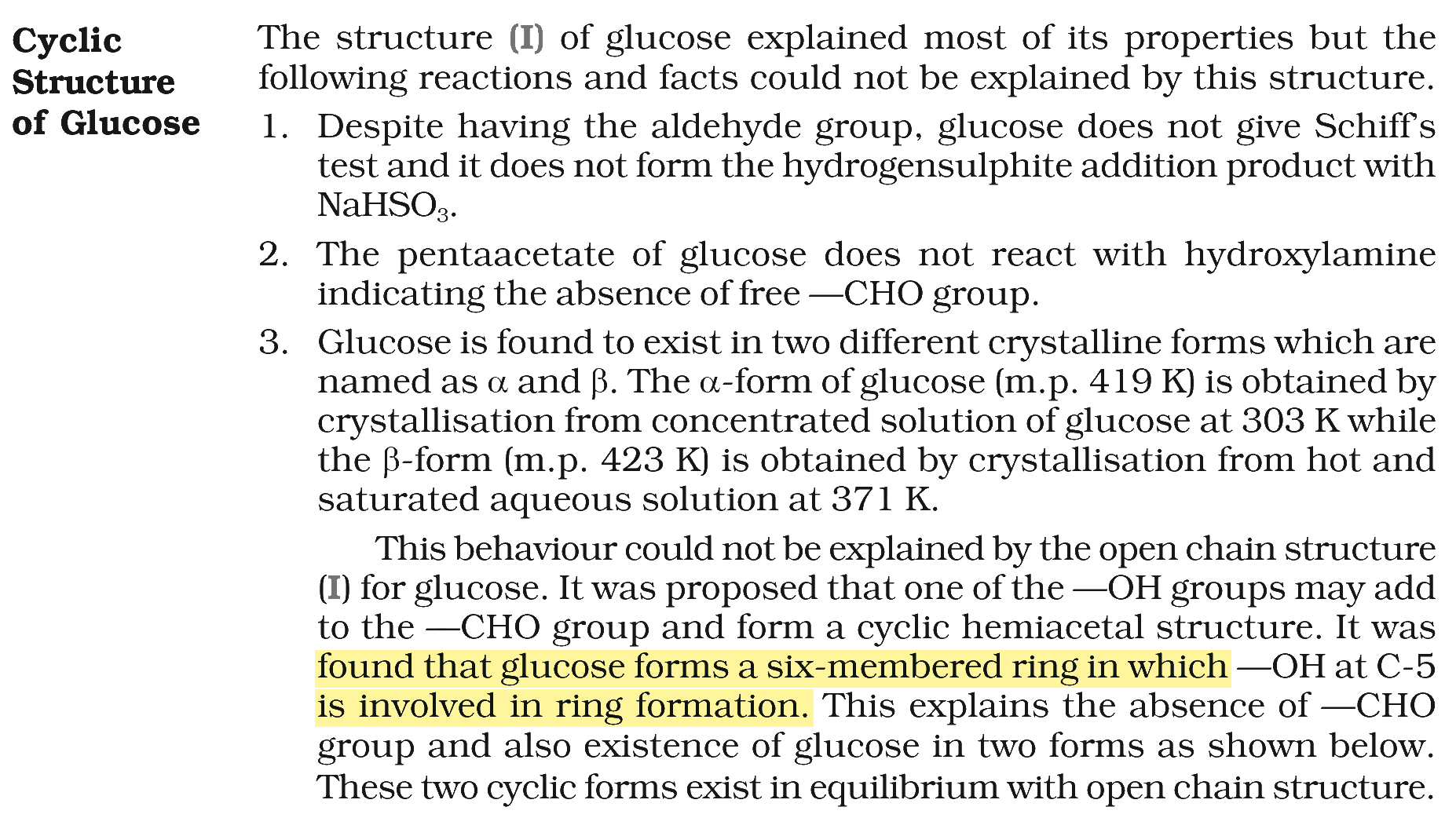
NCERT (2026-27 edition):
Cyclic Structure of Glucose