CUETMOCK
  • Pricing
  • Mentors
Log inStart freeStart free mocks→

First test, then trust

Try a free CUET mock test.

Join 5,00,000+ students who rehearsed exam day on the exact NTA screen before sitting CUET. On the web and on Android.

Start free mocks →Get the Android app
CUETMOCK

India's #1 CUET Mock Test Platform. Original NCERT-based questions on the exact NTA exam screen — trusted by 5,00,000+ students since CUET 2022.

Get it onGoogle PlayScan to download the CUETMOCK app

Mock tests

  • CUET mock test series
  • Browse all papers
  • Commerce mocks
  • Humanities (Arts) mocks
  • Science mocks
  • Languages & GAT mocks
  • Free practice questions
  • Pricing

Resources

  • CUET exam guide
  • CUET syllabus
  • Universities accepting CUET
  • Expert blogs
  • News & notifications
  • Webinars & counselling
  • CUET score calculator
  • How we estimate your rank
  • FAQs

Company

  • About us
  • Our leadership & team
  • Our toppers
  • Mentors
  • For schools
  • Contact us
  • Terms
  • Privacy
  • Refund policy

Talk to us

+91 7696 6630 56info@cuetmock.comWhatsApp us

Our other platforms

  • JEE Mock — For IIT-JEE aspirants
  • NEET Mock — For NEET aspirants

Newsletter

Exam updates, study material and offers — no spam.

© 2026 NYC Ventures Pvt. Ltd.

701-702, Royal Business Park, Zirakpur, Punjab - 140603

  • Terms of use
  • Privacy policy
  • Refund policy
  • Contact us

iCUETMOCK is an independent preparation platform, not affiliated with the National Testing Agency (NTA). Always check exam details on the official NTA website.

  • Home
  • Mock tests
  • CUET guide
  • Pricing
  • Log in
Home/Practice questions/History
HistoryModern India: Framing the Constitution

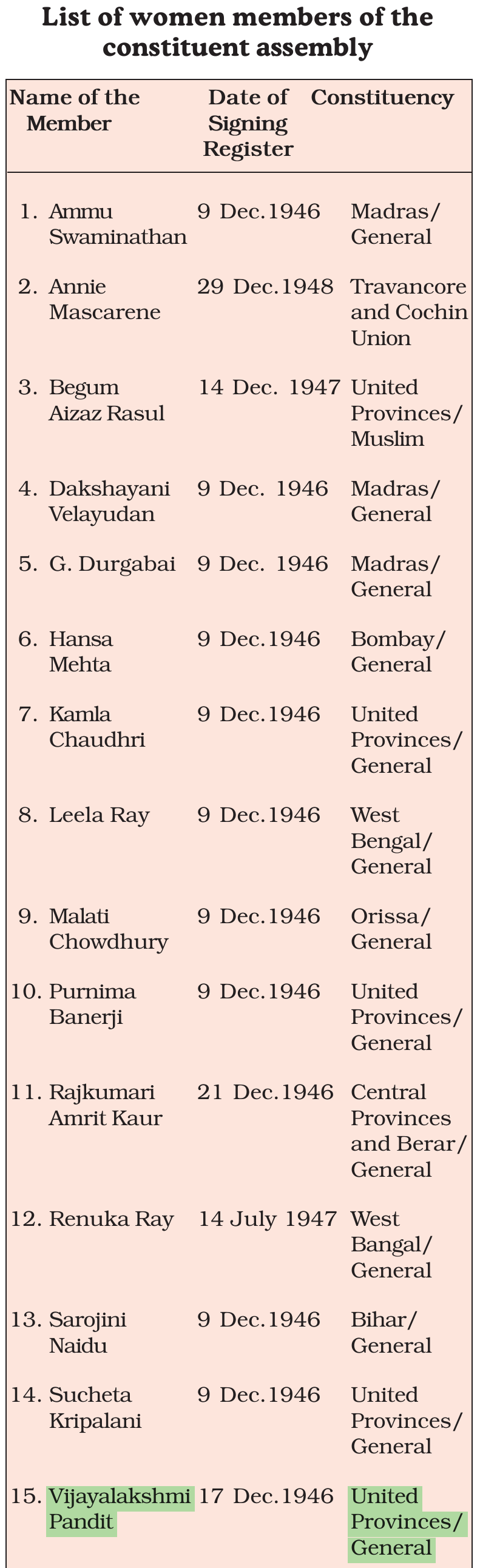
Which woman member belonged to the United Provinces constituency?

Read the passage and answer the questions:

Constituent Assembly

The Constituent Assembly had 300 members. Of these, six members played particularly important roles. Three were representatives of the Congress, namely, Jawaharlal Nehru, Vallabh Bhai Patel and Rajendra Prasad. It was Nehru who moved the crucial “Objectives Resolution”, as well as the resolution proposing that the National Flag of India be a “horizontal tricolour of saffron, white and dark green in equal proportion”, with a wheel in navy blue at the centre. Patel, on the other hand, worked mostly behind the scenes, playing a key role in the drafting of several reports, and working to reconcile opposing points of view. Rajendra Prasad’s role was as President of the Assembly, where he had to steer the discussion along constructive lines while making sure all members had a chance to speak. Besides this Congress trio, a very important member of the Assembly was the lawyer and economist B.R. Ambedkar. During the period of British rule, Ambedkar had been a political opponent of the Congress; but, on the advice of Mahatma Gandhi, he was asked at Independence to join the Union Cabinet as law minister. In this capacity, he served as Chairman of the Drafting Committee of the Constitution. Serving with him were two other lawyers, K.M. Munshi from Gujarat and Alladi Krishnaswamy Aiyar from Madras, both of whom gave crucial inputs in the drafting of the Constitution. These six members were given vital assistance by two civil servants. One was B. N. Rau, Constitutional Advisor to the Government of India, who prepared a series of background papers based on a close study of the political systems obtaining in other countries. The other was the Chief Draughtsman, S. N. Mukherjee, who had the ability to put complex proposals in clear legal language. Ambedkar himself had the responsibility of guiding the Draft Constitution through the Assembly.

Which woman member belonged to the United Provinces constituency?

Answer & explanation+

Correct answer: option 4

The correct answer is Option (4) → Vijayalakshmi Pandit

Fifteen women were members of the Constituent Assembly. Vijayalakshmi Pandit represented the United Provinces (General), and signed the register on 17 December 1946. Of the other three, G. Durgabai came from Madras, Hansa Mehta from Bombay and Sarojini Naidu from Bihar.

Note: This passage is taken from the NCERT chapter ‘Framing the Constitution’, almost word for word, but the answer to this question is not in the passage: it comes from the list of women members of the Constituent Assembly, printed in the same chapter. Lists and tables inside a chapter are part of the syllabus too; give them the same attention as the text.


NCERT: Themes in Indian History Part III — Chapter 12: Framing the Constitution (2025-26)

NCERT extract

Advertisement

Practise more on Modern India: Framing the Constitution

Chapter-wise mocks on the real NTA exam screen, with solutions and your rank. Your first mocks are free.

Start free mocks →

Advertisement

Next questions

  1. “Tha’mma! I shouted.” The narrator shouted—English · Comprehension - (Narrative / Factual)
  2. Which among the following statements is not true about ‘Bodhisattas’?History · Ancient India: Thinkers, Beliefs and Buildings
  3. Which one of the following regions is not a part of transcription unit ?Biology · Molecular Basis of Inheritance
  4. Choose the correct sequence of financial statements prepared for a partnership firm at the end of a financial year.A. Capital AccountsB. Pr…Accountancy Part A · Accounting for Partnership
  5. Given below are five figures marked A, B, C, D and E. Select the option where when three of the given figures are fitted together, they wil…General Aptitude Test · Non-Verbal Reasoning
  6. Let the corner points of the bounded feasible region of an LPP determined by a set of constraints are A(1, 5), B(3, 2) and C(2, 1). If the…Maths. Section B1 · Linear Programming
  7. Leydig cells are present in -Biology · Human Reproduction
  8. Which one of the following evolutionary stages of human has brain capacity between 650-800cc?Biology · Evolution
  9. Identify the proliferative phase.Biology · Human Reproduction
  10. Which of the following is a secondary battery ?Chemistry · Physical: Electro Chemistry