Which of the following is a secondary battery ?
Answer & explanation
Correct answer: option 3
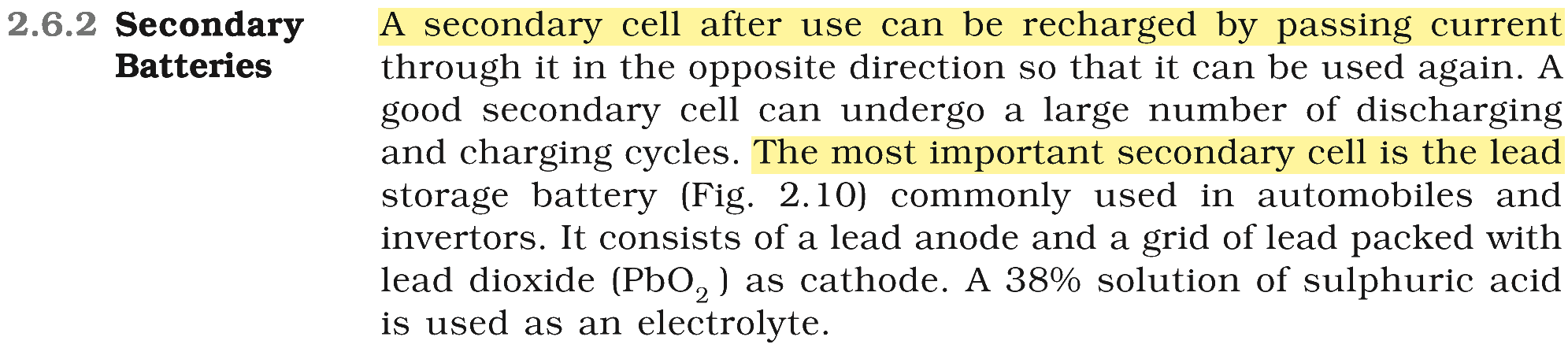
The correct answer is Option (3) → Lead storage battery
A primary battery works only once: its reaction cannot be reversed, so the dry (Leclanche) cell and the mercury cell are discarded when used up. A secondary battery can be recharged by passing current through it in the opposite direction.
In the lead storage battery the reactions on discharge are:
\( \displaystyle \text{Anode: }\ce{Pb(s) + SO4^{2-}(aq) -> PbSO4(s) + 2e^-} \)
\( \displaystyle \text{Cathode: }\ce{PbO2(s) + SO4^{2-}(aq) + 4H^+(aq) + 2e^- -> PbSO4(s) + 2H2O(l)} \)
\( \displaystyle \text{Cell reaction: }\ce{Pb(s) + PbO2(s) + 2H2SO4(aq) -> 2PbSO4(s) + 2H2O(l)} \)
On charging, this reaction is reversed and the \( \ce{PbSO4} \) on the electrodes is converted back into Pb and \( \ce{PbO2} \). So the lead storage battery is a secondary battery.
Why the other options are incorrect
Option (1) Leclanche cell — Incorrect. This is the ordinary dry cell (zinc anode, carbon rod cathode with \( \ce{MnO2} \)), a primary battery.
Option (2) Electrolytic cell — Incorrect. It is not a battery at all; it uses electrical energy to drive a non-spontaneous reaction.
Option (4) Mercury cell — Incorrect. Used in hearing aids and watches, it gives a constant 1.35 V but is a primary battery.
NCERT (2026-27 edition):
Secondary Batteries