Decomposition of humus by microbes is known as -
Answer & explanation
Correct answer: option 4
The correct answer is Option (4) → Mineralisation
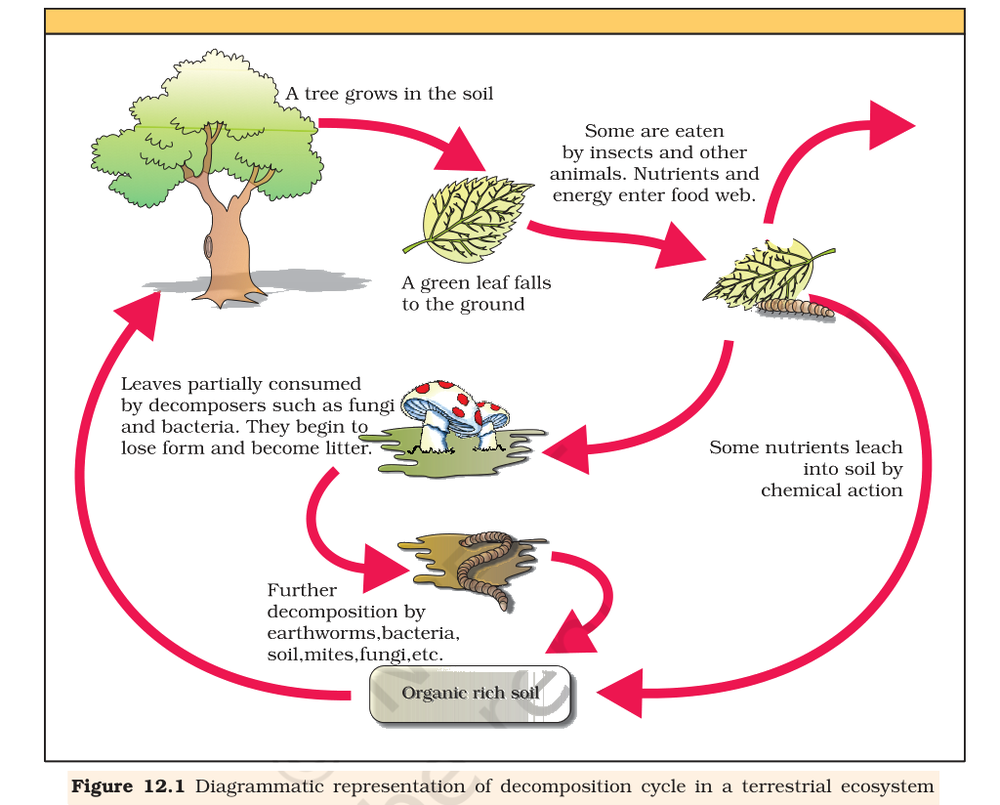
Decomposition of dead matter (detritus) goes through five steps: fragmentation, leaching, catabolism, humification and mineralisation. All of them go on together.
(1) Leaching — Incorrect. Water-soluble inorganic nutrients move down into the soil and are held there as unavailable salts.
(2) Humification — Incorrect. It is the formation of humus, a dark-coloured, shapeless substance that resists microbial action and breaks down very slowly. It is the step that makes humus, not the one that breaks it down.
(3) Fragmentation — Incorrect. Detritivores such as earthworms break the detritus into smaller pieces.
(4) Mineralisation — Correct. Some microbes slowly degrade the humus and release inorganic nutrients such as nitrogen and phosphorus into the soil.
NCERT Extract:
Decomposition – “… Humification and mineralisation occur during decomposition in the soil. Humification leads to accumulation of a dark coloured amorphous substance called humus that is highly resistant to microbial action and undergoes decomposition at an extremely slow rate. Being colloidal in nature it serves as a reservoir of nutrients. The humus is further degraded by some microbes and release of inorganic nutrients occur by the process known as mineralisation.”