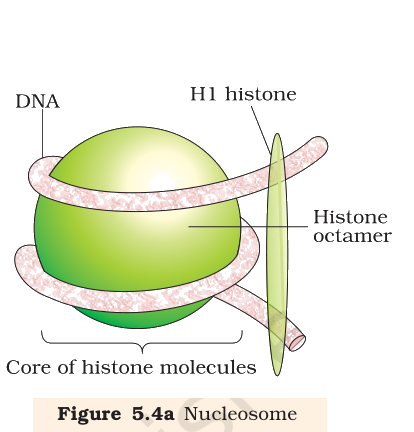
The negatively charged DNA is wrapped around the positively charged histone octamer to form a structure called:
Answer & explanation
Correct answer: option 3
The correct answer is Option (3) → Nucleosome
Histones are proteins rich in the basic amino acids lysine and arginine, so they carry a positive charge. Eight histone molecules form a histone octamer. The negatively charged DNA wraps around it, because opposite charges attract.
(1) Nucleolus — Incorrect. The nucleolus is a dense body inside the nucleus where rRNA is made. It is not formed by DNA wrapping around histones.
(2) Chromatid — Incorrect. A chromatid is one of the two identical halves of a replicated chromosome, joined at the centromere.
(3) Nucleosome — Correct. The unit of DNA wrapped around a histone octamer is the nucleosome. A typical nucleosome has 200 bp of DNA.
(4) Chromatin — Incorrect. Chromatin is the larger structure built of many nucleosomes, seen as ‘beads-on-string’ under the electron microscope. The nucleosome is its repeating unit.
Note: A similar question was also asked in CUET (UG) 2026 on 19-05-2026 (Slot 2), and in CUET (UG) 2025 on 23-05-2025 (Slot 2).
NCERT Extract:
Packaging of DNA Helix – “… There is a set of positively charged, basic proteins called histones. A protein acquires charge depending upon the abundance of amino acids residues with charged side chains. Histones are rich in the basic amino acid residues lysine and arginine. Both the amino acid residues carry positive charges in their side chains. Histones are organised to form a unit of eight molecules called histone octamer. The negatively charged DNA is wrapped around the positively charged histone octamer to form a structure called nucleosome (Figure 5.4 a). A typical nucleosome contains 200 bp of DNA helix. Nucleosomes constitute the repeating unit of a structure in nucleus called chromatin, thread- like stained (coloured) bodies seen in nucleus.”