
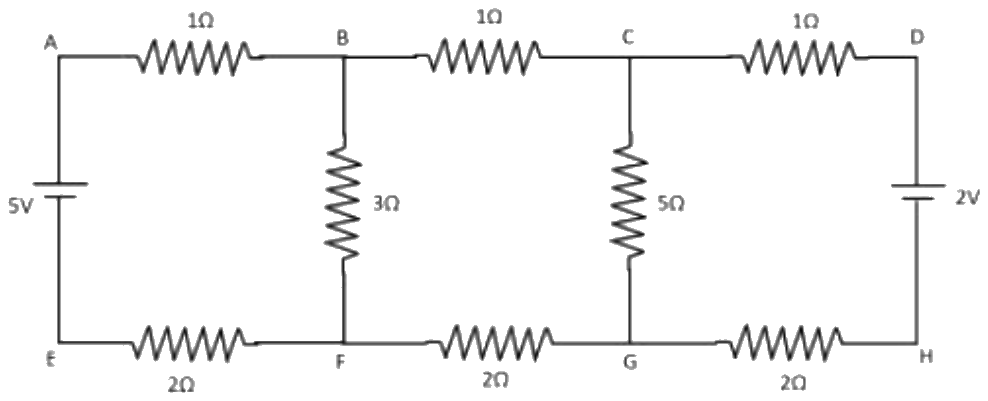
In the network of resistors in the circuit given below, the current flowing through \( 5\ \Omega \) resistor is:
Answer & explanation
Correct answer: option 2
The correct answer is Option (2) → \( (11/34)\ \mathrm{A} \)
Apply Kirchhoff’s loop rule with mesh currents. Reading the cell symbols (longer plate positive), the \( 5\ \mathrm{V} \) cell has its positive terminal at A and the \( 2\ \mathrm{V} \) cell has its positive terminal at D.
Take clockwise mesh currents \( i_{1} \) in ABFE, \( i_{2} \) in BCGF and \( i_{3} \) in CDHG. The \( 3\ \Omega \) resistor (BF) is shared by meshes 1 and 2, and the \( 5\ \Omega \) resistor (CG) by meshes 2 and 3.
Mesh ABFE (\( 1 + 3 + 2 = 6\ \Omega \); the 5 V cell drives clockwise):
\( 6i_{1} - 3i_{2} = 5 \)
Mesh BCGF (\( 1 + 5 + 2 + 3 = 11\ \Omega \); no cell):
\( -3i_{1} + 11i_{2} - 5i_{3} = 0 \)
Mesh CDHG (\( 1 + 2 + 5 = 8\ \Omega \); the 2 V cell opposes clockwise flow):
\( -5i_{2} + 8i_{3} = -2 \)
From the first and third equations:
\( \displaystyle i_{1} = \frac{5 + 3i_{2}}{6}, \quad i_{3} = \frac{5i_{2} - 2}{8} \)
Putting these into the second equation and multiplying by 8:
\( -4(5 + 3i_{2}) + 88i_{2} - (25i_{2} - 10) = 0 \)
\( 51i_{2} = 10 \)
\( \displaystyle i_{2} = \frac{10}{51}\ \mathrm{A}, \quad i_{3} = \frac{50/51 - 2}{8} = -\frac{13}{102}\ \mathrm{A} \)
Current in the \( 5\ \Omega \) resistor (from C to G):
\( \displaystyle I = i_{2} - i_{3} = \frac{20}{102} + \frac{13}{102} = \frac{33}{102} = \frac{11}{34}\ \mathrm{A} \)