People with IQ range of 20-25 find it difficult to manage their lives independently and require constant care, fall in the category of __________.
Answer & explanation
Correct answer: option 3
The correct answer is Option (3) → Profound Intellectual Disability
Intellectual disability has four levels, set by IQ: mild (IQs 55 to approximately 70), moderate (IQs 35-40 to approximately 50-55), severe (IQs 20-25 to approximately 35-40) and profound (IQs below 20-25). An IQ range of 20-25 lies at the lowest end of the scale.
Option (1) Mild Intellectual Disability — Incorrect. Mild disability starts only at an IQ of 55. Such people function quite independently, hold jobs and have families, so they do not need constant care.
Option (2) Moderate Intellectual Disability — Incorrect. Moderate disability covers IQs from 35-40 to 50-55. These people can be trained in self-care skills and simple social skills and need only a moderate degree of supervision.
Option (3) Profound Intellectual Disability — Correct. Profound disability is the level of IQs below 20-25, the lowest band. Individuals with profound disability are incapable of managing life and need constant care for their entire lives, as the question describes.
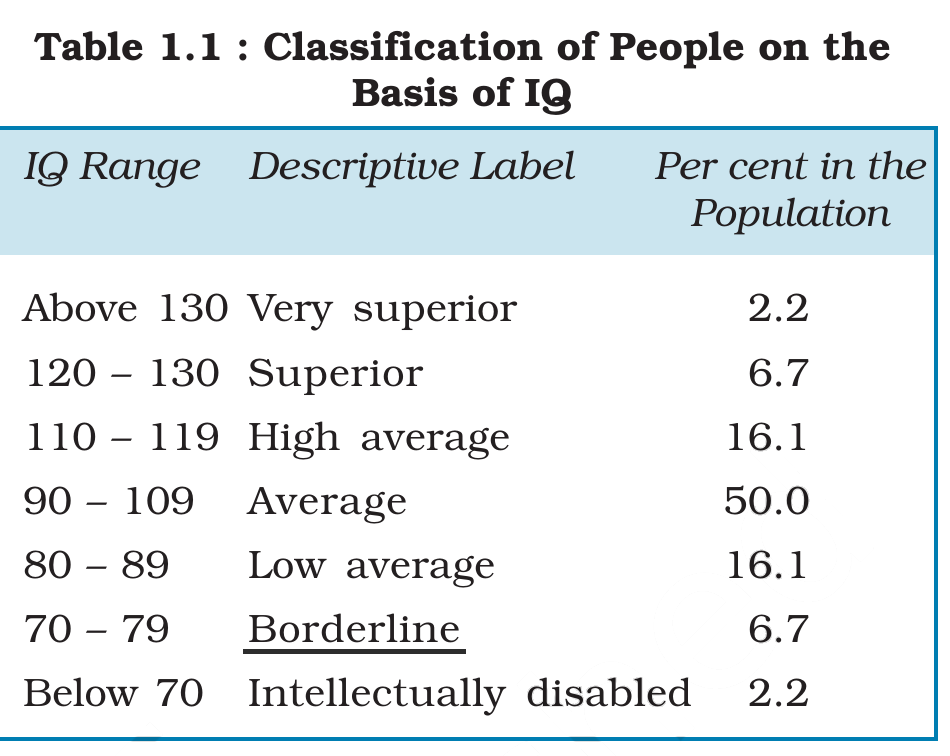
Option (4) Borderline Intelligence — Incorrect. ‘Borderline’ is the label for IQs of 70-79, just above the range of intellectual disability. Such a person manages daily life on her/his own.
Note: The original NTA paper printed Option (4) as ‘Severe Intellectual Disability’. NTA accepted it too, along with Option (3), because an IQ of 20-25 is the boundary between the two levels: it is the upper limit of profound disability (below 20-25) and the lower limit of severe disability (20-25 to 35-40), and people at both levels need constant care for their entire lives. To leave a single answer, Option (4) has been changed to ‘Borderline Intelligence’, for the benefit of students.
NCERT (2025-26): “Intellectual Deficiency … You have learnt earlier that the mean IQ score in the population is 100. These figures are used to understand the categories of intellectually disabled. The different levels of intellectual disability are: mild (IQs 55 to approximately 70), moderate (IQs 35–40 to approximately 50– 55), severe (IQs 20–25 to approximately 35–40), and profound (IQs below 20–25). Although the development of people with mild disability is typically slower than that of their peers, they can function quite independently, hold jobs and families. As the level of disability increases, the difficulties are strongly marked. The people with moderate disability lag behind their peers in language and motor skills. They can be trained in self-care skills, and simple social and communication skills. They need to have moderate degree of supervision in everyday tasks. Individuals with profound and severe disability are incapable of managing life and need constant care for their entire lives.…”
|