
CUETMOCK
  • Pricing
  • Mentors
Log inStart freeStart free mocks→

First test, then trust

Try a free CUET mock test.

Join 5,00,000+ students who rehearsed exam day on the exact NTA screen before sitting CUET. On the web and on Android.

Start free mocks →Get the Android app
CUETMOCK

India's #1 CUET Mock Test Platform. Original NCERT-based questions on the exact NTA exam screen — trusted by 5,00,000+ students since CUET 2022.

Get it onGoogle PlayScan to download the CUETMOCK app

Mock tests

  • CUET mock test series
  • Commerce mocks
  • Humanities (Arts) mocks
  • Science mocks
  • Languages & GAT mocks
  • Free practice questions
  • Pricing

Resources

  • CUET exam guide
  • CUET syllabus
  • Universities accepting CUET
  • Expert blogs
  • News & notifications
  • Webinars & counselling
  • CUET score calculator
  • How we estimate your rank
  • FAQs

Company

  • About us
  • Our leadership & team
  • Our toppers
  • Mentors
  • For schools
  • Contact us
  • Terms
  • Privacy
  • Refund policy

Talk to us

+91 7696 6630 56info@cuetmock.comWhatsApp us

Our other platforms

  • JEE Mock — For IIT-JEE aspirants
  • NEET Mock — For NEET aspirants

Newsletter

Exam updates, study material and offers — no spam.

© 2026 NYC Ventures Pvt. Ltd.

701-702, Royal Business Park, Zirakpur, Punjab - 140603

  • Terms of use
  • Privacy policy
  • Refund policy
  • Contact us

iCUETMOCK is an independent preparation platform, not affiliated with the National Testing Agency (NTA). Always check exam details on the official NTA website.

  • Home
  • Mock tests
  • CUET guide
  • Pricing
  • Log in
Home/Practice questions/Chemistry
ChemistryInorganic: D and F Block Elements

Match the LIST-I with LIST-II.LIST-ICompoundLIST-IIApplicationA. TiOI…

Match the LIST-I with LIST-II.

LIST-I
Compound
LIST-II
Application
A. TiOI. Oxidation of ethyne
B. MnO2II. Pigment Industry
C. TiCl4 and Al(CH3)3III. Dry battery cells
D. PdCl2IV. Polythene formation

Choose the correct answer from the options given below:

Answer & explanation+

Correct answer: option 2

The correct answer is Option (2) → A-II, B-III, C-IV, D-I

Transition metals and their compounds are useful in industry in two ways. Their variable oxidation states let them act as catalysts: they form an intermediate and then change back. Some also have a useful bulk property, such as colour or being easy to reduce. Each compound in the list is a standard example.

  • A. TiO — This matches II. Pigment Industry. Titanium dioxide is the white pigment in paints, paper and plastics. It is valued for its brilliant whiteness, very high refractive index and chemical inertness.

  • B. \( \ce{MnO2} \) — This matches III. Dry battery cells. In the Leclanché dry cell, manganese dioxide is packed around the carbon rod. It oxidises the hydrogen released there and is itself reduced from Mn(IV) to Mn(III), which stops the cell from polarising:

        \( \displaystyle \ce{MnO2 + NH4^{+} + e^{-} -> MnO(OH) + NH3} \)

  • C. \( \ce{TiCl4} \) and \( \ce{Al(CH3)3} \) — This matches IV. Polythene formation. Together these two form the Ziegler–Natta catalyst. It polymerises ethene to polythene at low pressure and gives a high-density, linear polymer:

        \( \displaystyle n\,\ce{CH2=CH2} \xrightarrow{\ce{TiCl4 + Al(CH3)3}} \text{polythene, }\ce{(-CH2-CH2-)}_{n} \)

  • D. \( \ce{PdCl2} \) — This matches I. Oxidation of ethyne. Palladium(II) chloride is the catalyst of the Wacker process, in which ethene is oxidised to ethanal, \( \ce{CH3CHO} \). It is the only oxidation catalyst in the list.

        \( \displaystyle \ce{CH2=CH2} + \frac{1}{2}\ce{O2} \xrightarrow{\ce{PdCl2/CuCl2}} \ce{CH3CHO} \)

Note: Item I says “Oxidation of ethyne”. This wording is often quoted in textbooks, but the Wacker process actually oxidises ethene to ethanal:

    \( \displaystyle \ce{CH2=CH2 + PdCl2 + H2O -> CH3CHO + Pd + 2HCl} \)

Also, item A prints TiO; the pigment is titanium dioxide, \( \ce{TiO2} \).

NCERT (2026-27 edition):
Some Applications of d- and f-Block Elements
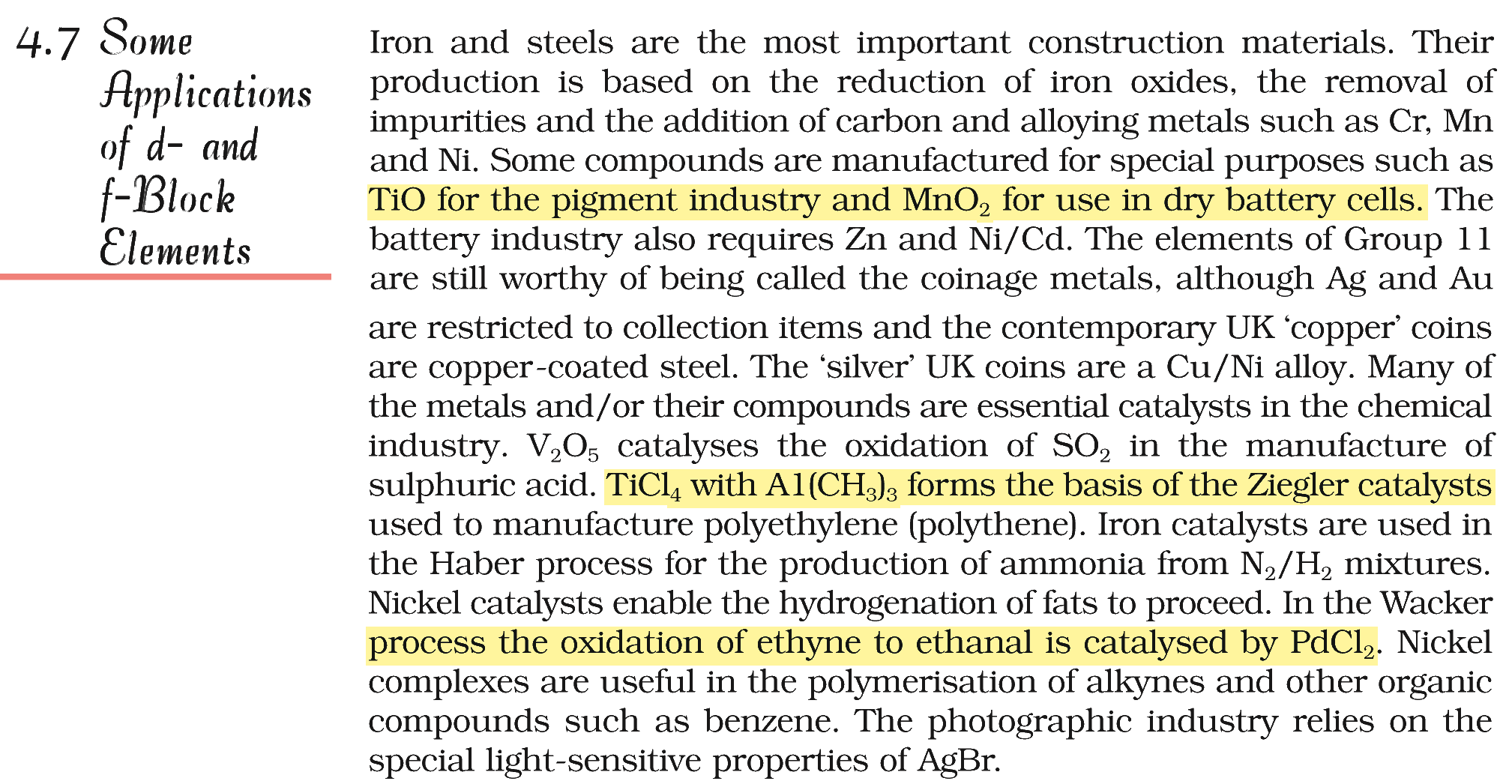
Textbook extract

Advertisement

Practise more on Inorganic: D and F Block Elements

Chapter-wise mocks on the real NTA exam screen, with solutions and your rank. Your first mocks are free.

Start free mocks →

Advertisement

Next questions

  1. The price of one currency in terms of another currency is called?Economics · Macro Economics: Open Economy Macro Economics
  2. Arrange the following in a chronological order:(A) Punch-marked coins(B) Coins issued by the Indo-Greeks(C) Coins issued by the Kushanas(D)…History · Ancient India: Kings, Farmers and Towns
  3. Match the LIST-I with LIST-IILIST-IJournal EntriesLIST-IIRevaluation of assets and reassessment of liabilitiesA.Asset A/c Dr. To Revaluatio…Accountancy Part A · Reconstitution of Partnership Firm: Retirement and Death
  4. The determinant of which of the following matrices is a perfect square?A. […] B. […] C. […] D. […] Choose the correct answer from the optio…Applied Maths. Section B2 · Algebra
  5. The variation of ln k vs 1/T is indicated byChemistry · Physical: Chemical Kinetics
  6. Complete the given pattern:General Aptitude Test · Non-Verbal Reasoning
  7. In the integral form of the exponential growth equation N_t = N_0 e^rt , ‘r’ stands for:Biology · Organisms and Populations
  8. Match List-I with List-IIList-IList-IITerms in sewage treatmentFeatures(A) Flocs(I) Large tank where bacteria grow anaerobically, digest th…Biology · Microbes in Human Welfare
  9. A company has been producing steel tubes of mean inner diameter of 2 cm. A sample of 10 tubes gives an inner diameter of 2.01 cm and a stan…Applied Maths. Section B2 · Inferential Statistics
  10. Let f:R→R be defined by f(x)=2x+cos x (where R is set of real numbers), then which of following statements are TRUE?(A) f(x) is an increasi…Maths. Section B1 · Applications of Derivatives