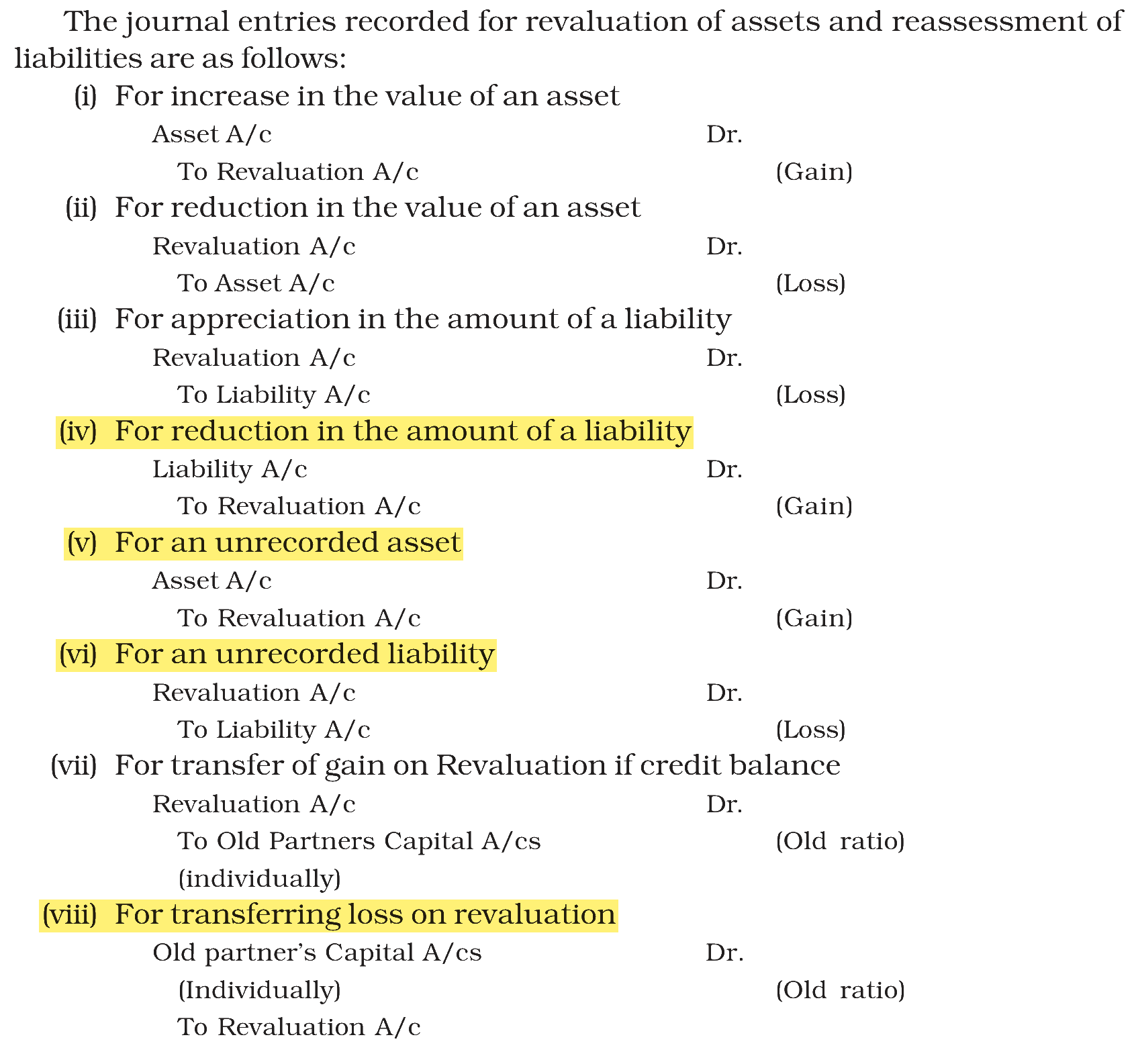
Match the LIST-I with LIST-II
| LIST-I Journal Entries | LIST-II Revaluation of assets and reassessment of liabilities | ||
|---|---|---|---|
| A. | Asset A/c Dr. To Revaluation A/c | I. | For reduction in the amount of a liability |
| B. | Old Partner\'s Capital A/c Dr. To Revaluation A/c | II. | For unrecorded liability |
| C. | Liability A/c Dr. To Revaluation A/c | III. | For an unrecorded asset |
| D. | Revaluation A/c Dr. To Liability A/c | IV. | For transferring loss on revaluation |
Choose the correct answer from the options given below:
Answer & explanation
Correct answer: option 1
The correct answer is Option (1) → A - III, B - IV, C - I, D - II
The Revaluation Account is credited with every gain and debited with every loss when assets and liabilities are restated. Read each entry by asking which side Revaluation is on.
(A) Asset A/c Dr. To Revaluation A/c — this matches (III) For an unrecorded asset. An asset the books never showed is brought in, and Revaluation is credited because it is a gain.
(B) Old Partner’s Capital A/c Dr. To Revaluation A/c — this matches (IV) For transferring loss on revaluation. A debit balance on Revaluation is closed by crediting it and charging the old partners in the old ratio.
(C) Liability A/c Dr. To Revaluation A/c — this matches (I) For reduction in the amount of a liability. A liability written down is a gain, so Revaluation is credited.
(D) Revaluation A/c Dr. To Liability A/c — this matches (II) For unrecorded liability. A liability nobody had recorded is created, and Revaluation bears it as a loss.
NCERT (2026-27 edition):
|