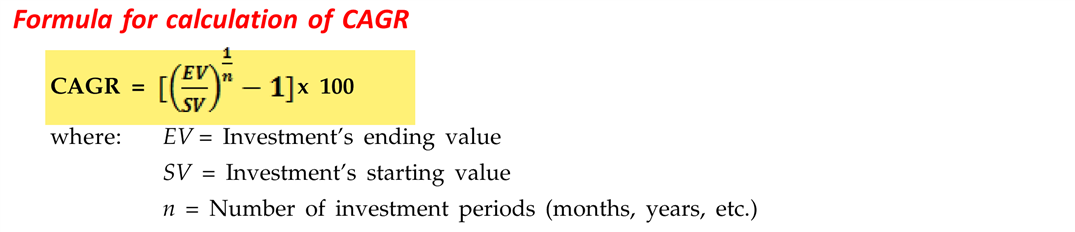
The formula for calculating compound annual growth rate of an investment is:
[ \( F.V \) = final value of the investment, \( P.V \) = starting value of the investment, \( n \) = investment period]
Answer & explanation
Correct answer: option 3
The correct answer is Option (3) → \( \left(\displaystyle\frac{F.V}{P.V}\right)^{1/n}-1 \)
The CAGR is the constant yearly rate r that grows the starting value into the final value in n years:
\( \displaystyle F.V=P.V(1+r)^n \)
\( \displaystyle (1+r)^n=\frac{F.V}{P.V} \)
\( \displaystyle 1+r=\left(\frac{F.V}{P.V}\right)^{1/n} \)
\( \displaystyle r=\left(\frac{F.V}{P.V}\right)^{1/n}-1 \)
Why the other options are incorrect
Option (1) \( \left(\displaystyle\frac{P.V}{F.V}\right)^{1/n}-1 \) — Incorrect. The ratio is upside down; for a growing investment it would give a negative rate.
Option (2) \( \left(\displaystyle\frac{F.V}{P.V}\right)^{1/n}+1 \) — Incorrect. 1 must be subtracted, not added: \( \left(\frac{F.V}{P.V}\right)^{1/n} \) is 1 + r.
Option (4) \( \left(\displaystyle\frac{P.V}{F.V}\right)^{1/n}+1 \) — Incorrect. The ratio is inverted and 1 is added instead of subtracted.
CBSE Applied Mathematics (Class XII):
Compound Annual Growth Rate