Which of the following are correct about money measures?
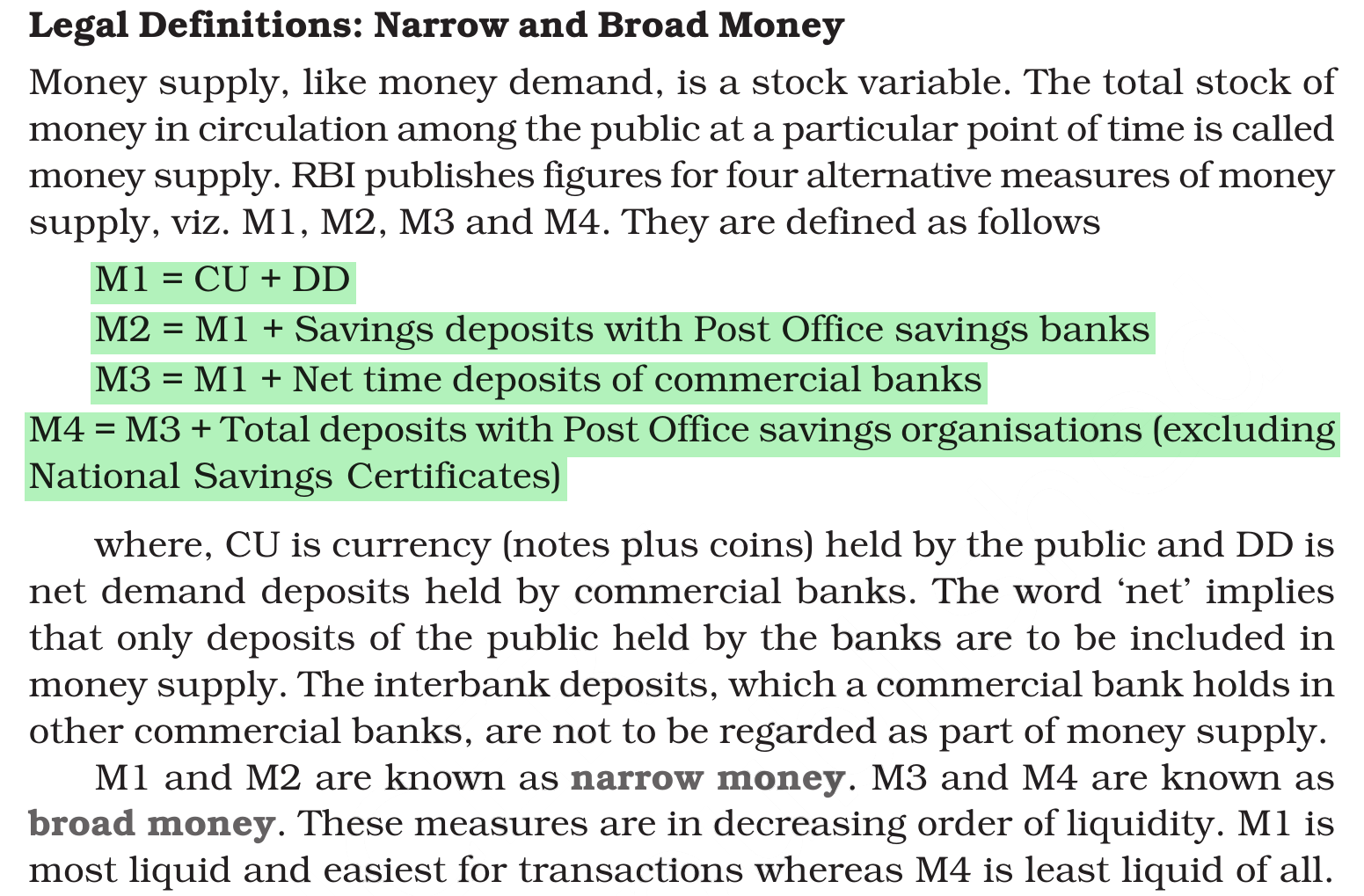
(A) M1 = CU + DD
(B) M2 = M1 + Savings deposits with commercial banks
(C) M3 = M1 + Net time deposits of commercial banks
(D) M4 = M3 + Total deposits with Post Office savings organisations (excluding National Savings Certificates)
Choose the correct answer from the options given below:
Answer & explanation
Correct answer: option 1
The correct answer is Option (1) → (A), (C) and (D) only
Money supply is the total stock of money in circulation among the public at a particular point of time. Some of it can be spent at once and some is tied up in deposits, so the RBI publishes four measures, M1 to M4, each adding one more kind of deposit to M1. They run in decreasing order of liquidity: M1 is the most liquid and M4 the least.
(A) M1 = CU + DD Correct. M1 is currency (notes and coins) held by the public plus net demand deposits held by commercial banks, the money that can be spent at once.
(B) M2 = M1 + Savings deposits with commercial banks Incorrect. M2 adds to M1 the savings deposits with post office savings banks, not savings deposits with commercial banks. The deposits of commercial banks that enter the measures are their net demand deposits, already in M1, and their net time deposits, added in M3.
(C) M3 = M1 + Net time deposits of commercial banks Correct. M3 adds to M1 the net time (fixed) deposits of commercial banks. It is the most commonly used measure of money supply.
(D) M4 = M3 + Total deposits with Post Office savings organisations (excluding National Savings Certificates) Correct. M4 is the widest measure: M3 plus all deposits with post office savings organisations, excluding National Savings Certificates.
NCERT: Introductory Macroeconomics — Chapter 3: Money and Banking (2025-26)
|