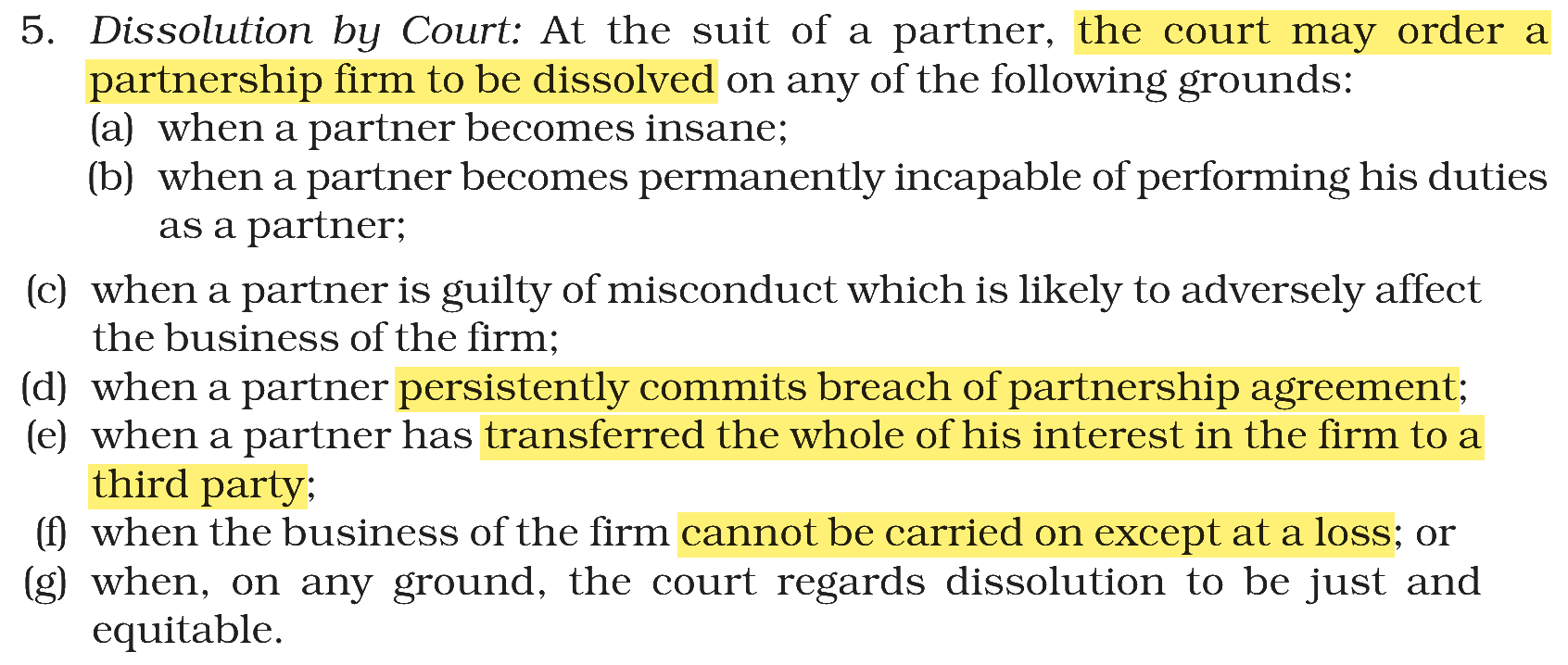
Under which of the following cases, the Court can order the dissolution of a partnership firm?
(A) When a partner persistently commits breach of partnership agreement.
(B) When a partner has transferred the whole of his interest in the firm to a third party.
(C) By the death of a partner.
(D) When the business of the firm cannot be carried on except at a loss.
Choose the correct answer from the options given below:
Answer & explanation
Correct answer: option 2
The correct answer is Option (2) → (A), (B) and (D) only
Dissolution by Court happens only when a partner files a suit and the court orders the firm to be dissolved on one of the grounds the law lists. Some other events dissolve the firm by themselves, without any court order.
(A) When a partner persistently commits breach of partnership agreement. Correct. A partner who keeps breaking the agreement makes it hard to run the firm together. The other partners can go to court, and the court may order dissolution on this ground.
(B) When a partner has transferred the whole of his interest in the firm to a third party. Correct. Such a partner has handed his whole interest to an outsider, so the court may dissolve the firm at the suit of another partner.
(C) By the death of a partner. Incorrect. Death is one of the contingencies on which the firm is dissolved by itself, subject to any contract between the partners. No suit and no court order is needed.
(D) When the business of the firm cannot be carried on except at a loss. Correct. A firm that can only run at a loss has no future, and the court may order it to be dissolved.
NCERT (2026-27 edition):
NCERT (2026-27 edition): |