CUETMOCK
  • Pricing
  • Mentors
Log inStart freeStart free mocks→

First test, then trust

Try a free CUET mock test.

Join 5,00,000+ students who rehearsed exam day on the exact NTA screen before sitting CUET. On the web and on Android.

Start free mocks →Get the Android app
CUETMOCK

India's #1 CUET Mock Test Platform. Original NCERT-based questions on the exact NTA exam screen — trusted by 5,00,000+ students since CUET 2022.

Get it onGoogle PlayScan to download the CUETMOCK app

Mock tests

  • CUET mock test series
  • Commerce mocks
  • Humanities (Arts) mocks
  • Science mocks
  • Languages & GAT mocks
  • Free practice questions
  • Pricing

Resources

  • CUET exam guide
  • CUET syllabus
  • Universities accepting CUET
  • Expert blogs
  • News & notifications
  • Webinars & counselling
  • CUET score calculator
  • How we estimate your rank
  • FAQs

Company

  • About us
  • Our leadership & team
  • Our toppers
  • Mentors
  • For schools
  • Contact us
  • Terms
  • Privacy
  • Refund policy

Talk to us

+91 7696 6630 56info@cuetmock.comWhatsApp us

Our other platforms

  • JEE Mock — For IIT-JEE aspirants
  • NEET Mock — For NEET aspirants

Newsletter

Exam updates, study material and offers — no spam.

© 2026 NYC Ventures Pvt. Ltd.

701-702, Royal Business Park, Zirakpur, Punjab - 140603

  • Terms of use
  • Privacy policy
  • Refund policy
  • Contact us

iCUETMOCK is an independent preparation platform, not affiliated with the National Testing Agency (NTA). Always check exam details on the official NTA website.

  • Home
  • Mock tests
  • CUET guide
  • Pricing
  • Log in
Home/Practice questions/History
HistoryMedieval India: Peasants, Zamindars and the State

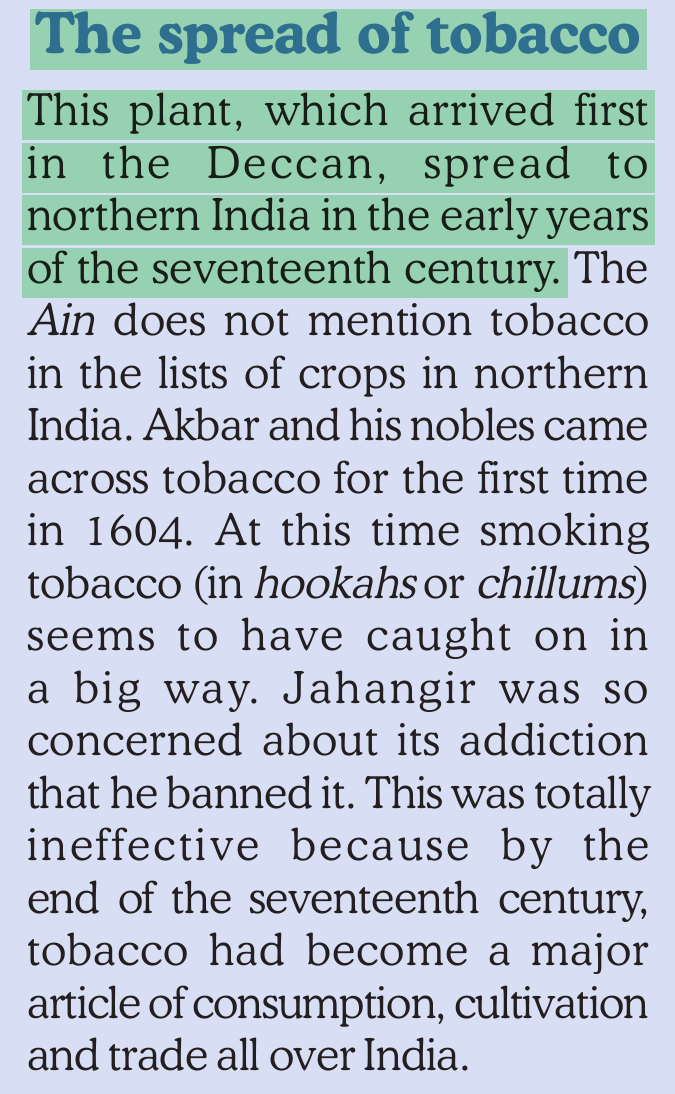
This plant (tobacco), which arrived first in the _________ spread to…

This plant (tobacco), which arrived first in the _________ spread to northern India in the early years of seventeenth-century.

Answer & explanation+

Correct answer: option 2

The correct answer is Option (2) → Deccan

Tobacco arrived first in the Deccan and spread to northern India in the early years of the seventeenth century. The Ain-i Akbari does not list it among the crops of northern India; Akbar and his nobles first came across it in 1604. Smoking soon caught on so widely that Jahangir banned it, without success: by the end of the century tobacco was a major crop and article of trade all over India.


NCERT: Themes in Indian History Part II — Chapter 8: Peasants, Zamindars and the State (2025-26)

NCERT extract

Advertisement

Practise more on Medieval India: Peasants, Zamindars and the State

Chapter-wise mocks on the real NTA exam screen, with solutions and your rank. Your first mocks are free.

Start free mocks →

Advertisement

Next questions

  1. Which of the following features are correct regarding Law of Dominance?A. In a dissimilar pair of factors one member of the pair dominates…Biology · Principles of Inheritance and Variation
  2. Which of the following is NOT true about Foot Loose Industries?Geography · Fundamentals of Human Geography: Secondary Activities
  3. Which approach looks at human beings as beneficiaries of all developmental activities?Geography · Fundamentals of Human Geography: Human Development
  4. If A is a square matrix such that A^2=A , then (I+A)^3 is equal toApplied Maths. Section B2 · Algebra
  5. Why did the Harappans establish settlements at Nageshwar and Balakot?History · Ancient India: Bricks, Beads and Bones
  6. Which of the following is not accounted for in the books and shown as an asset?Accountancy Part A · Admission of a Partner
  7. The electric power consumed by a 220 V , 60 W bulb, when operated at 110 V , isPhysics · Current Electricity
  8. Select the grammatically correct sentences.(A) How much further is it to the station?(B) How much farther is it to the station?(C) Farther…English · Spot Error
  9. The formula for calculating compound annual growth rate of an investment is:[ F.V = final value of the investment, P.V = starting value of…Applied Maths. Section B2 · Financial Mathematics
  10. In amylopectin, α-D-glucose units are joined by ________ glycosidic linkage.Chemistry · Organic: Biomolecules