GDP and Welfare
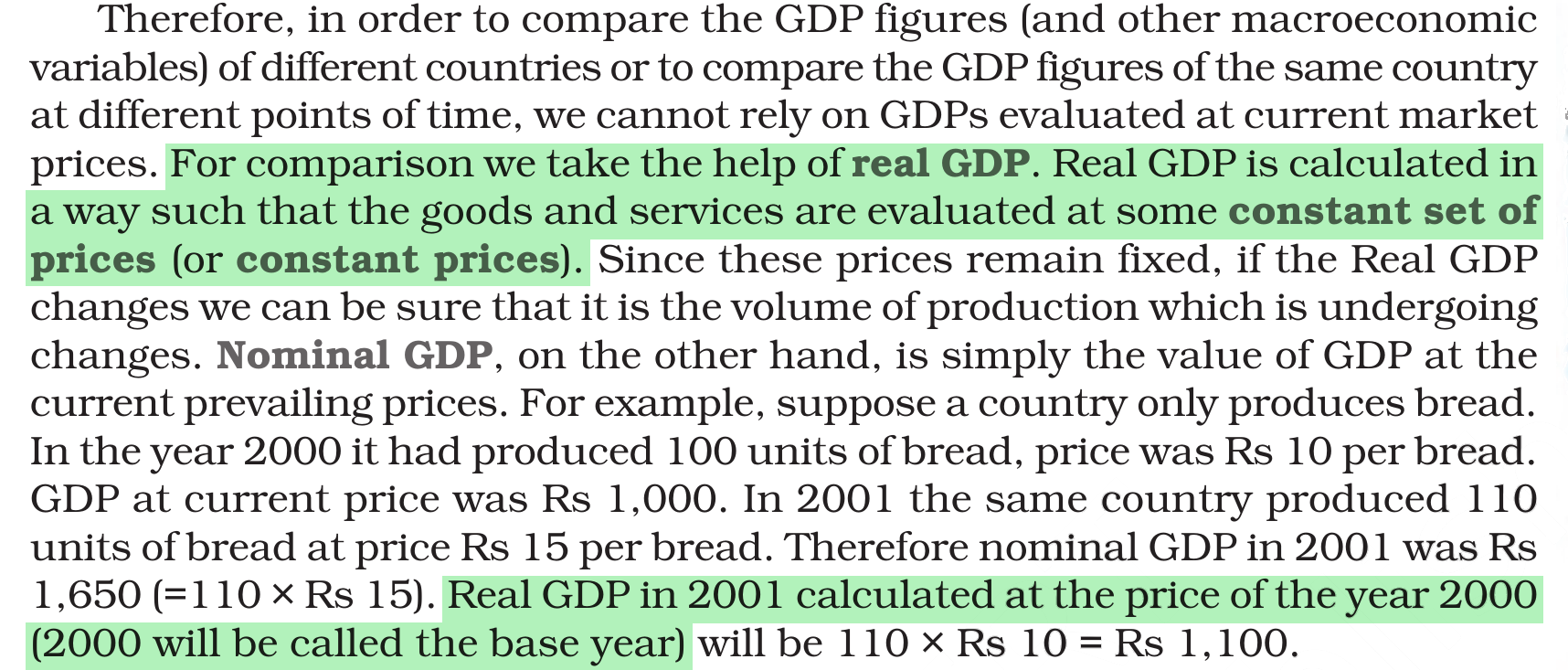
GDP is the sum total of the value of goods and services created within the geographical boundary of a country in a particular year. In order to compare the GDP figures and other macroeconomic variables of different countries or to compare the GDP figures of the same country at different points of time, we take the help of real GDP instead of relying on current market prices. The ratio of nominal GDP to real GDP gives us an idea of how prices have moved from the base year to the current year. The Consumer Price Index (CPI) and Wholesale Price Index (WPI) are the other important ways to measure change of prices in an economy.
GDP gets distributed among the people as incomes and may treat higher level of GDP of a country as an index of greater well-being of the people of that country. But it may be incorrect to treat GDP as an index of the welfare of the country based on three reasons. Firstly, the distribution of GDP is not uniform, secondly, non-monetary exchanges are not accounted as part of economic activity and lastly, GDP does not take into account externalities.
Suppose India only produces wheat. In the year 2020, India produced 200 kg of wheat at a price of Rs 20 per kg of wheat and in the year 2021, it produced 310 kg of wheat at a price of Rs 30 per kg of wheat. Calculate India's real GDP of year 2021 taking 2020 as base year.
Answer & explanation
Correct answer: option 2
The correct answer is Option (2) → Rs. 6200
GDP valued at the current year’s prices can rise only because prices rise, even if no more is produced. To see the change in production alone, the current year’s output is valued at the prices of a base year, and this is real GDP.
Given:
Year 2020 (base year): 200 kg of wheat at Rs. 20 per kg
Year 2021: 310 kg of wheat at Rs. 30 per kg
Valuing the 2021 output at 2020 prices:
Real GDP of 2021 = quantity produced in 2021 × price in 2020
Real GDP of 2021 = 310 × Rs. 20 = Rs. 6,200, which is Option (2)
Rs. 9,300 (Option 1) is nominal GDP, the 2021 output at 2021 prices.
Note: The passage of Questions 41 to 45 is drawn from the National Income Accounting chapter of the NCERT book (the parts on real and nominal GDP and on GDP and welfare), shortened, with several of its sentences kept word for word. Read that chapter closely, worked examples included. The passage swaps the book’s bread for wheat and keeps the method.
NCERT: Introductory Macroeconomics — Chapter 2: National Income Accounting (2025-26)
|