Acetaldehyde is converted to ethane by Wolff-Kishner reduction. Acetaldehyde is treated with
Answer & explanation
Correct answer: option 3
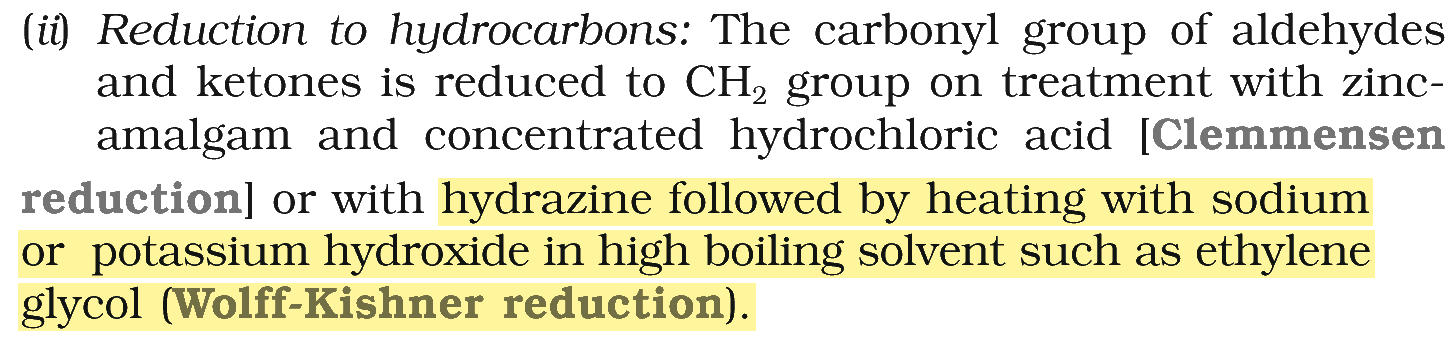
The correct answer is Option (3) → NH2NH2 and KOH/ ethylene glycol, heat
In the Wolff-Kishner reduction the >C=O group of an aldehyde or ketone is reduced to >CH2: the hydrazone formed with hydrazine is heated with KOH in ethylene glycol and loses nitrogen.
For acetaldehyde:
\( \displaystyle \ce{CH3CHO + NH2NH2 -> CH3CH=NNH2 + H2O} \)
\( \displaystyle \ce{CH3CH=NNH2} \xrightarrow[\text{heat}]{\ce{KOH}\text{/ethylene glycol}} \ce{CH3CH3 + N2} \)
So acetaldehyde is treated with NH2NH2 followed by KOH/ethylene glycol and heat to give ethane.
Why the other options are incorrect
Option (1) LiAlH4 — Incorrect. It reduces an aldehyde only as far as the primary alcohol (ethanol), not to the alkane.
\( \displaystyle \ce{CH3CHO} \xrightarrow[\text{(ii) }\ce{H2O}]{\text{(i) }\ce{LiAlH4}} \ce{CH3CH2OH} \)
Option (2) NaBH4 — Incorrect. A milder hydride reagent; it also gives ethanol.
\( \displaystyle \ce{CH3CHO} \xrightarrow{\ce{NaBH4}} \ce{CH3CH2OH} \)
Option (4) H2 with Pd/BaSO4 — Incorrect. This poisoned catalyst is used in the Rosenmund reduction of acyl chlorides to aldehydes; it does not reduce an aldehyde to an alkane.
\( \displaystyle \ce{R-COCl + H2} \xrightarrow{\ce{Pd-BaSO4}} \ce{R-CHO + HCl} \)
NCERT (2026-27 edition):
Reduction to Hydrocarbons