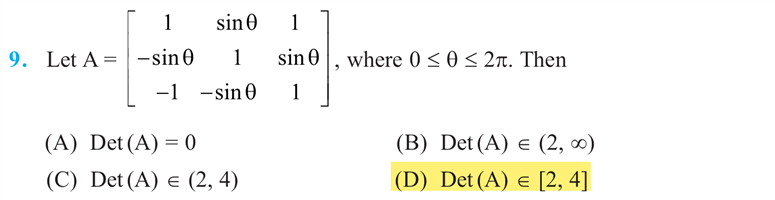
If \( \Delta \) represents the value of the determinant \( \begin{vmatrix}1 & \sin k\theta & 1\\ -\sin k\theta & 1 & \sin k\theta\\ -1 & -\sin k\theta & 1\end{vmatrix} \), where k is any real number then the value of \( \Delta \) belongs to
Answer & explanation
Correct answer: option 4
The correct answer is Option (4) → [2, 4]
Let \( s=\sin k\theta \). Expanding along the first row,
\( \displaystyle \Delta=1(1+s^{2})-s(-s+s)+1(s^{2}+1) \)
\( \displaystyle =2(1+s^{2}) \)
Since \( 0\le s^{2}\le1 \),
\( \displaystyle 2\le2(1+s^{2})\le4 \)
Both end values are attained, at \( s=0 \) and at \( s=\pm1 \). So \( \Delta\in[2,4] \).
Why the other options are incorrect
Option (1) R (set of real numbers) — Incorrect. \( \Delta \) never goes below 2 or above 4.
Option (2) (2, 4) — Incorrect. The open interval leaves out 2 and 4, but \( \Delta=2 \) at \( s=0 \) and \( \Delta=4 \) at \( s=\pm1 \).
Option (3) \( (-3,-1)\cup(2,4) \) — Incorrect. \( \Delta=2(1+s^{2}) \) is never negative, and it also takes the values 2 and 4.
NCERT (2026-27 edition):
Determinants