
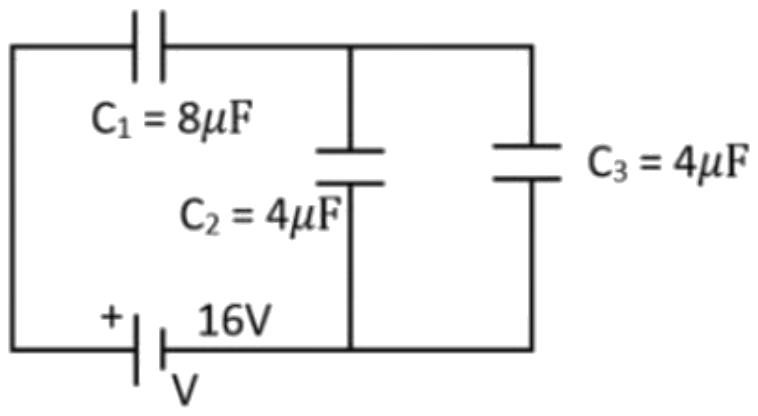
Three capacitors, \(C_1\), \(C_2\) and \(C_3\), having their values \(8\,\mu\mathrm{F}\), \(4\,\mu\mathrm{F}\) and \(4\,\mu\mathrm{F}\) respectively, are connected with a battery of \(16\,\mathrm{V}\) as shown in the given circuit. The charge stored in the capacitor \(C_3\) will be:
Answer & explanation
Correct answer: option 1
The correct answer is Option (1) → \(32\,\mu\mathrm{C}\)
In the figure, \( C_2 \) and \( C_3 \) are connected across the same two points, so they are in parallel; this combination is in series with \( C_1 \) and the battery.
\( \displaystyle C_{23} = C_2 + C_3 = 4\,\mu\mathrm{F} + 4\,\mu\mathrm{F} = 8\,\mu\mathrm{F} \)
\( \displaystyle C_{\mathrm{eq}} = \frac{C_1 C_{23}}{C_1 + C_{23}} = \frac{8 \times 8}{8 + 8}\,\mu\mathrm{F} = 4\,\mu\mathrm{F} \)
The charge drawn from the battery is the same on \( C_1 \) and on the parallel combination.
\( \displaystyle Q = C_{\mathrm{eq}}V = 4\,\mu\mathrm{F} \times 16\,\mathrm{V} = 64\,\mu\mathrm{C} \)
This charge divides between \( C_2 \) and \( C_3 \) in the ratio of their capacitances; since they are equal, each gets half.
\( \displaystyle Q_3 = \frac{C_3}{C_2 + C_3}\,Q = \frac{4}{8} \times 64\,\mu\mathrm{C} = 32\,\mu\mathrm{C} \)