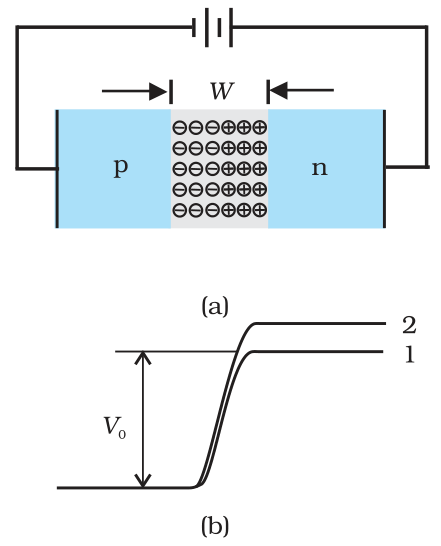
When a reverse bias is applied to a p-n junction, then
Answer & explanation
Correct answer: option 1
The correct answer is Option (1) → the potential barrier increases
The potential barrier at a p-n junction opposes the diffusion of majority carriers. In reverse bias the p-side is connected to the negative terminal, so the applied voltage V acts in the same direction as the barrier potential \( V_0 \).
\( V_{\mathrm{barrier}} = V_0 + V \)
The applied field pulls holes and electrons away from the junction, so the depletion layer becomes wider as well.
Why the other options are incorrect
Option (2) the width of depletion layer decreases — Incorrect. The depletion layer narrows in forward bias; in reverse bias it widens.
Option (3) the potential barrier decreases — Incorrect. The barrier decreases to \( V_0 - V \) in forward bias, not in reverse bias.
Option (4) the potential barrier remains unchanged. — Incorrect. The barrier stays at \( V_0 \) only when no bias is applied.
NCERT (2026-27):
p-n Junction Diode Under Reverse Bias – “When an external voltage ( \( V \) ) is applied across the diode such that n-side is positive and p-side is negative, it is said to be reverse biased [Fig.14.15(a)]. The applied voltage mostly drops across the depletion region. The direction of applied voltage is same as the direction of barrier potential. As a result, the barrier height increases and the depletion region widens due to the change in the electric field. The effective barrier height under reverse bias is ( \( V_0 + V \) ), [Fig. 14.15(b)].”