
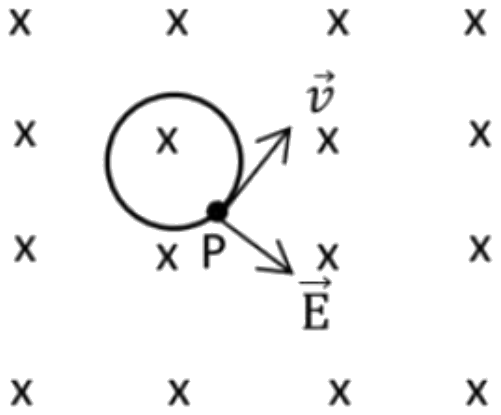
A particle having a charge of \( 10\ \mu\mathrm{C} \) and mass \( 20\ \mu\mathrm{g} \) moves along a circle of radius \( 5.0\ \mathrm{cm} \) under the action of a magnetic field \( B = 1.0\ \mathrm{T} \). When the particle is at a point \( P \), a uniform electric field is switched on and it is found that the particle continues on the tangent through \( P \) with a uniform velocity \( \vec{v} \) as shown in the diagram, the magnitude of the electric field is
Answer & explanation
Correct answer: option 2
The correct answer is Option (2) → \( 25\ \mathrm{V\,m^{-1}} \)
In the magnetic field alone, the magnetic force supplies the centripetal force. After the electric field is switched on, the particle moves along the tangent with uniform velocity, so the net force is zero: the electric force balances the magnetic force.
\( q = 10\,\mu\mathrm{C} = 1.0\times10^{-5}\,\mathrm{C} \)
\( m = 20\,\mu\mathrm{g} = 20\times10^{-9}\,\mathrm{kg} = 2.0\times10^{-8}\,\mathrm{kg} \)
\( r = 5.0\,\mathrm{cm} = 0.05\,\mathrm{m} \)
\( \displaystyle qvB = \frac{mv^{2}}{r} \Rightarrow v = \frac{qBr}{m} \)
\( \displaystyle v = \frac{(1.0\times10^{-5}\,\mathrm{C})(1.0\,\mathrm{T})(0.05\,\mathrm{m})}{2.0\times10^{-8}\,\mathrm{kg}} = 25\,\mathrm{m\,s^{-1}} \)
\( qE = qvB \Rightarrow E = vB \)
\( E = (25\,\mathrm{m\,s^{-1}})(1.0\,\mathrm{T}) = 25\,\mathrm{V\,m^{-1}} \)