Read the passage and answer the questions:
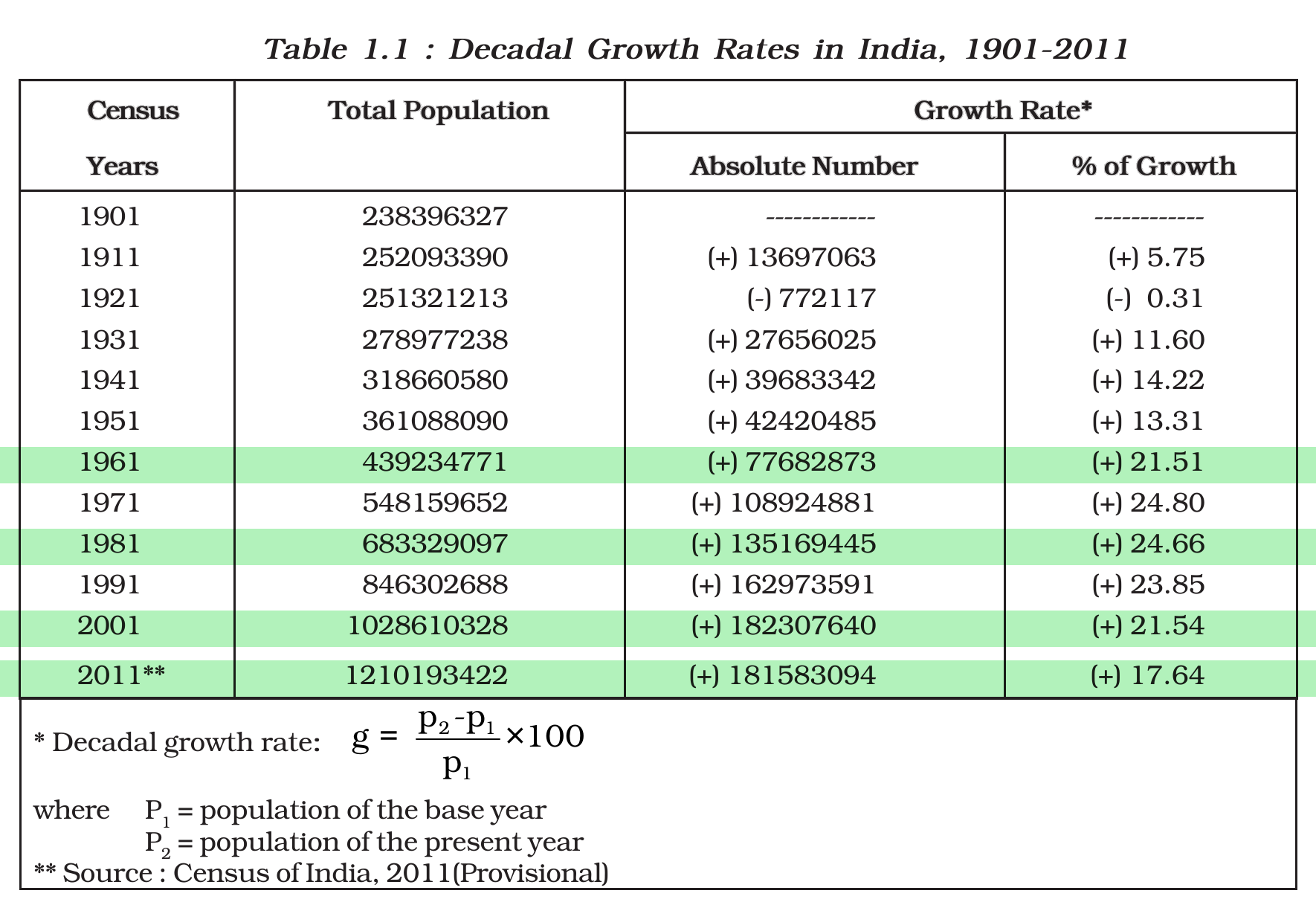
Decadal Growth Rates in India, 1901-2011
| Census Years | Total Population | Absolute Number | % of Growth |
| 1901 | 238396327 | — | — |
| 1911 | 252093390 | (+) 13697063 | (+) 5.75 |
| 1921 | 251321213 | (-) 772117 | (-) 0.31 |
| 1931 | 278977238 | (+) 27656025 | (+) 11.60 |
| 1941 | 318660580 | (+) 39683342 | (+) 14.22 |
| 1951 | 361088090 | (+) 42420485 | (+) 13.31 |
| 1961 | 439234771 | (+) 77682873 | (+) 21.51 |
| 1971 | 548159652 | (+) 108924881 | (+) 24.80 |
| 1981 | 683329097 | (+) 135169445 | (+) 24.66 |
| 1991 | 846302688 | (+) 162973591 | (+) 23.85 |
| 2001 | 1028610328 | (+) 182307640 | (+) 21.54 |
| 2011** | 1210193422 | (+) 181583094 | (+) 17.64 |
* Decadal growth rate: \( g = \displaystyle\frac{P_2 - P_1}{P_1} \times 100 \)
where
\( P_1 = \text{population of the base year} \)
\( P_2 = \text{population of the present year} \)
Source: Census of India, 2011 (Provisional)
The absolute number of persons added was highest during which of the following decades?
Answer & explanation
Correct answer: option 4
The correct answer is Option (4) → 1991-2001
The absolute number added in each decade of the options was:
1991-2001 — 182,307,640, the largest.
2001-2011 — 181,583,094.
1971-1981 — 135,169,445.
1951-1961 — 77,682,873.
Tip: The absolute number and the percentage growth are different columns. In 2001-2011 the growth rate fell sharply (to 17.64 per cent), yet almost as many people were added, because the base population was much larger.
NCERT (2025-26): “Growth of Population … Phase III : The decades 1951-1981 are referred to as the period of population explosion in India, which was caused by a rapid fall in the mortality rate but a high fertility rate of population in the country. The average annual growth rate was as high as 2.2 per cent.… Phase IV : In the post 1981 till present, the growth rate of country’s population though remained high, has started slowing down gradually (Table 1.1).…”
|