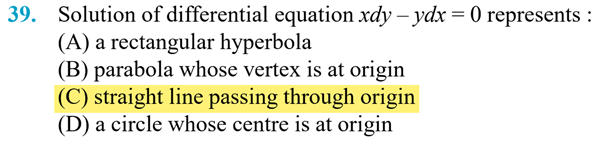
Solution of differential equation \( x\,dy-y\,dx=0 \) represents:
Answer & explanation
Correct answer: option 1
The correct answer is Option (1) → Family of straight lines passing through origin
The variables separate:
\( \displaystyle x\,dy=y\,dx \)
\( \displaystyle \frac{dy}{y}=\frac{dx}{x} \)
Integrating,
\( \displaystyle \log|y|=\log|x|+\log|c| \)
\( \displaystyle y=cx \)
For every value of c, \( y=cx \) is a straight line through the origin with slope c.
Shortcut: Rewrite as \( \frac{dy}{dx}=\frac{y}{x} \): the slope at every point equals the slope of the line joining that point to the origin, which is true only of lines through the origin.
NCERT Exemplar:
Differential Equations