
If the angles of elevation of the top of a tower from two points at distances \(a\) and \(b\) from the base and in the same straight line with it are complementary then the height of the tower is
Answer & explanation
Correct answer: option 2
The correct answer is Option (2) → \(\sqrt{ab}\)
Two angles are complementary when they add up to 90°. If the angle of elevation from C is \(\alpha\), the angle from D is \(90^\circ-\alpha\), and \(\tan(90^\circ-\alpha)=\cot\alpha=\frac{1}{\tan\alpha}\). In each right triangle with the tower, \(\tan(\text{angle})=\frac{\text{height}}{\text{distance}}\).
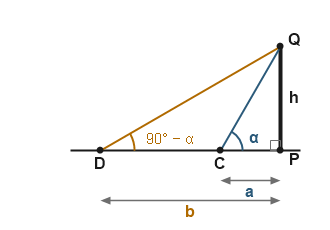
From C: \(\displaystyle \tan\alpha=\frac{h}{a}\) (1)
From D: \(\displaystyle \cot\alpha=\frac{h}{b}\) (2)
Multiplying (1) and (2), since \(\tan\alpha\times\cot\alpha=1\): \(\displaystyle 1=\frac{h^{2}}{ab}\)
\(h^{2}=ab\), so \(h=\sqrt{ab}\)
Tip: This result is worth memorising: when the angles of elevation from distances \(a\) and \(b\) are complementary, the height is the geometric mean \(\sqrt{ab}\) of the two distances.