The reaction of which of the following alcohol with pyridinium chlorochromate gives aldehyde?
Answer & explanation
Correct answer: option 3
The correct answer is Option (3) → Butanol
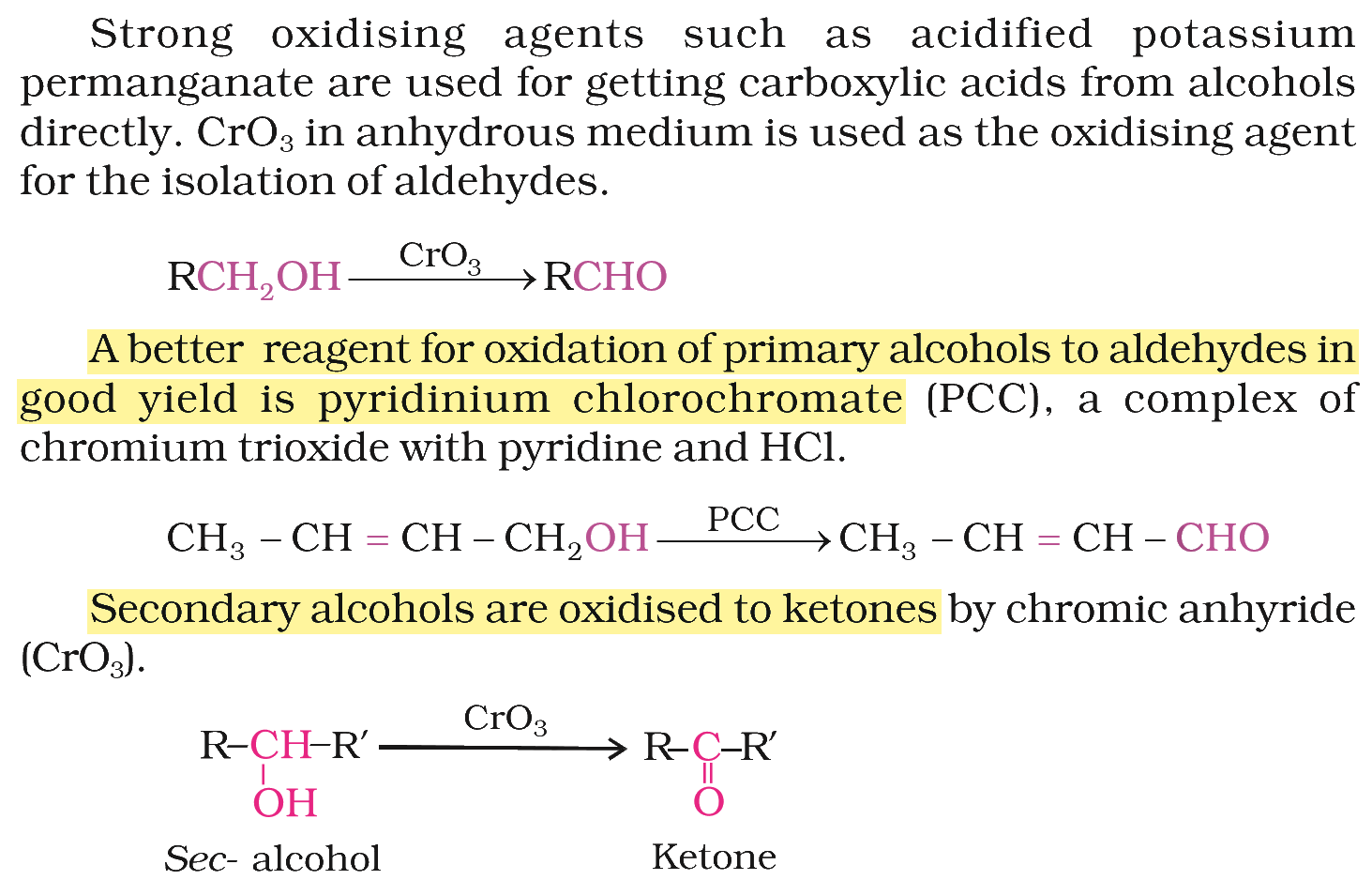
Pyridinium chlorochromate (PCC), a complex of chromium trioxide with pyridine and HCl, is a mild oxidising agent. It stops the oxidation at the carbonyl stage:
Primary alcohols (\( \ce{RCH2OH} \)) give aldehydes; PCC does not go on to the carboxylic acid.
Secondary alcohols (\( \ce{R2CHOH} \)) give ketones.
Tertiary alcohols have no H on the carbinol carbon and are not oxidised.
Butanol (butan-1-ol) is a primary alcohol, so it gives butanal:
\( \displaystyle \ce{CH3CH2CH2CH2OH} \xrightarrow{\text{PCC}} \ce{CH3CH2CH2CHO} \)
So the alcohol that gives an aldehyde is butanol.
Why the other options are incorrect
Option (1) tert-butyl alcohol — Incorrect. \( \ce{(CH3)3COH} \) is a tertiary alcohol with no H on the carbinol carbon, so PCC does not oxidise it.
Option (2) 2-propanol — Incorrect. \( \ce{CH3CH(OH)CH3} \) is a secondary alcohol and gives the ketone propanone:
\( \displaystyle \ce{CH3CH(OH)CH3} \xrightarrow{\text{PCC}} \ce{CH3COCH3} \)
Option (4) 2-Butanol — Incorrect. \( \ce{CH3CH(OH)CH2CH3} \) is a secondary alcohol and gives the ketone butanone:
\( \displaystyle \ce{CH3CH(OH)CH2CH3} \xrightarrow{\text{PCC}} \ce{CH3COCH2CH3} \)
NCERT (2026-27 edition):
Oxidation – …