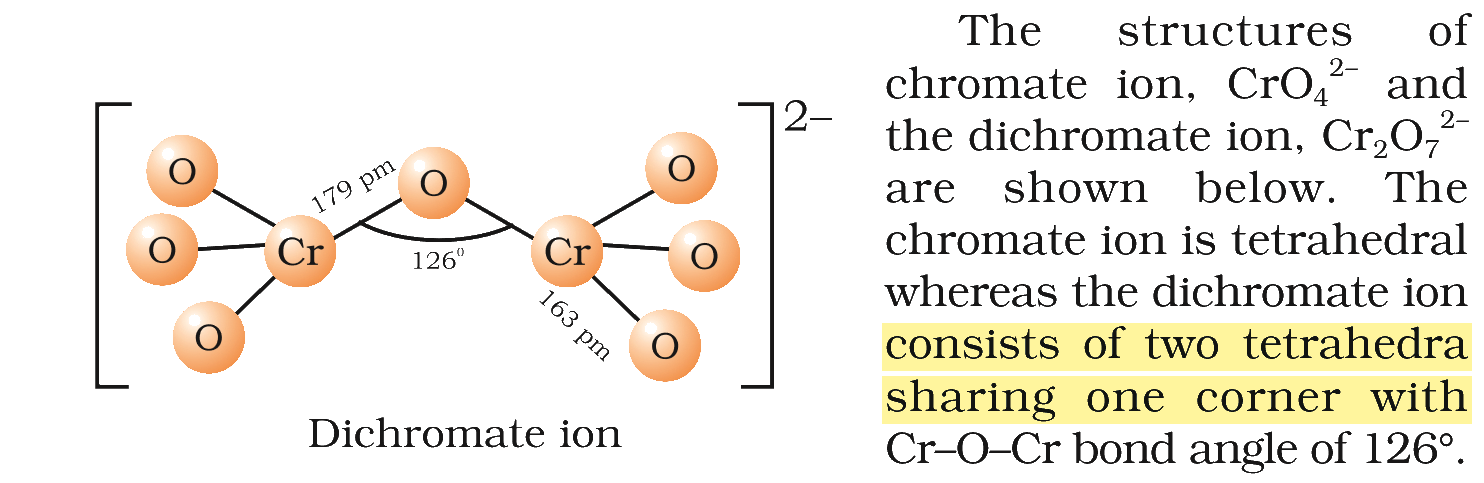
Which of the following is the INCORRECT statement for dichromate ion?
Answer & explanation
Correct answer: option 2
The correct answer is Option (2) → Cr-O (Terminal) bond length is 189 pm.
The dichromate ion, Cr2O72−, is made of two CrO4 tetrahedra sharing one corner oxygen. Each chromium (+6) is bonded to three terminal oxygens and to the one bridging oxygen:
The terminal Cr–O bonds are short, 163 pm, because they have partial double bond character.
The bridging Cr–O bonds are longer, 179 pm, as they are single bonds.
The Cr–O–Cr angle at the bridging oxygen is 126°.
Option (1) Cr-O-Cr bond angle is 126°. — A correct statement for dichromate ion. This is the angle at the shared bridging oxygen.
Option (2) Cr-O (Terminal) bond length is 189 pm. — An incorrect statement (terminal Cr–O is 163 pm). A terminal bond of 189 pm would be longer even than the bridging bond (179 pm).
Option (3) The dichromate ion consists of two tetrahedra. — A correct statement for dichromate ion. The two \( \ce{CrO4} \) tetrahedra are joined through one common oxygen atom.
Option (4) The dichromate ion is orange in colour. — A correct statement for dichromate ion. Yellow chromate turns into orange dichromate when the solution is acidified: \( \ce{2CrO4^2- + 2H^+ -> Cr2O7^2- + H2O} \)
NCERT (2026-27 edition):
Potassium Dichromate – …