An example of ligand which has two different donor atoms and either of the two ligates in the complex is _____
Answer & explanation
Correct answer: option 1
The correct answer is Option (1) → SCN–
Ligands are classified by the number and kind of donor atoms through which they bind to the metal:
Unidentate: one donor atom, e.g. \( \ce{Cl^{-}} \), \( \ce{H2O} \), \( \ce{NH3} \).
Didentate and polydentate: two or more donor atoms that bind at the same time, e.g. en (two N), \( \ce{C2O4^{2-}} \) (two O), \( \ce{N(CH2CH2NH2)3} \) (four N), EDTA4− (two N and four O). When they form a ring with the metal they are called chelating ligands.
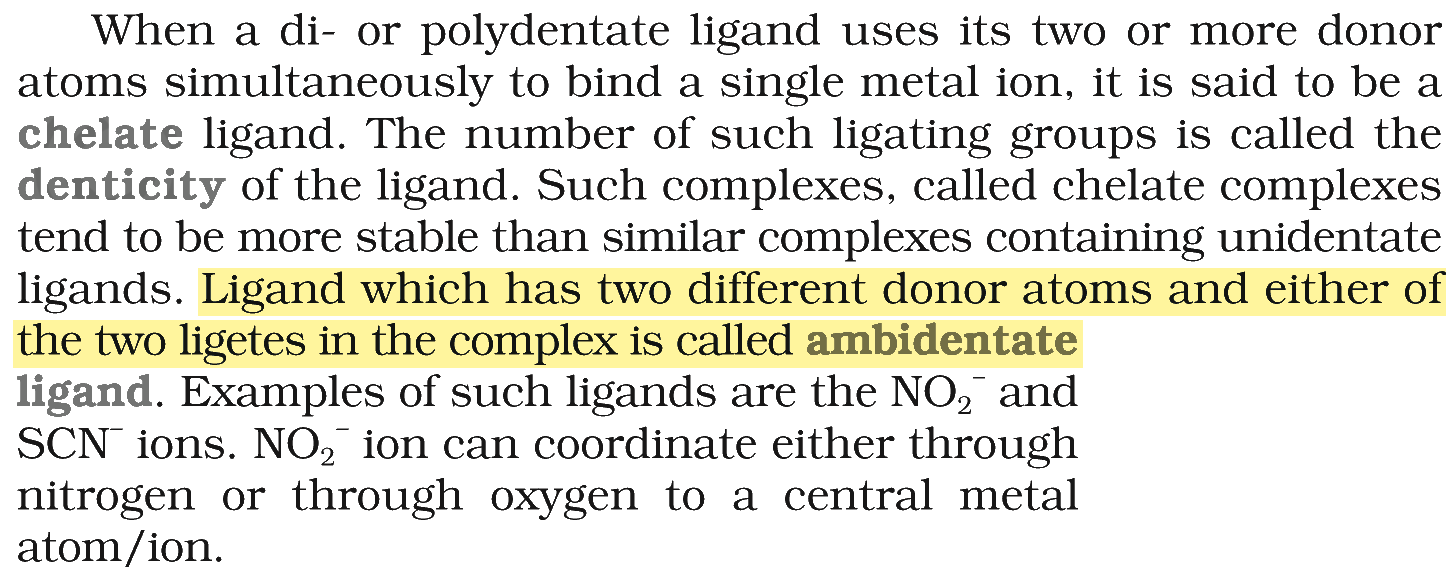
Ambidentate: two different donor atoms, but the ligand binds through either one of them, never both together. Examples are \( \ce{NO2^{-}} \), which binds through N (nitrito-N) or through O (nitrito-O), and SCN−, which binds through S (thiocyanato-S) or through N (thiocyanato-N).
So the ligand with two different donor atoms that ligates through either of them is SCN−.
Why the other options are incorrect
Option (2) Cl– — Incorrect. It is unidentate and has only one kind of donor atom.
Option (3) N(CH2CH2NH2 )3 — Incorrect. It is a tetradentate ligand. All four donor atoms are nitrogen, and they bind to the metal together, not one or the other.
Option (4) H2O — Incorrect. It is unidentate and binds only through oxygen.
NCERT (2026-27 edition):
Ligands – …