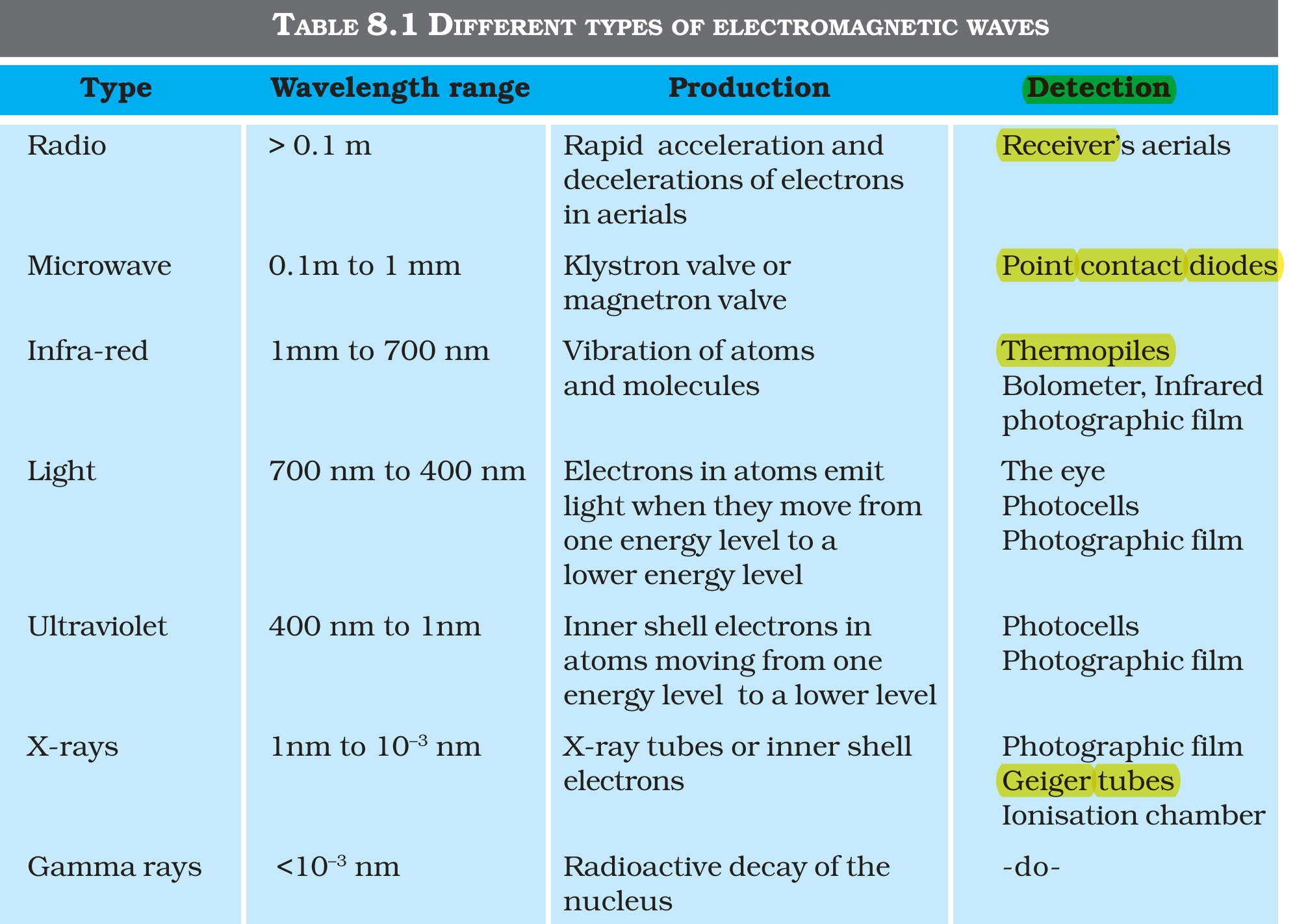
Match List-I with List-II
| List-I | List-II | ||
| Electromagnetic waves | Detection | ||
| (A) | X-rays | (I) | Receiver’s aerials |
| (B) | Infra-red waves | (II) | Geiger tubes |
| (C) | Radio waves | (III) | Point contact diodes |
| (D) | Microwaves | (IV) | Thermopiles |
Choose the correct answer from the options given below:
Answer & explanation
Correct answer: option 1
The correct answer is Option (1) → (A) - (II), (B) - (IV), (C) - (I), (D) - (III)
Each region of the electromagnetic spectrum is detected by a device matched to how that radiation interacts with matter.
(A) X-rays — this matches (II) Geiger tubes. X-rays are ionising, and a Geiger tube counts the ionisation they produce in its gas (photographic film and ionisation chambers are also used).
(B) Infra-red waves — this matches (IV) Thermopiles. Infra-red radiation is heat radiation, so it is detected by its heating effect in thermopiles and bolometers.
(C) Radio waves — this matches (I) Receiver’s aerials. Radio waves induce oscillating currents in the receiving aerial.
(D) Microwaves — this matches (III) Point contact diodes. Microwaves are detected by point contact diodes, which rectify the very high-frequency signal.
NCERT (2026-27):
Gamma Rays – …